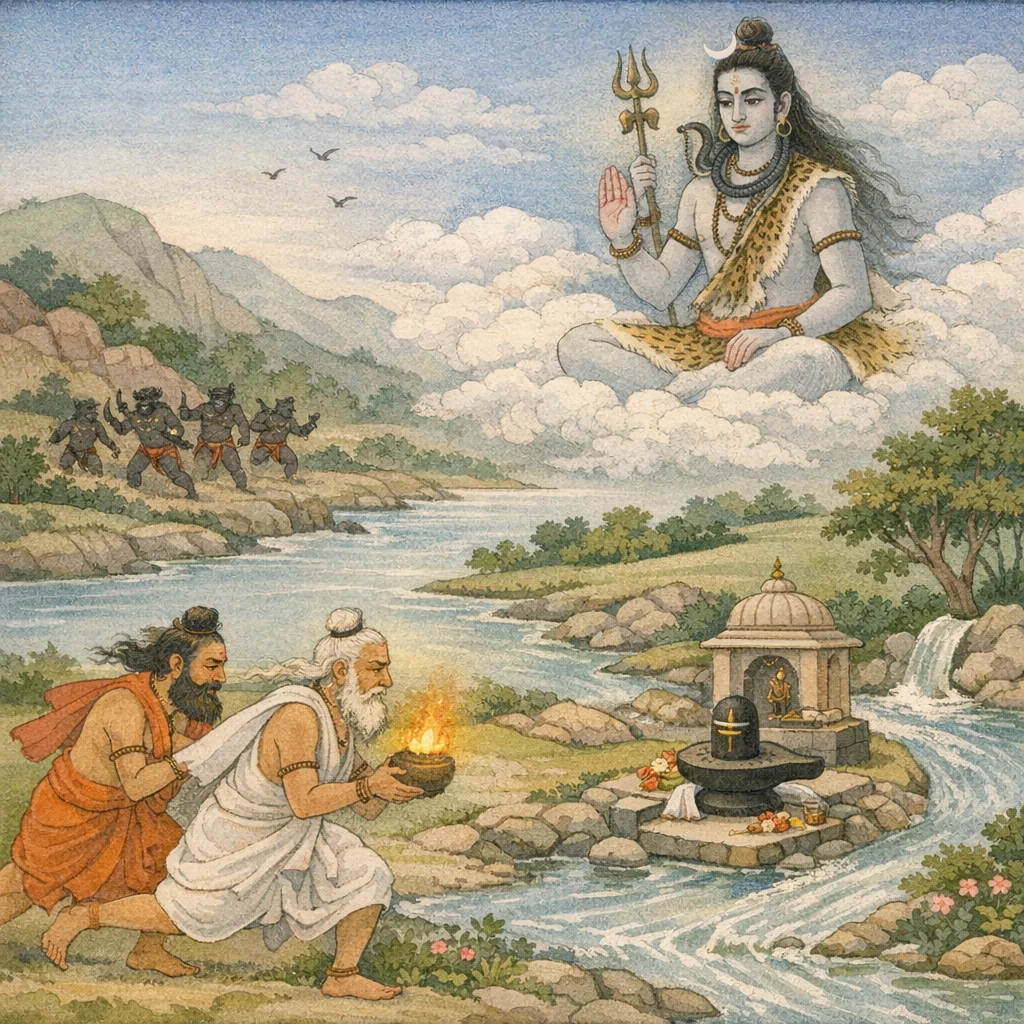
Adhyaya 116: Mahānala (Vaḍavānala) Tīrtha and the Vaḍavā-saṅgama: The Rishis’ Sattra, Mṛtyu, and Śiva’s Protection
อัธยายะ 116 กล่าวถึงมหิมาแห่งมหานล/วฑวานลตีรถะ และสังฆมศักดิ์สิทธิ์ชื่อวฑวา-สังคมะ. พระพรหมเล่าว่า ในพิธีสัทตรยัญญะอันยืดยาว ณ ไนมิษารัณยะ ฤๅษีทั้งหลายได้ประกอบพิธีผูกยับยั้งมฤตยู (เทพแห่งความตาย) จนความตายหยุดลงในหมู่สรรพชีวิต ทำให้สวรรค์ร่อยหรอและโลกมนุษย์แน่นล้น. เหล่าเทวะเพื่อฟื้นสมดุลจึงล่อรากษสด้วยส่วนแบ่งยัญญะให้ไปก่อกวนสัทตร และเกิดการบุกทำลายพิธี. ฤๅษีปรึกษากับมฤตยูและศมิตฤ (ผู้ยับยั้ง/ผู้ปลอบประโลมความตาย) แล้วรีบย้ายไปยังฝั่งแม่น้ำคौตมี (โคทาวรี) อัญเชิญมหेशวร (พระศิวะ) ขอความคุ้มครอง; พระศิวะประทานอภัยและทำให้สัทตรสำเร็จสมบูรณ์. เมื่อเทวะมารับส่วนหวิ (เครื่องบูชา) ฤๅษีประกาศให้รากษสเป็นศัตรูนิรันดร์ของเทวะ. ตอนท้ายมฤตยูสถาปนาศิวลึงค์นาม “มหานล” ตั้งวฑวาเป็นคู่ครอง และจากน้ำอภิเษกบังเกิดแม่น้ำวฑวา—ทำให้สถานที่นี้เป็นตีรถะประทานทั้งความสุขทางโลกและโมกษะ.
Chapter Arc
{"opening_hook":"Brahmā introduces a tīrtha-māhātmya by recounting an extraordinary ritual consequence at Naimiṣāraṇya: the sages’ sattra becomes so potent that Mṛtyu (Death) is ritually restrained and mortality ceases—an immediately gripping cosmic anomaly.","rising_action":"The suspension of death destabilizes the worlds: Svarga thins while the human realm overfills. Seeking to restore the sacrificial economy, the devas bargain with rākṣasas—offering them a share in the yajña—to sabotage the sattra. The rākṣasas assault the rite, forcing the sages to deliberate with Mṛtyu and the śamitr̥ (restrainer/appeaser) and to relocate, carrying only the sacred fire, to the Gautamī.","climax_moment":"On the banks of the Gautamī, the sages bathe and invoke Maheśvara (Someśvara, Trinetra, Vṛṣabhadhvaja) for refuge. Śiva’s protection becomes the decisive turning point: the sattra is shielded until completion, demonstrating that even cosmic regulators like Mṛtyu and the devas are subordinated to Śiva’s guardianship of dharma and tapas.","resolution":"After the sattra concludes, the devas arrive for their oblations; the sages pronounce rākṣasas as perpetual enemies of the gods, fixing a mythic charter for divine–demonic hostility in the context of yajña. The tīrtha is then founded: Mṛtyu installs a Śiva-liṅga named Mahānala (Vaḍavānala), Vaḍavā is consecrated as Mṛtyu’s consort, and from the abhiṣeka waters the Vaḍavā river manifests, establishing Vaḍavā-saṅgama as a bhukti-mukti-prada pilgrimage site with many subsidiary tīrthas on both banks.","key_verse":null}
Thematic Essence
{"primary_theme":"Godāvarī tīrtha-māhātmya: Mahānala (Vaḍavānala) and Vaḍavā-saṅgama as bhukti-mukti-prada sacred geography.","secondary_themes":["Ritual power and cosmic regulation: restraining Mṛtyu disrupts loka-balance","Sacrificial economy and divine politics: entitlement to yajña shares and rākṣasa sabotage","Śaiva refuge as dharma-protection: Śiva as guardian of tapas and rite","Mythic chartering of enmity: devas–rākṣasas hostility articulated after yajña completion"],"brahma_purana_doctrine":"Tīrtha is not merely a place but a cosmically authorized remedy: when yajña and mortality fall out of balance, Śiva-centered consecration (liṅga स्थापना and abhiṣeka-born river) re-stabilizes the worlds and grants both enjoyment and liberation to pilgrims.","adi_purana_significance":"As an ‘Adi Purāṇa’ chapter, it models how primordial order is maintained through the triad of yajña, regulated death, and Śiva’s supreme protection—then inscribes that order onto the Godāvarī landscape as enduring pilgrimage memory."}
Emotional Journey
{"opening_rasa":"adbhuta","climax_rasa":"bhayānaka","closing_rasa":"śānta","rasa_transitions":["adbhuta → vaividhya(śaṅkā) → bhayānaka → vīra → śānta"],"devotional_peaks":["The sages’ collective invocation of Maheśvara on the Gautamī bank as sole refuge","Śiva’s granting of protection so the sattra may conclude without violation","The consecration sequence: Mahānala liṅga स्थापना and the river’s emergence from abhiṣeka waters"]}
Tirtha Focus
{"tirthas_covered":["Mahānala/Vaḍavānala Tīrtha","Vaḍavā-saṅgama","Gautamī (Godāvarī)","Vaḍavā River","Naimiṣāraṇya"],"jagannath_content":null,"surya_content":null,"cosmology_content":"A ritual-cosmological episode: the temporary cessation of death causes inter-loka imbalance (Svarga depletion, human overpopulation), resolved through Śiva’s protection of yajña and the re-normalization of cosmic functions via tīrtha foundation."}
Shlokas in Adhyaya 116
Verse 1
ब्रह्मोवाच महानलम् इति ख्यातं वडवानलम् उच्यते महानलो यत्र देवो वडवा यत्र सा नदी //
คาถา 116.1—มีเพียง ‘1’ ระบุไว้ แต่ไม่มีข้อความสันสกฤตต้นฉบับ โปรดส่งต้นฉบับเพื่อแปล
Verse 2
तत् तीर्थं पुत्र वक्ष्यामि मृत्युदोषजरापहम् पुरासन् नैमिषारण्ये ऋषयः सत्त्रकारिणः //
คาถา 116.2—ไม่มีข้อความต้นฉบับ จึงไม่สามารถแปลได้ โปรดส่งคาถาฉบับเต็ม
Verse 3
शमितारं च ऋषयो मृत्युं चक्रुस् तपस्विनः वर्तमाने सत्त्रयागे मृत्यौ शमितरि स्थिते //
ที่นี่ไม่มีบทสันสกฤตต้นฉบับ มีเพียงเลข ‘3’ เท่านั้น กรุณาส่งข้อความสันสกฤตมา แล้วจึงจะแปลได้อย่างถูกต้อง
Verse 4
न ममार तदा कश्चिद् उभयं स्थास्नु जङ्गमम् विना पशून् मुनिश्रेष्ठ मर्त्यं चामर्त्यतां गतम् //
ที่นี่ไม่มีบทสันสกฤตต้นฉบับ มีเพียงเลข ‘4’ เท่านั้น กรุณาส่งข้อความสันสกฤตมา แล้วจึงจะแปลได้อย่างถูกต้อง
Verse 5
ततस् त्रिविष्टपे शून्ये मर्त्ये चैवातिसंभृते मृत्युनोपेक्षिते देवा राक्षसान् ऊचिरे तदा //
ที่นี่ไม่มีบทสันสกฤตต้นฉบับ มีเพียงเลข ‘5’ เท่านั้น กรุณาส่งข้อความสันสกฤตมา แล้วจึงจะแปลได้อย่างถูกต้อง
Verse 6
देवा ऊचुः गच्छध्वम् ऋषिसत्त्रं तन् नाशयध्वं महाध्वरम् ब्रह्मोवाच इति देववचः श्रुत्वा प्रोचुस् ते राक्षसाः सुरान् //
ที่นี่ไม่มีบทสันสกฤตต้นฉบับ มีเพียงเลข ‘6’ เท่านั้น กรุณาส่งข้อความสันสกฤตมา แล้วจึงจะแปลได้อย่างถูกต้อง
Verse 7
असुरा ऊचुः विध्वंसयामस् तं यज्ञम् अस्माकं किं फलं ततः प्रवर्तते विना हेतुं न कोपि क्वापि जातुचित् //
ที่นี่ไม่มีบทสันสกฤตต้นฉบับ มีเพียงเลข ‘7’ เท่านั้น กรุณาส่งข้อความสันสกฤตมา แล้วจึงจะแปลได้อย่างถูกต้อง
Verse 8
ब्रह्मोवाच देवा अप्य् असुरान् ऊचुर् यज्ञार्धं भवताम् अपि भवेद् एव ततो यान्तु ऋषीणां सत्त्रम् उत्तमम् //
คาถาที่แปด—ที่นี่ไม่ได้ให้บทสันสกฤตต้นฉบับ จึงยังแปลอย่างถูกต้องไม่ได้ โปรดส่งคาถามาให้ด้วย
Verse 9
ते श्रुत्वा त्वरिताः सर्वे यत्र यज्ञः प्रवर्तते जग्मुस् तत्र विनाशाय देववाक्याद् विशेषतः //
คาถาที่เก้า—ไม่มีคาถาสันสกฤตต้นฉบับให้ จึงยังแปลพร้อมความหมายไม่ได้ โปรดส่งข้อความคาถามา
Verse 10
तज् ज्ञात्वा ऋषयो मृत्युम् आहुः किं कुर्महे वयम् आगता देववचनाद् राक्षसा यज्ञनाशिनः //
คาถาที่สิบ—หากไม่มีต้นฉบับย่อมแปลได้ไม่เหมาะสม โปรดคัดคาถาจากพรหมปุราณะส่งมาให้ตามเดิม
Verse 11
मृत्युना सह संमन्त्र्य नैमिषारण्यवासिनः सर्वे त्यक्त्वा स्वाश्रमं तं शमित्रा सह नारद //
คาถาที่สิบเอ็ด—มีเพียงตัวเลข ไม่มีบทคาถา จึงแปลไม่ได้ โปรดส่งคาถาต้นฉบับมา
Verse 12
अग्निमात्रम् उपादाय त्यक्त्वा पात्रादिकं तु यत् क्रतुनिष्पत्तये जग्मुर् गौतमीं प्रति सत्वराः //
คาถาที่สิบสอง—เมื่อไม่มีบทต้นฉบับ จึงแปลความไม่ได้ โปรดส่งข้อความเป็นเทวนาครีหรือ IAST
Verse 13
तत्र स्नात्वा महेशानं रक्षणायोपतस्थिरे कृताञ्जलिपुटास् ते तु तुष्टुवुस् त्रिदशेश्वरम् //
ที่นี่ไม่มีบทสันสกฤตของโศลกให้มา มีเพียงเลข ‘13’ จึงไม่อาจแปลได้อย่างถูกต้องและครบถ้วน
Verse 14
ऋषय ऊचुः यो लीलया विश्वम् इदं चकार धाता विधाता भुवनत्रयस्य यो विश्वरूपः सदसत्परो यः सोमेश्वरं तं शरणं व्रजामः
ที่นี่ไม่มีบทสันสกฤตของโศลกให้มา มีเพียงเลข ‘14’ จึงไม่อาจแปลได้อย่างถูกต้องและครบถ้วน
Verse 15
मृत्युर् उवाच इच्छामात्रेण यः सर्वं हन्ति पाति करोति च तम् अहं त्रिदशेशानं शरणं यामि शंकरम् //
ที่นี่ไม่มีบทสันสกฤตของโศลกให้มา มีเพียงเลข ‘15’ จึงไม่อาจแปลได้อย่างถูกต้องและครบถ้วน
Verse 16
महानलं महाकायं महानागविभूषणम् महामूर्तिधरं देवं शरणं यामि शंकरम् //
ที่นี่ไม่มีบทสันสกฤตของโศลกให้มา มีเพียงเลข ‘16’ จึงไม่อาจแปลได้อย่างถูกต้องและครบถ้วน
Verse 17
ब्रह्मोवाच ततः प्रोवाच भगवान् मृत्यो का प्रीतिर् अस्तु ते //
ที่นี่ไม่มีบทสันสกฤตของโศลกให้มา มีเพียงเลข ‘17’ จึงไม่อาจแปลได้อย่างถูกต้องและครบถ้วน
Verse 18
मृत्युर् उवाच राक्षसेभ्यो भयं घोरम् आपन्नं त्रिदशेश्वर यज्ञम् अस्मांश् च रक्षस्व यावत् सत्त्रं समाप्यते //
คาถาที่ 18—ไม่ได้ให้บทสันสกฤตต้นฉบับไว้ที่นี่ จึงไม่อาจแปลได้อย่างถูกต้องตามความหมายเดิม
Verse 19
ब्रह्मोवाच तथा चकार भगवांस् त्रिनेत्रो वृषभध्वजः शमित्रा मृत्युना सत्त्रम् ऋषीणां पूर्णतां ययौ //
คาถาที่ 19—ไม่ปรากฏบทต้นฉบับ จึงไม่อาจกำหนดความหมายและแปลได้อย่างแน่นอน
Verse 20
हविषां भागधेयाय आजग्मुर् अमराः क्रमात् तान् अवोचन् मुनिगणाः संक्षुब्धा मृत्युना सह //
คาถาที่ 20—เมื่อไม่มีวลีสันสกฤตต้นฉบับ จึงไม่อาจจัดทำคำแปลตามสำนวนคัมภีร์ปุราณะได้
Verse 21
ऋषय ऊचुः अस्मन्मखविनाशाय राक्षसाः प्रेषिता यतः तस्माद् भवद्भ्यः पापिष्ठा राक्षसाः सन्तु शत्रवः //
คาถาที่ 21—เมื่อไม่มีบท จึงไม่อาจแปลแบบคำต่อคำ และไม่อาจอธิบายเจตนาความหมายได้
Verse 22
ब्रह्मोवाच ततः प्रभृति देवानां राक्षसा वैरिणो ऽभवन् कृत्यां च वडवां तत्र देवाश् च ऋषयो ऽमलाः //
คาถาที่ 22—โปรดส่งบทสันสกฤตต้นฉบับของคาถานี้มา แล้วจะแปลด้วยความเคารพและศรัทธา
Verse 23
मृत्योर् भार्या भव त्वं ताम् इत्य् उक्त्वा ते ऽभ्यषेचयन् अभिषेकोदकं यत् तु सा नदी वडवाभवत् //
ที่นี่มีเพียงเลขบท 116.23 แต่ไม่มีต้นฉบับสันสกฤต จึงไม่อาจแปลได้อย่างถูกต้องตามความหมายเดิม
Verse 24
मृत्युना स्थापितं लिङ्गं महानलम् इति श्रुतम् ततः प्रभृति तत् तीर्थं वडवासंगमं विदुः //
มีเพียงเลขบท 116.24 เท่านั้น ไม่มีข้อความสันสกฤตเดิม จึงไม่สามารถแปลความได้
Verse 25
महानलो यत्र देवस् तत् तीर्थं भुक्तिमुक्तिदम् सहस्रं तत्र तीर्थानां सर्वाभीष्टप्रदायिनाम् उभयोस् तीरयोस् तत्र स्मरणाद् अघघातिनाम् //
มีเลขบท 116.25 แต่ไม่พบต้นฉบับ จึงไม่อาจให้คำแปลที่แน่นอนได้
Frequently Asked Questions
The chapter foregrounds the safeguarding of yajña (sacrificial order) through Śaiva refuge: when ritual power disrupts cosmic balance by restraining Mṛtyu, restoration occurs not by violence but by relocating the rite, preserving the sacred fire, and seeking Śiva’s protection so the sattra can conclude in dharmic completeness.
It explains the origin and sanctity of the Mahānala/Vaḍavānala tīrtha and the confluence known as Vaḍavā-saṅgama on the Gautamī (Godāvarī), including Mṛtyu’s स्थापना of a Śiva-liṅga called “Mahānala” and the emergence/naming of the Vaḍavā river from consecration waters.
The text emphasizes tīrtha-smaraṇa and स्नान (ritual bathing) at the Gautamī-linked confluence, reverence to the Mahānala liṅga, and engagement with the broader tīrtha-field (said to include many subsidiary tīrthas on both banks) as a means to destroy sin and attain both bhukti (worldly welfare) and mukti (liberation).