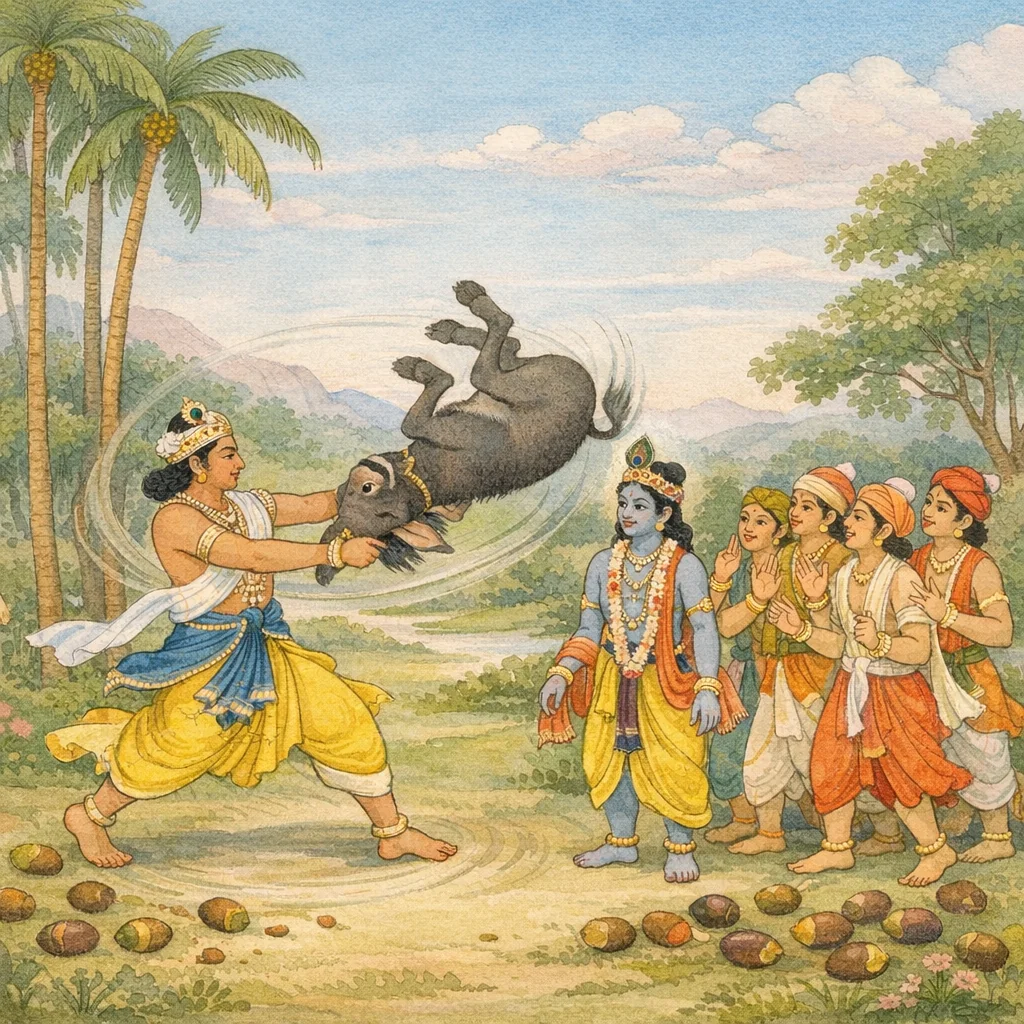
Adhyaya 186: Balarama and Krishna Slay Dhenuka in the Tālavana
อัธยายะ 186 ซึ่งฤๅษีวยาสะเล่า กล่าวถึงเหตุการณ์วีรกรรมในทุ่งเลี้ยงโคที่ปลดปล่อยป่าที่อุดมสมบูรณ์จากอำนาจอสูร พระราม (สังกรษณะ/พลภัทร) และพระกฤษณะขณะเลี้ยงโคร่วมกับเหล่าโคบาล ได้เข้าไปยังตาลวะนะ ป่าตาลที่งดงามมีผลสุกหอมมากมาย โคบาลบอกว่าป่านี้ถูกละทิ้งมานานเพราะมีอสูรชื่อเธนุกะ ผู้มีร่างเป็นลาและกินเนื้อ คอยเฝ้าอยู่ เมื่อเด็กๆ ปรารถนาผลตาล สองพี่น้องจึงเขย่าต้นตาลให้ผลร่วง ทำให้เธนุกะโกรธและเข้าต่อสู้ ในศึกนั้นเธนุกะถูกจับเหวี่ยงจนสิ้นชีวิตแล้วถูกโยนลงในป่า ต่อมาอสูรรูปลาตัวอื่นๆ มาถึงก็ถูกปราบโดยง่าย ตาลวะนะจึงบริสุทธิ์และกลับคืนความปลอดภัย พื้นดินเต็มไปด้วยผลตาล และฝูงโคได้กินหญ้าสดอย่างไร้ความหวาดกลัว—ระเบียบในแดนโคบาลได้รับการสถาปนาอีกครั้ง
Chapter Arc
{"opening_hook":"Vyāsa’s narration opens in a serene Vraja-pastoral register: Kṛṣṇa and Rāma, moving with the cowherd boys amid grazing cattle, are drawn toward the alluring Tālavana—fragrant, heavy with ripe tāla (palm) fruits—immediately setting desire (for fruit) against a forbidden, feared space.","rising_action":"The boys explain why the grove has been abandoned: it is occupied by Dhenuka, a donkey-formed daitya who makes the forest lethal. The tension rises as the brothers deliberately enter anyway and begin shaking the palms, turning innocent play into a conscious challenge to adharma’s territorial claim.","climax_moment":"Dhenuka’s furious charge is met by Saṃkarṣaṇa’s overwhelming strength: the ass-demon is seized, whirled, and slain, then hurled down so that the impact and agitation of the grove causes fruits to rain like a storm—an emblem of dharma restored through decisive, effortless divine force.","resolution":"Dhenuka’s allied donkey-demons arrive in succession and are dispatched by the two brothers; the Tālavana is purified and reopened. The earth lies strewn with palm fruits, fresh grass becomes safe for grazing, and the cowherds’ fear is replaced by abundance and free movement—order reestablished in the pastoral landscape.","key_verse":null}
Thematic Essence
{"primary_theme":"Vraja-līlā as landscape-liberation: the cleansing of Tālavana through the slaying of Dhenuka.","secondary_themes":["Abundance withheld by fear: how adharma turns fertile nature into forbidden territory","Divine play (līlā) that is also social protection: satisfying the boys’ desire while restoring safety","Effortless avatāra-heroism: the demon’s might collapses before bala and dharma","Re-sanctification of space: from haunted grove to communal pasture and orchard"],"brahma_purana_doctrine":"A recurring Purāṇic doctrinal motif is reinforced: when daitya-force occupies a region, the avatāra’s intervention is not merely martial but ecological and communal—restoring rightful access to nature’s gifts and reestablishing dharmic order in lived geography.","adi_purana_significance":"As an ‘Ādi Purāṇa’ layer within a text famed for mapping sacred space, this episode models how sacred history explains why a place becomes safe, fruitful, and fit for human and bovine life—myth functioning as an origin-story for a reclaimed landscape."}
Emotional Journey
{"opening_rasa":"शृङ्गार (śṛṅgāra)","climax_rasa":"वीर (vīra)","closing_rasa":"शान्त (śānta)","rasa_transitions":["śṛṅgāra → अद्भुत (adbhuta) → भयानक (bhayānaka) → vīra → adbhuta → śānta"],"devotional_peaks":["The fearless entry of Kṛṣṇa and Saṃkarṣaṇa into a demon-held grove—bhakti as trust in divine protection","The moment Dhenuka is whirled and cast down—darśana of irresistible divine bala restoring dharma","The transformed grove—abundance and safety as a tangible ‘phala’ (fruit) of divine presence"]}
Tirtha Focus
{"tirthas_covered":["तालवन (Tālavana)"],"jagannath_content":null,"surya_content":null,"cosmology_content":null}
Shlokas in Adhyaya 186
Verse 1
व्यास उवाच गाः पालयन्तौ च पुनः सहितौ रामकेशवौ भ्रममाणौ वने तत्र रम्यं तालवनं गतौ //
ที่นี่เป็นโศลกที่ 1 ของบทที่ 186—ยังไม่ได้ให้บทสันสกฤตต้นฉบับ จึงไม่อาจแปลได้อย่างถูกต้อง โปรดส่งข้อความสันสกฤตของโศลกนี้มาให้ด้วย
Verse 2
तच् च तालवनं नित्यं धेनुको नाम दानवः नृगोमांसकृताहारः सदाध्यास्ते खराकृतिः //
ที่นี่เป็นโศลกที่ 2 ของบทที่ 186—ยังไม่ได้ให้บทสันสกฤตต้นฉบับ จึงไม่อาจแปลได้อย่างถูกต้อง โปรดส่งข้อความสันสกฤตของโศลกนี้มาให้ด้วย
Verse 3
तत्र तालवनं रम्यं फलसंपत्समन्वितम् दृष्ट्वा स्पृहान्विता गोपाः फलादाने ऽब्रुवन् वचः //
ที่นี่เป็นโศลกที่ 3 ของบทที่ 186—ยังไม่ได้ให้บทสันสกฤตต้นฉบับ จึงไม่อาจแปลได้อย่างถูกต้อง โปรดส่งข้อความสันสกฤตของโศลกนี้มาให้ด้วย
Verse 4
गोपा ऊचुः हे राम हे कृष्ण सदा धेनुकेनैव रक्ष्यते भूप्रदेशो यतस् तस्मात् त्यक्तानीमानि सन्ति वै //
นี่คือคาถาที่สี่
Verse 5
फलानि पश्य तालानां गन्धमोदयुतानि वै वयम् एतान्य् अभीप्सामः पात्यन्तां यदि रोचते //
นี่คือคาถาที่ห้า
Verse 6
इति गोपकुमाराणां श्रुत्वा संकर्षणो वचः कृष्णश् च पातयाम् आस भुवि तालफलानि वै //
นี่คือคาถาที่หก
Verse 7
तालानां पततां शब्दम् आकर्ण्यासुरराट् ततः आजगाम स दुष्टात्मा कोपाद् दैतेयगर्दभः //
นี่คือคาถาที่เจ็ด
Verse 8
पद्भ्याम् उभाभ्यां स तदा पश्चिमाभ्यां च तं बली जघानोरसि ताभ्यां च स च तेनाप्य् अगृह्यत //
นี่คือคาถาที่แปด
Verse 9
गृहीत्वा भ्रामणेनैव चाम्बरे गतजीवितम् तस्मिन्न् एव प्रचिक्षेप वेगेन तृणराजनि //
นี่คือคาถาที่เก้า—ถ้อยคำศักดิ์สิทธิ์ว่าด้วยธรรมะ; ผู้ฟังด้วยศรัทธาย่อมได้รับผลบุญ.
Verse 10
ततः फलान्य् अनेकानि तालाग्रान् निपतन् खरः पृथिव्यां पातयाम् आस महावातो ऽम्बुदान् इव //
คาถาที่สิบ—สัจจะคือธรรมะสูงสุด และเมตตาคือบำเพ็ญตบะสูงสุด; ปฏิบัติตามนี้ย่อมบรรลุความสงบ.
Verse 11
अन्यान् अप्य् अस्य वै ज्ञातीन् आगतान् दैत्यगर्दभान् कृष्णश् चिक्षेप तालाग्रे बलभद्रश् च लीलया //
คาถาที่สิบเอ็ด—ญาณที่ประกอบด้วยครูและคัมภีร์ เปรียบดังประทีปขจัดความมืดแห่งอวิชชา; ด้วยนั้นสัตว์ย่อมพบหนทาง.
Verse 12
क्षणेनालंकृता पृथ्वी पक्वैस् तालफलैस् तदा दैत्यगर्दभदेहैश् च मुनयः शुशुभे ऽधिकम् //
คาถาที่สิบสอง—พร้อมด้วยยัญญะ ทาน และตบะ พึงระลึกถึงพระวิษณุเป็นนิตย์; นั่นแลเป็นเครื่องปลดเปลื้องพันธะแห่งภพ.
Verse 13
ततो गावो निराबाधास् तस्मिंस् तालवने द्विजाः नवशष्पं सुखं चेरुर् यत्र भुक्तम् अभूत् पुरा //
คาถาที่สิบสาม—ผู้ใดอ่านและสดับตัตตวะที่กล่าวไว้ในปุราณะ ผู้นั้นย่อมได้เกียรติยศ อายุยืน และความสุข.
Frequently Asked Questions
The chapter foregrounds the restoration of dharmic order through the removal of a predatory, disruptive force from a shared ecological commons. By clearing Tālavana of Dhenuka and his kin, the narrative frames divine power as protective governance that enables nonviolent livelihood—safe grazing, communal access to food resources, and the reestablishment of normal pastoral life.
Within the Brahma Purana’s encyclopedic purview, this episode functions as a paradigmatic mythic unit: it encodes a foundational motif of early Purāṇic narration—divine intervention that reorders space, removes adharma from a locality, and renders the landscape socially usable. Such localized restorations help structure the Purāṇic world as an ordered, narratively mapped terrain rather than an undifferentiated wilderness.
No explicit tīrtha-māhātmya, vrata, or formal rite is instituted in this adhyāya. The text instead emphasizes a practical-sacral transformation of place: Tālavana shifts from a demon-guarded exclusion zone to a safe pastoral grove, implying purification-through-divine-action rather than prescribing a named pilgrimage observance.
Read Brahma Purana in the Vedapath app
Scan the QR code to open this directly in the app, with audio, word-by-word meanings, and more.