
Shloka 25
Vishwarupa Darshana Yoga — Vishwarupa Darshana Yoga
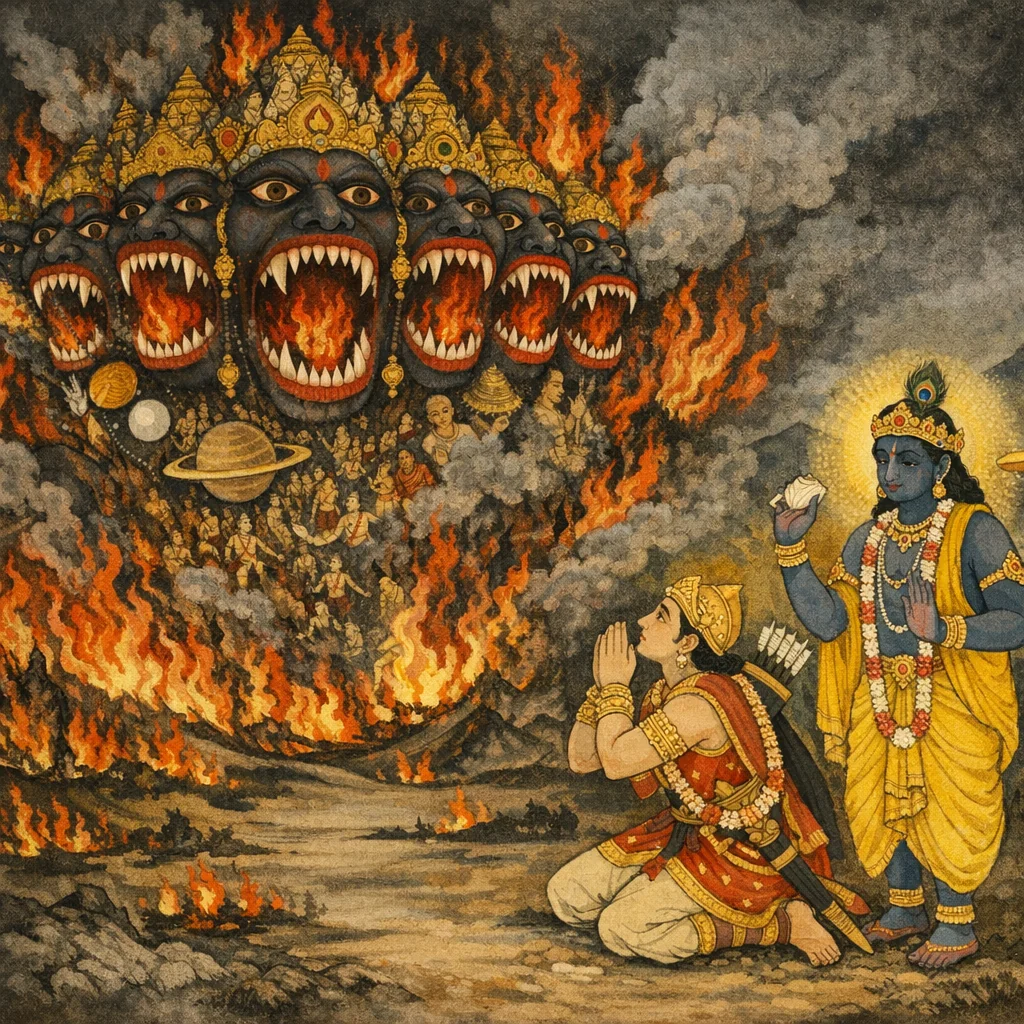
दंष्ट्राकरालानि च ते मुखानि दृष्ट्वैव कालानलसन्निभानि । दिशो न जाने न लभे च शर्म प्रसीद देवेश जगन्निवास ॥
daṃṣṭrā-karālāni ca te mukhāni dṛṣṭvaiva kālānala-sannibhāni | diśo na jāne na labhe ca śarma prasīda deveśa jagan-nivāsa ||

ครั้นเห็นพระพักตร์ของพระองค์อันน่ากลัวด้วยเขี้ยว ดุจไฟแห่งกาลเวลา ข้าพเจ้าหลงทิศ ไม่อาจพบความร่มเย็นได้ โปรดเมตตาเถิด โอ้พระผู้เป็นจอมเทพ ผู้เป็นที่พำนักแห่งโลก
Seeing Your mouths with formidable teeth, like the fire of time, I lose my sense of direction and find no comfort. Be gracious, O Lord of the gods, abode of the world.
Having seen your mouths, terrifying with teeth, resembling the conflagration of time, I do not know the directions and I do not find ease. Show favor, O lord of gods, dwelling-place of the world.
kālānala (‘time-fire’) is often read as an image of impermanence and cosmic dissolution. The verse can be interpreted as an existential confrontation with mortality and change rather than a literal threat.
FAQs
Losing ‘sense of direction’ is a metaphor for disorientation under stress; the plea ‘prasīda’ shows a turn toward relational coping—seeking reassurance from a trusted source of meaning.
The imagery of ‘time-fire’ suggests that the divine encompasses transformative processes (arising and passing), integrating creation and dissolution within one reality.
This is a pivot from witnessing to supplication, foreshadowing Arjuna’s desire to return from the cosmic vision to a more personal, approachable form.
It can be read as a response to impermanence: acknowledging anxiety about change while seeking steadiness through ethical practice, reflection, or faith.