
Shloka 17
Vishwarupa Darshana Yoga — Vishwarupa Darshana Yoga
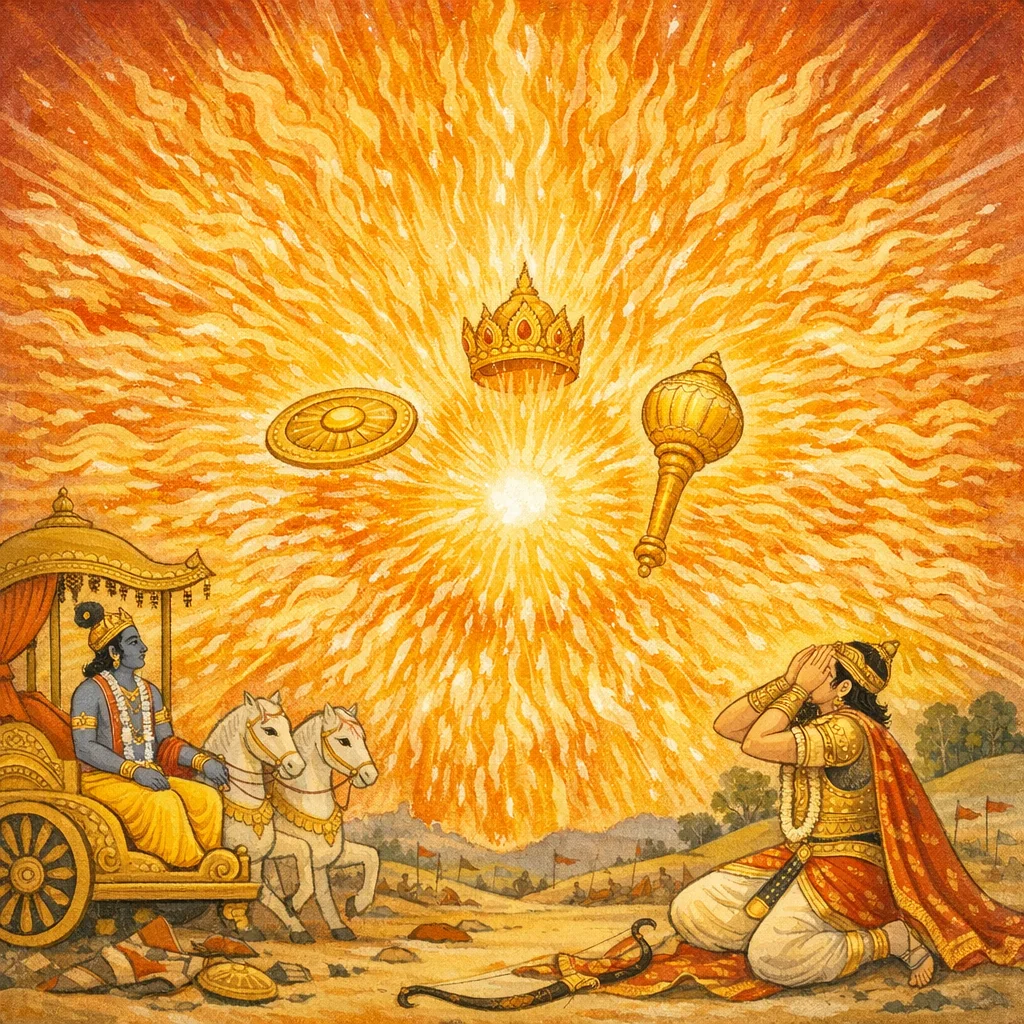
किरीटिनं गदिनं चक्रिणं च तेजोराशिं सर्वतो दीप्तिमन्तम् । पश्यामि त्वां दुर्निरीक्ष्यं समन्ताद्द्दीप्तानलार्कद्युतिमप्रमेयम् ॥
kirīṭinaṃ gadinaṃ cakriṇaṃ ca tejorāśiṃ sarvato dīptimantam | paśyāmi tvāṃ durnirīkṣyaṃ samantād dīptānalārkadyutim aprameyam ||

ข้าพระองค์เห็นพระองค์ทรงมงกุฎ ทรงคทา และทรงจักร—เป็นมวลรัศมีอันมหาศาลส่องสว่างไปทุกทิศ; ยากแก่การเพ่งมองจากทุกด้าน ลุกโชติช่วงดุจไฟและดวงอาทิตย์ และหาประมาณมิได้
I see You wearing a crown, holding a mace and a discus—an immense mass of radiance shining in all directions; You are difficult to behold from every side, blazing like fire and the sun, immeasurable.
I behold you: crowned, bearing mace and discus; a heap of splendor, luminous on all sides—hard to gaze upon everywhere, with the brilliance of blazing fire and the sun, beyond measure.
This verse is stable across common recensions; minor sandhi/punctuation differences occur (e.g., samantāt + dīpta-). The interpretive emphasis varies between devotional iconography (crown/mace/discus as Viṣṇu markers) and phenomenological description (radiance and perceptual overwhelm).
FAQs
Arjuna reports perceptual overload—an encounter that exceeds ordinary cognitive framing, suggesting awe and the mind’s limits when faced with the ‘totality’ symbolized by the cosmic form.
The verse presents the divine as immeasurable (aprameya) and not fully graspable by sense-perception, pointing to a reality that transcends empirical categories while still appearing within them.
Within the Viśvarūpa episode, Arjuna’s language shifts from dialogue to direct testimony (paśyāmi), marking an experiential climax of the chapter.
It can be read as a model for intellectual humility: some aspects of reality—ethical, existential, or spiritual—may be approached through reverence and disciplined attention rather than control.