
Bhagavad Gita — Vibhuti Yoga, Shloka 15
Vibhuti Yoga
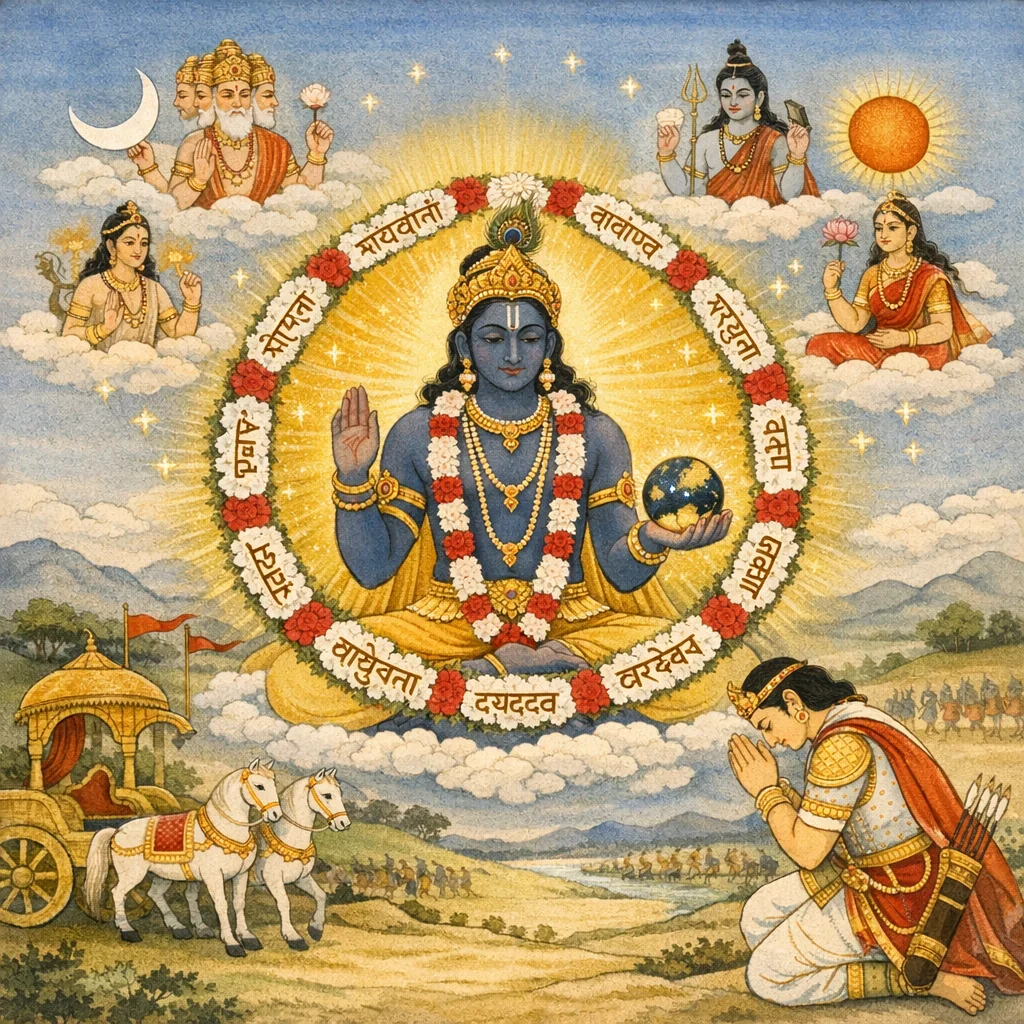
स्वयमेवात्मनात्मानं वेत्थ त्वं पुरुषोत्तम । भूतभावन भूतेश देवदेव जगत्पते ॥ १०.१५ ॥
svayam evātmanātmānaṁ vettha tvaṁ puruṣottama | bhūtabhāvana bhūteśa devadeva jagatpate || 10.15 ||

ข้าแต่ปุรุโษตตม พระองค์ทรงรู้พระองค์เองด้วยพระองค์เองเท่านั้น ข้าแต่ผู้ให้กำเนิดสรรพสัตว์ เจ้าแห่งสรรพสัตว์ เทพเหนือเทพ และเจ้าแห่งโลก!
You alone know Yourself by Yourself, O Supreme Person; O originator of beings, Lord of beings, God of gods, ruler of the world.
You yourself know yourself by yourself, Supreme Person—creator/nurturer of beings, lord of beings, god of gods, lord of the world.
The verse is stable; interpretive nuance lies in bhūta-bhāvana (either ‘source’ or ‘nurturer’ of beings) and in reading the line as asserting divine self-knowledge as unique and unsurpassable.
FAQs
The verse contrasts finite self-understanding (often partial and mediated) with an ideal of complete self-knowledge, which can serve as a regulative ideal for self-inquiry.
It asserts the divine as self-grounded and self-knowing, not dependent on external validation—an important theistic claim about ultimate reality’s independence.
Arjuna emphasizes that only Krishna can fully disclose Krishna’s nature, justifying his request for further teaching on divine manifestations.
It supports the practice of intellectual humility: recognizing that some domains require guidance from more comprehensive standpoints (teachers, traditions, or disciplined methods) rather than speculation alone.