
Shloka 14
Shraddhatraya Vibhaga Yoga — Shraddhatraya Vibhaga Yoga
देवद्विजगुरुप्राज्ञपूजनं शौचमार्जवम् । ब्रह्मचर्यमहिंसा च शारीरं तप उच्यते ॥ १७.१४ ॥
deva-dvija-guru-prājña-pūjanaṃ śaucam ārjavam | brahmacaryam ahiṃsā ca śārīraṃ tapa ucyate || 17.14 ||

การบูชาเทวดา ทวิชะ (พราหมณ์) ครู และบัณฑิตผู้รู้ ความสะอาด ความซื่อตรงเรียบง่าย พรหมจรรย์ และอหิงสา—สิ่งนี้เรียกว่า ตบะทางกาย
देव, द्विज (ब्राह्मण), गुरु और ज्ञानी जनों का पूजन, शौच, सरलता, ब्रह्मचर्य और अहिंसा—यह शारीरिक तप कहा जाता है।
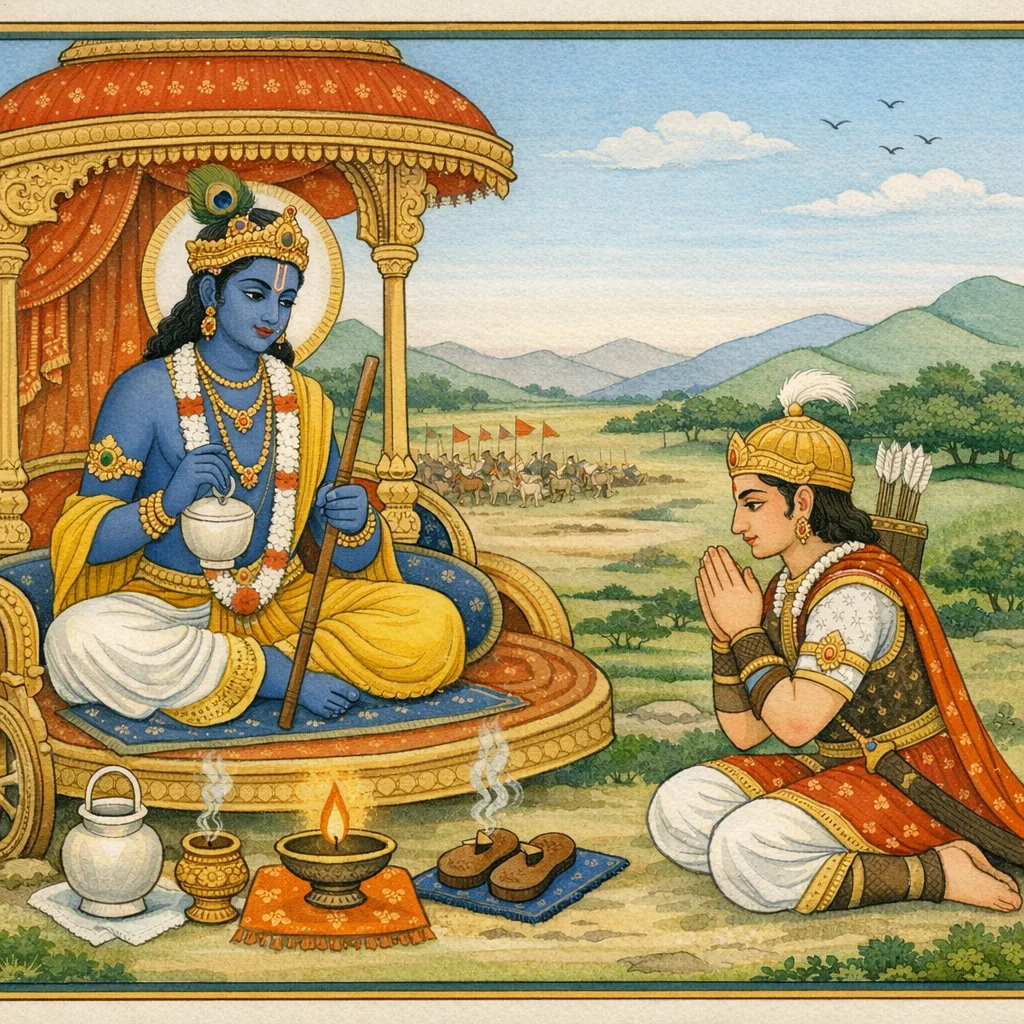
Reverence toward the divine, the twice-born (learned religious specialists), teachers, and the wise; purity; straightforwardness; sexual restraint; and non-harming—this is called bodily austerity.
‘Dvija’ is traditionally ‘twice-born’ (often tied to varṇa-based initiation); academic databases frequently gloss it as ‘initiated/learned classes’ and note the socio-historical specificity. ‘Ahiṃsā’ is best rendered as non-harming/non-injury in broad ethical sense.
FAQs
Bodily discipline is framed as ethical habits—cleanliness, restraint, and non-harming—that stabilize conduct and reduce impulsivity.
Tapas is not mere hardship but an ordering of embodied life that supports inner clarity; the body becomes an instrument aligned with ethical and contemplative aims.
After classifying sacrifice, the chapter turns to austerity (tapas), beginning with its ‘bodily’ (śārīra) form.
It can be applied as a principle of respectful conduct, hygiene, honesty in action, and harm-minimization, interpreted within contemporary social norms.