
Bhagavad Gita — Raja Vidya Raja Guhya Yoga, Shloka 17
Raja Vidya Raja Guhya Yoga
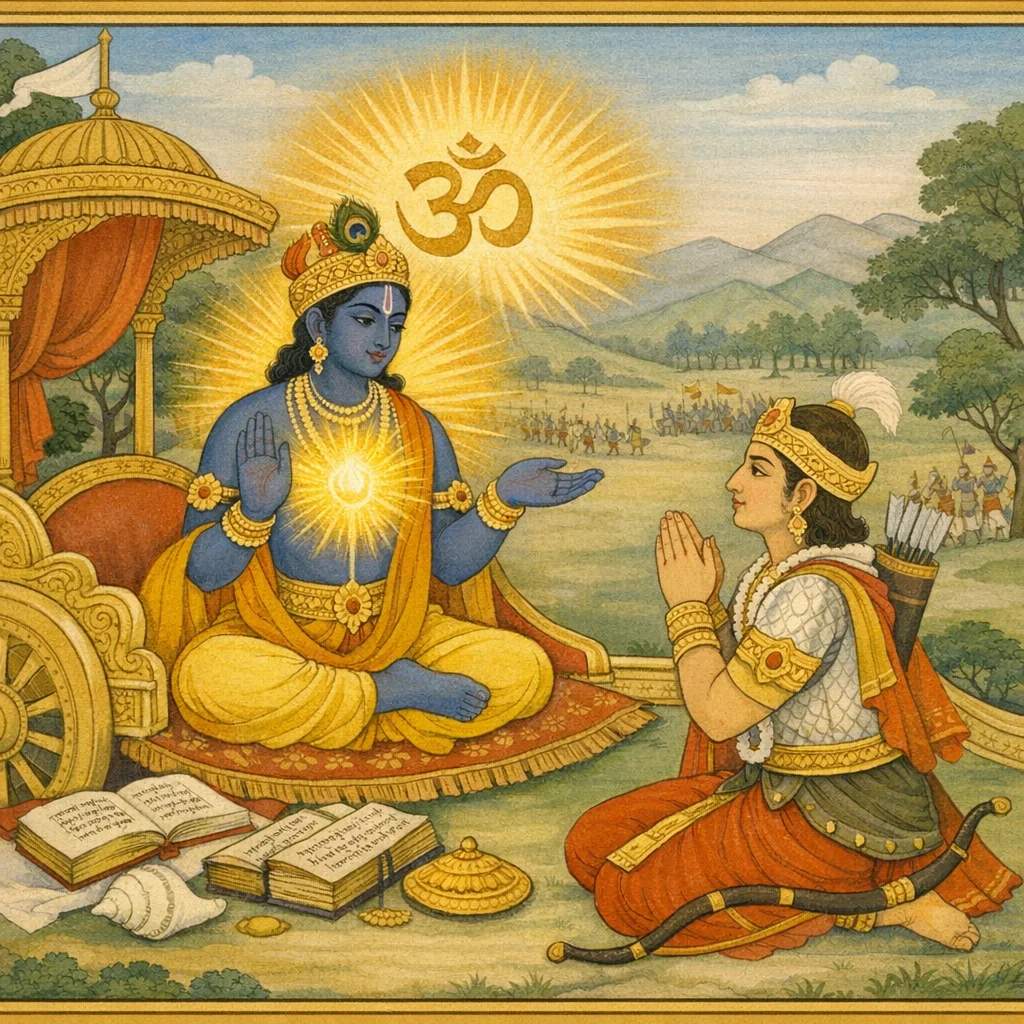
पिताहमस्य जगतो माता धाता पितामहः । वेद्यं पवित्रमोंकार ऋक्साम यजुरेव च ॥ ९.१७ ॥
pitāham asya jagato mātā dhātā pitāmahaḥ | vedyaṃ pavitram oṃkāra ṛk-sāma yajur eva ca || 9.17 ||

เราคือบิดาแห่งโลกนี้ คือมารดา คือผู้ทรงค้ำจุน และคือปิตามหะ เราคือสิ่งที่พึงรู้ คือผู้ชำระให้บริสุทธิ์ คือพยางค์โอม และเราคือฤค สาม และยชุรด้วย
I am the father of this world, the mother, the sustainer, and the grandsire; I am the knowable, the purifier, the syllable Oṃ, and also Ṛg, Sāma, and Yajus.
I am the father of this world, the mother, the arranger/sustainer (dhātṛ), the grandfather; (I am) what is to be known, the purifier, the syllable Oṃ, and also the Ṛg-, Sāma-, and Yajur- (Vedas).
“धाता” may be translated as creator, supporter, or ordainer. The list links cosmic parenthood with the epistemic ‘knowable’ and with Vedic revelation (Oṃ and the three Vedas).
FAQs
The parental metaphors can convey security and belonging, while ‘knowable/purifier’ emphasizes clarity through disciplined understanding.
The divine is presented as both efficient and sustaining cause, and as the object of ultimate knowledge, integrating cosmology and epistemology.
It continues the ‘I am’ catalog to show that the sacred is present in family metaphors, in knowledge, and in Vedic liturgical foundations.
One may interpret it as a call to connect learning and ethical purification: knowledge should transform character, not merely inform.