
Shloka 18
Purushottama Yoga — Purushottama Yoga
यस्मात्क्षरमतीतोऽहमक्षरादपि चोत्तमः ।
अतोऽस्मि लोके वेदे च प्रथितः पुरुषोत्तमः ॥ १५.१८ ॥
yasmāt kṣaram atīto 'ham akṣarād api cottamaḥ |
ato 'smi loke vede ca prathitaḥ puruṣottamaḥ || 15.18 ||

เพราะเราล่วงพ้นกษร และยังประเสริฐยิ่งกว่าอักษร ดังนั้นทั้งในโลกและในพระเวท เราจึงเป็นที่รู้จักในนาม “ปุรุโษตตมะ”
क्योंकि मैं क्षर से परे हूँ और अक्षर से भी उत्तम हूँ, इसलिए लोक में और वेद में मैं पुरुषोत्तम नाम से प्रसिद्ध हूँ।
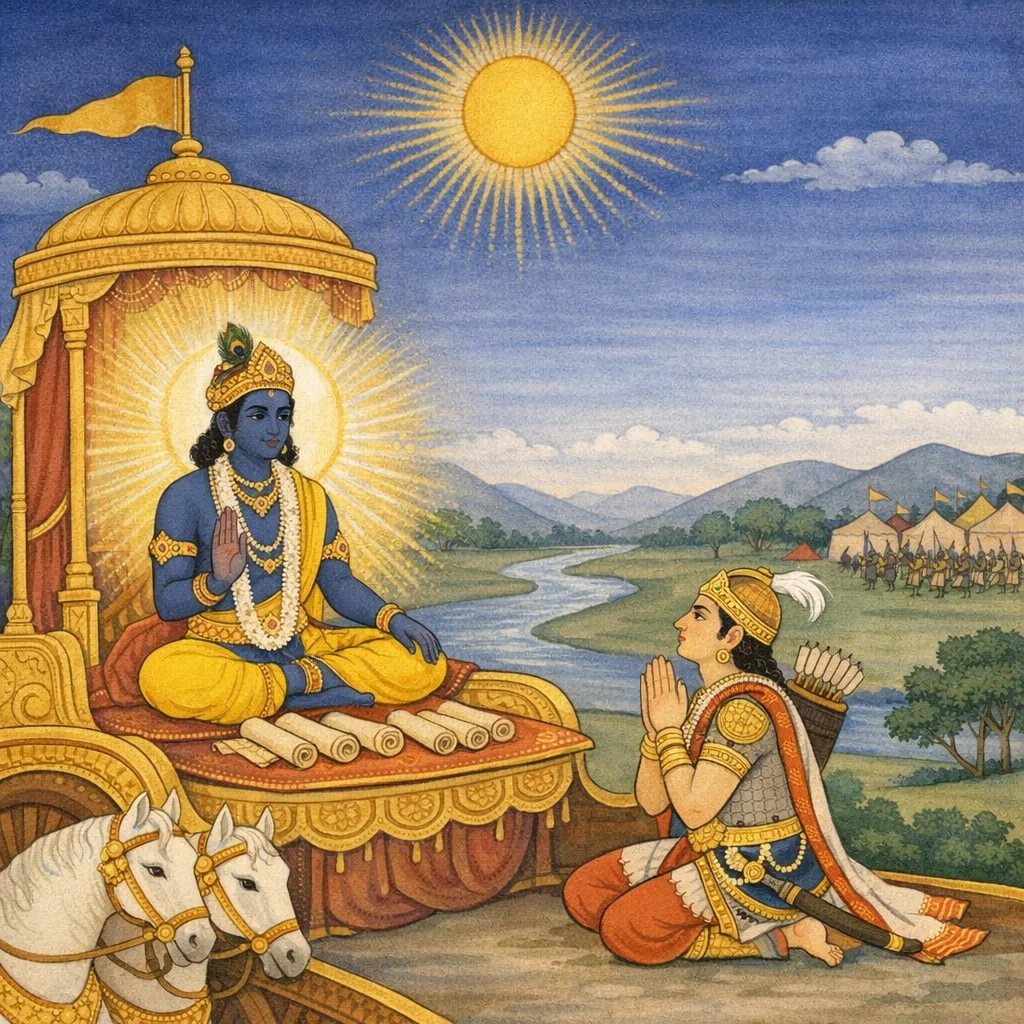
Because I transcend the perishable and am higher even than the imperishable, therefore in the world and in the Veda I am renowned as Puruṣottama.
The verse is programmatic for naming: ‘Puruṣottama’ is justified by surpassing both kṣara and akṣara categories. Commentarial traditions debate whether this indicates a personal theism, a highest Brahman, or a synthesis (personal absolute).
FAQs
It offers a cognitive anchor: rather than oscillating between attachment to change and retreat into detachment, it points to a ‘higher’ standpoint integrating both.
The supreme is defined as exceeding both the changing domain and the imperishable principle, establishing a highest ontological category identified with Krishna.
This is the chapter’s explicit definition of ‘Puruṣottama,’ linking the metaphysical hierarchy to scriptural and cultural recognition.
For readers, it can function as a framework for ultimate concern: clarifying what one treats as highest value beyond both transient success and mere withdrawal.