
Shloka 4
Karma Yoga — Karma Yoga
न कर्मणामनारम्भान्नैष्कर्म्यं पुरुषोऽश्नुते । न च संन्यसनादेव सिद्धिं समधिगच्छति ॥ ३.४ ॥
na karmaṇām anārambhān naiṣkarmyaṃ puruṣo'śnute | na ca saṃnyasanād eva siddhiṃ samadhigacchati || 3.4 ||

มนุษย์ย่อมไม่บรรลุความไร้กรรม (นৈษ्कर्मยะ) ด้วยการไม่เริ่มทำกรรม; และย่อมไม่บรรลุความสำเร็จสมบูรณ์ด้วยการสละเพียงอย่างเดียว
A person does not attain actionlessness (freedom from karma) by not undertaking actions; nor does one attain perfection merely by renunciation.
Not by refraining from initiating actions does a person reach ‘non-action’ (naiṣkarmya); nor, merely by renunciation, does one attain accomplishment (siddhi).
Key interpretive issue: ‘naiṣkarmya’ is often read not as literal inactivity but as freedom from binding action (karma-bandha). ‘Saṃnyāsa’ here can mean external abandonment; commentators frequently contrast it with inner renunciation of attachment.
FAQs
Avoidance of duties can function as a defense mechanism (escape from anxiety or responsibility). The verse suggests that genuine freedom is not achieved by suppression or withdrawal alone, but by transforming one’s relation to action.
‘Non-action’ is framed as a state where actions do not generate binding residues, implying a shift in agency and identification rather than physical stillness.
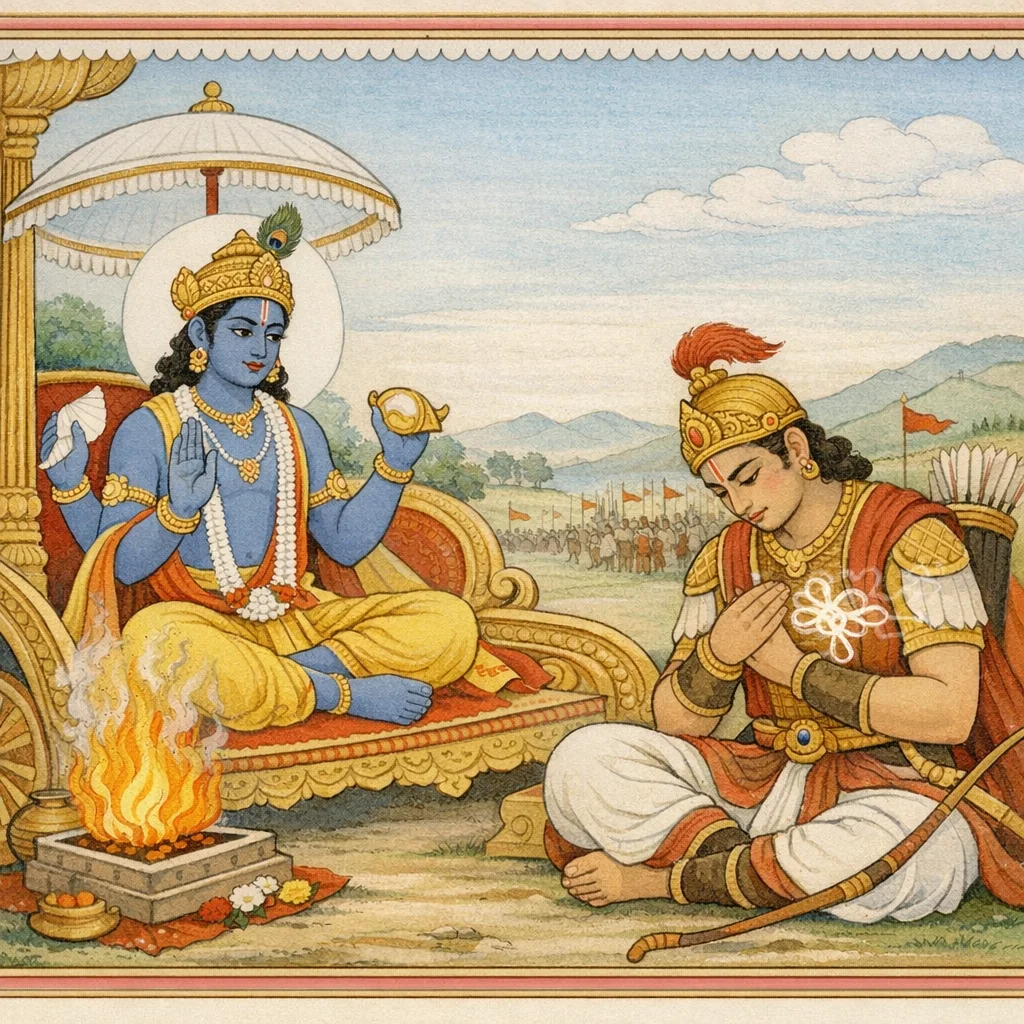
It directly addresses Arjuna’s temptation to step back from his obligations. Krishna argues that mere non-participation does not itself yield spiritual completion.
In contemporary life, quitting tasks is not automatically liberating; the verse recommends acting with clarity and reduced attachment—e.g., doing one’s work conscientiously without over-identifying with success or failure.