
Shloka 2
Karma Yoga — Karma Yoga
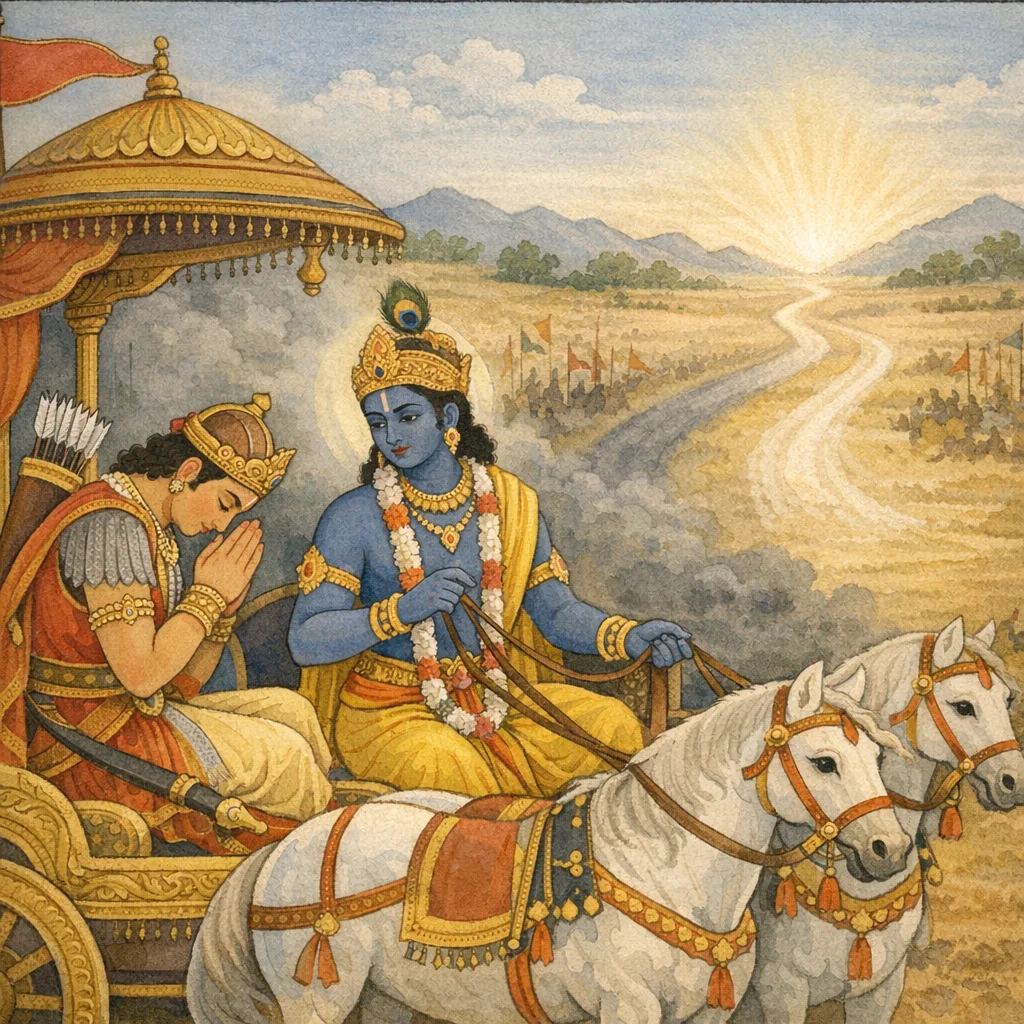
व्यामिश्रेणेव वाक्येन बुद्धिं मोहयसीव मे । तदेकं वद निश्चित्य येन श्रेयोऽहमाप्नुयाम् ॥ ३.२ ॥
vyāmiśreṇeva vākyena buddhiṁ mohayasīva me | tad ekaṁ vada niścitya yena śreyo 'ham āpnuyām || 3.2 ||

พระดำรัสของพระองค์ประหนึ่งปะปนกัน ทำให้พุทธิของข้าพเจ้าราวกับสับสน ดังนั้นโปรดตรัสให้แน่ชัดถึงหนทางเดียว ที่ข้าพเจ้าจะบรรลุศฺเรยะ (ความเกษมสูงสุด) ได้
With seemingly mixed words, You confuse my understanding. Therefore, tell me decisively the one path by which I may attain the highest good.
By speech as though mixed, you seem to bewilder my understanding. Therefore tell me one (course) decisively, by which I might attain the good (śreyas).
Vyāmiśra (‘mixed/combined’) can indicate perceived inconsistency or a deliberate synthesis. Śreyas is ‘the good/the beneficial,’ often contrasted with preyas (the merely pleasant) in broader Indian ethical vocabulary.
FAQs
It reflects a common learning dynamic: when guidance seems internally complex, the student requests a single actionable principle to reduce uncertainty and paralysis.
The request anticipates the Gītā’s claim that liberation-oriented insight and disciplined action can be harmonized; the ‘one path’ can be understood as a unified orientation rather than a single technique.
This verse motivates Krishna’s forthcoming explanation of karma-yoga and how action can be performed without attachment, resolving the perceived contradiction.
It supports the value of clear decision frameworks: identifying core principles (values, duties, non-attachment to outcomes) that organize complex choices.