
Bhagavad Gita — Gunatraya Vibhaga Yoga, Shloka 6
Gunatraya Vibhaga Yoga
तत्र सत्त्वं निर्मलत्वात्प्रकाशकमनामयम् । सुखसङ्गेन बध्नाति ज्ञानसङ्गेन चानघ ॥ १४.६ ॥
tatra sattvaṃ nirmalatvāt prakāśakam anāmayam | sukha-saṅgena badhnāti jñāna-saṅgena cānagha || 14.6 ||

ในบรรดาคุณเหล่านั้น สัตตวะเพราะความบริสุทธิ์ จึงส่องสว่างและปราศจากโทษภัย โอ ผู้ปราศจากมลทิน มันผูกมัดด้วยความยึดติดในสุข และด้วยความยึดติดในความรู้
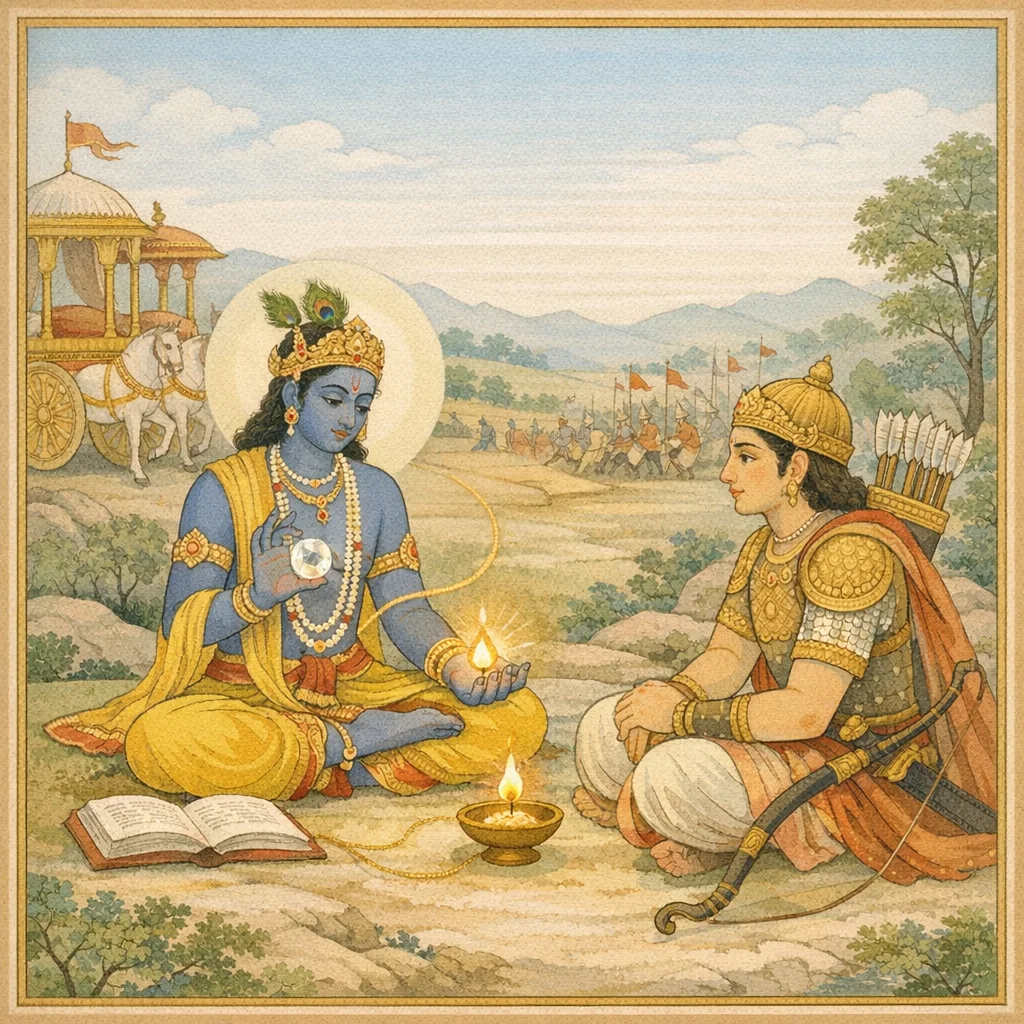
Among them, sattva, because of its purity, is illuminating and free from ailment; it binds, O sinless one, by attachment to happiness and by attachment to knowledge.
There, sattva—due to purity—illuminates and is untroubled; it binds (a person) through attachment to pleasure and also through attachment to knowledge, O Anagha.
The verse gives a nuanced critique: even the ‘best’ guṇa binds when one clings to refined enjoyment or to the pride/possessiveness of knowing. Commentators distinguish liberating knowledge (jñāna leading beyond guṇas) from guṇa-based ‘knowledge’ that still reinforces identification.
FAQs
It observes that even healthy, clear states can become limiting if one becomes dependent on them—e.g., needing constant comfort or validation of being ‘wise’.
Sattva is luminous and stabilizing, yet still a feature of prakṛti; thus it cannot be ultimate freedom. Liberation requires going beyond identification with any guṇa.
After defining the three guṇas, the text begins by characterizing sattva first, explaining both its benefits (clarity) and its binding mechanism (attachment).
Cultivate clarity and learning, but watch for attachment: maintain curiosity without ego, and well-being without insisting that life must always feel pleasant.