
Bhagavad Gita — Gunatraya Vibhaga Yoga, Shloka 16
Gunatraya Vibhaga Yoga
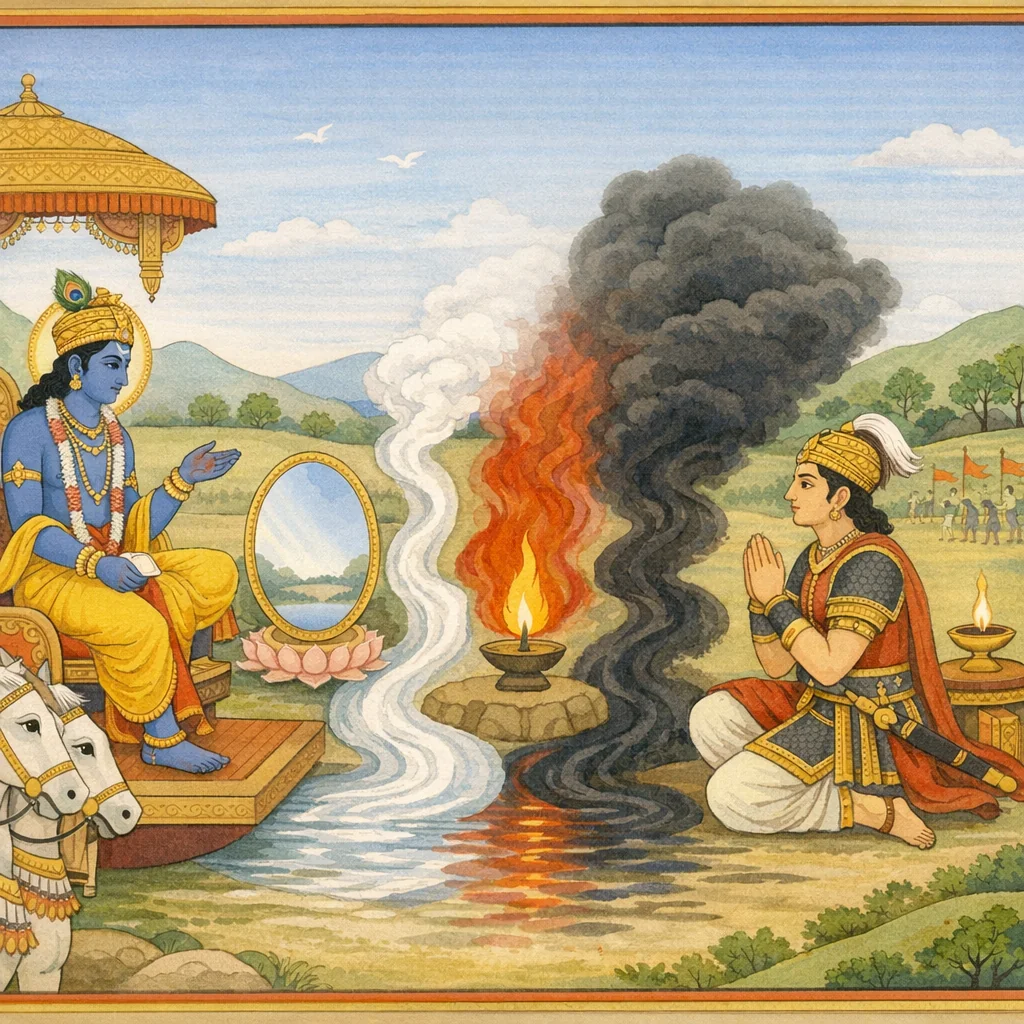
कर्मणः सुकृतस्याहुः सात्त्विकं निर्मलं फलम् । रजसस्तु फलं दुःखमज्ञानं तमसः फलम् ॥ १४.१६ ॥
karmaṇaḥ sukṛtasyāhuḥ sāttvikaṁ nirmalaṁ phalam | rajasas tu phalaṁ duḥkham ajñānaṁ tamasaḥ phalam || 14.16 ||

เขากล่าวกันว่า ผลแห่งกรรมอันดีเป็นสัตตวะ บริสุทธิ์ผ่องใส; ส่วนผลแห่งรชัสเป็นทุกข์ และผลแห่งตมัสเป็นอวิชชา
They say the fruit of good action is sāttvic and pure; the fruit of rajas is suffering; the fruit of tamas is ignorance.
The result of well-done action is said to be sāttvic and stainless; but the result of rajas is distress, and the result of tamas is non-knowledge.
‘Sukṛta’ can mean morally ‘good’ or skillfully ‘well-performed’ action; ‘duḥkha’ is often rendered ‘sorrow/suffering/distress.’ The verse is evaluative: it links guṇic motivation to experiential outcomes.
FAQs
It correlates motivational quality with felt outcomes: clarity and balance tend toward ‘clean’ results, restless striving tends toward strain, and inertia/confusion tends toward diminished understanding.
Within karmic theory, actions shaped by different guṇas yield corresponding results; the verse presents a normative hierarchy where sattva supports clarity and rajas/tamas obscure it.
After discussing guṇa dominance and rebirth outcomes, it summarizes the experiential ‘fruits’ produced by guṇa-colored action in this life and beyond.
It can be used to reflect on how the manner of acting—calm clarity vs agitation vs confusion—affects both outcomes and one’s well-being during and after the action.