
Bhagavad Gita — Gunatraya Vibhaga Yoga, Shloka 12
Gunatraya Vibhaga Yoga
लोभः प्रवृत्तिरारम्भः कर्मणामशमः स्पृहा । रजस्येतानि जायन्ते विवृद्धे भरतर्षभ ॥ १४.१२ ॥
lobhaḥ pravṛttir ārambhaḥ karmaṇām aśamaḥ spṛhā | rajasy etāni jāyante vivṛddhe bharatarṣabha || 14.12 ||

ความโลภ ความกระสับกระส่าย การริเริ่มการงาน ความไม่สงบ และความใคร่ปรารถนา—สิ่งเหล่านี้ย่อมเกิดขึ้นเมื่อรชัสเพิ่มพูน โอ ผู้ประเสริฐแห่งวงศ์ภารตะ
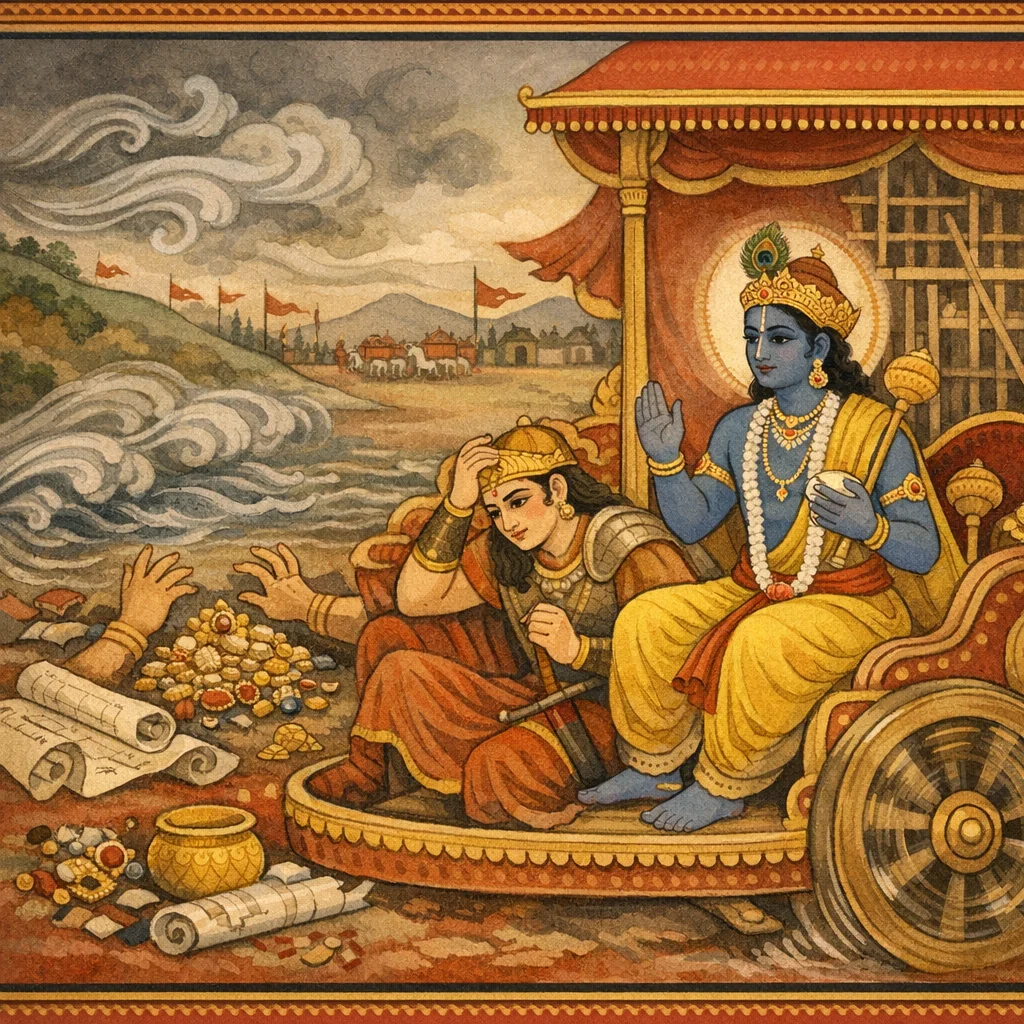
Greed, activity, the undertaking of actions, restlessness, and longing—these arise when rajas increases, O best of the Bharatas.
Greed, outward engagement, initiating enterprises, lack of tranquility, and craving arise when rajas is intensified.
Pravṛtti may be rendered as ‘activity,’ ‘engagement,’ or ‘outward inclination.’ Spṛhā overlaps with ‘desire/longing’; some translations differentiate it from tṛṣṇā as a subtler ‘yearning.’
FAQs
Rajas is profiled through observable patterns: heightened wanting, increased busyness, frequent new initiatives, and difficulty settling the mind.
As a guṇa, rajas energizes action but also tightens identification with doing and possessing, reinforcing cyclical dissatisfaction when driven by craving.
This verse parallels 14.11 and 14.13 by listing diagnostic features of each guṇa when it becomes predominant.
It may be used to recognize burnout-prone patterns—constant initiating and striving—and to introduce practices that reduce compulsive craving and restore calm.