
Shloka 18
Vishwarupa Darshana Yoga — Vishwarupa Darshana Yoga
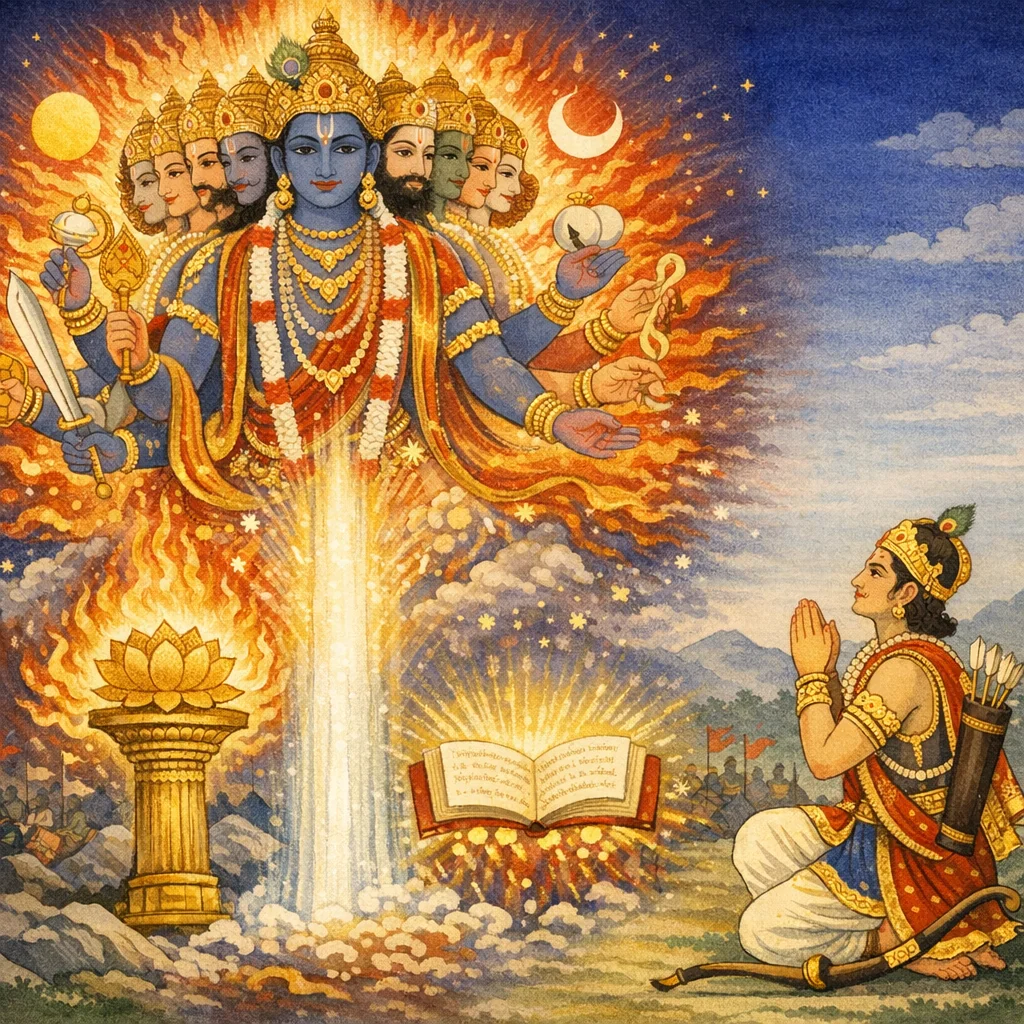
त्वमक्षरं परमं वेदितव्यं त्वमस्य विश्वस्य परं निधानम् । त्वमव्ययः शाश्वतधर्मगोप्ता सनातनस्त्वं पुरुषो मतो मे ॥
tvam akṣaraṃ paramaṃ veditavyaṃ tvam asya viśvasya paraṃ nidhānam | tvam avyayaḥ śāśvatadharmagoptā sanātanas tvaṃ puruṣo mato me ||

నీవే అక్షరుడు, పరమంగా తెలుసుకొనవలసిన తత్త్వం; నీవే ఈ సమస్త విశ్వానికి పరమ ఆధారం, నిధానం. నీవు అవ్యయుడు; శాశ్వత ధర్మానికి రక్షకుడు. నీవే సనాతన పురుషుడు—ఇదే నా దృఢమైన అభిప్రాయం.
You are the Imperishable, the supreme to be known; You are the highest support of this universe. You are the unchanging guardian of the eternal dharma; You are the ancient Person—this is my conviction.
You are the imperishable, the highest object of knowledge; you are the supreme repository/foundation of this universe. You are un-decaying, the protector of enduring dharma; you are the primordial Person—so I understand.
Key terms invite interpretive spread: nidhānam can mean ‘abode/treasury’ or ‘final ground’; puruṣa may be read theistically (supreme person) or philosophically (cosmic principle). ‘Śāśvatadharma’ is often taken as perennial order rather than a sectarian code.
FAQs
The verse shows a shift from fear to cognitive anchoring: Arjuna frames the overwhelming vision with stable concepts—imperishable, foundation, protector—reducing inner disorientation.
It identifies the divine with the ‘imperishable’ and the ultimate ground of the universe, aligning devotional address with a metaphysics of an unchanging reality underpinning change.
After describing sensory splendor, Arjuna articulates philosophical recognition—moving from what is seen to what is understood about the nature of the divine.
It can support reflective practice: clarifying one’s highest values (dharma) and one’s sense of what is ‘non-negotiable’ (akṣara) amid uncertainty.