
Shloka 18
Sankhya Yoga — Sankhya Yoga
अन्तवन्त इमे देहा नित्यस्योक्ताः शरीरिणः । अनाशिनोऽप्रमेयस्य तस्माद्युध्यस्व भारत ॥ २.१८ ॥
antavanta ime dehā nityasyoktāḥ śarīriṇaḥ | anāśino 'prameyasya tasmād yudhyasva bhārata || 2.18 ||

ఈ దేహాలు అంతమున్నవని చెప్పబడుతున్నాయి; ఇవి నిత్యమైన శరీరధారి ఆత్మకు చెందినవి; ఆ ఆత్మ అనాశి, అప్రమేయుడు. కాబట్టి, ఓ భారతవంశజుడా, యుద్ధం చేయి.
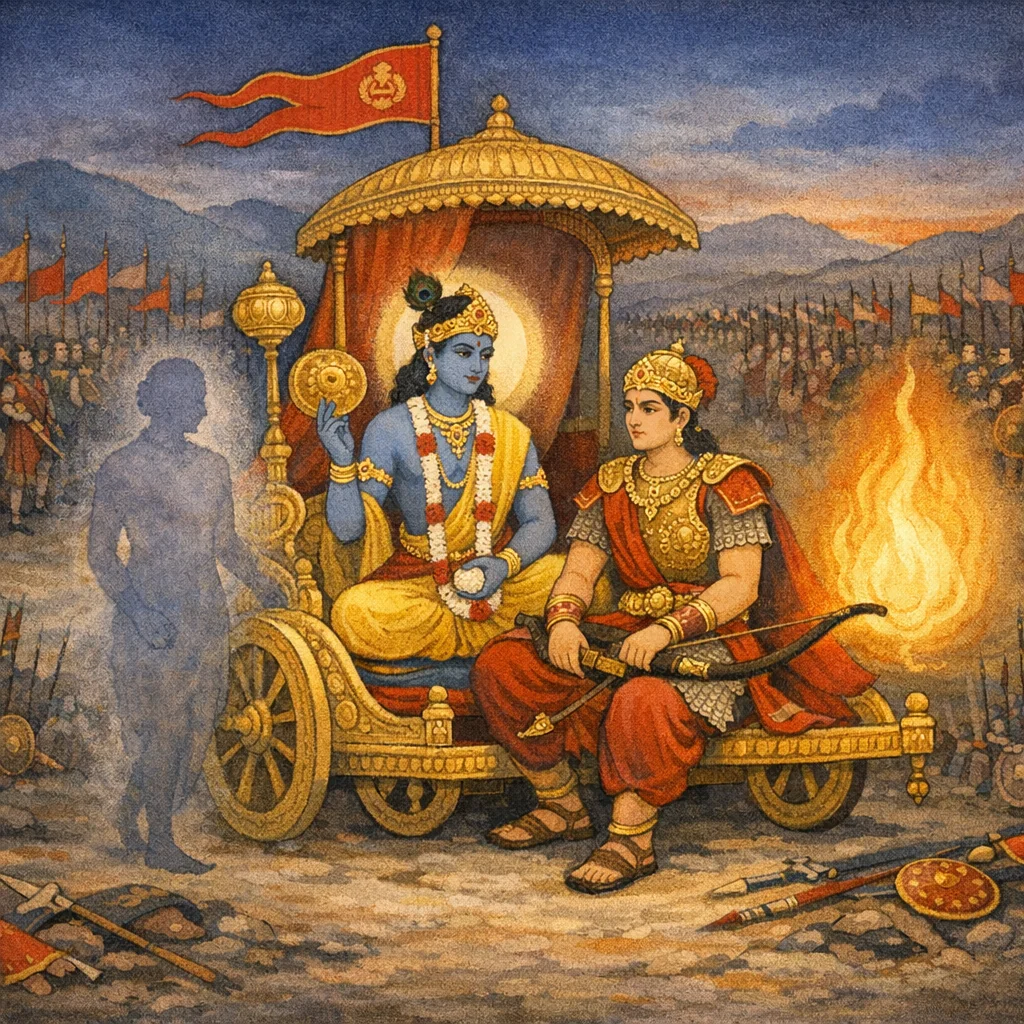
These bodies are said to have an end, belonging to the eternal embodied (Self), which is indestructible and immeasurable. Therefore, fight, O descendant of Bharata.
These bodies are declared finite, belonging to the eternal embodied one—indestructible and immeasurable; therefore, engage in your duty, O Bhārata.
‘Yudhyasva’ in context refers to Arjuna’s warrior-duty in an epic setting; a non-graphic rendering such as ‘engage in your duty/strive’ preserves the ethical injunction without sensationalizing conflict.
FAQs
Separating self-worth from bodily vulnerability can reduce panic and support steadier action under pressure.
The verse contrasts finite embodiment with an enduring, non-measurable self, implying that ultimate identity is not exhausted by physical form.
Krishna uses the self/body distinction to address Arjuna’s paralysis, urging him to perform his socially defined responsibility.
It can be read as guidance to act responsibly while recognizing that many external conditions (including the body) are transient.