
Bhagavad Gita — Raja Vidya Raja Guhya Yoga, Shloka 14
Raja Vidya Raja Guhya Yoga
सततं कीर्तयन्तो मां यतन्तश्च दृढव्रताः । नमस्यन्तश्च मां भक्त्या नित्ययुक्ता उपासते ॥ ९.१४ ॥
satataṃ kīrtayanto māṃ yatantaś ca dṛḍha-vratāḥ | namasyantaś ca māṃ bhaktyā nitya-yuktā upāsate || 9.14 ||

ఎల్లప్పుడూ నా కీర్తిని గానము చేస్తూ, దృఢవ్రతాలతో ప్రయత్నిస్తూ, భక్తితో నాకు నమస్కరిస్తూ—నిత్యం నాతో యుక్తులై—నన్ను ఉపాసిస్తారు.
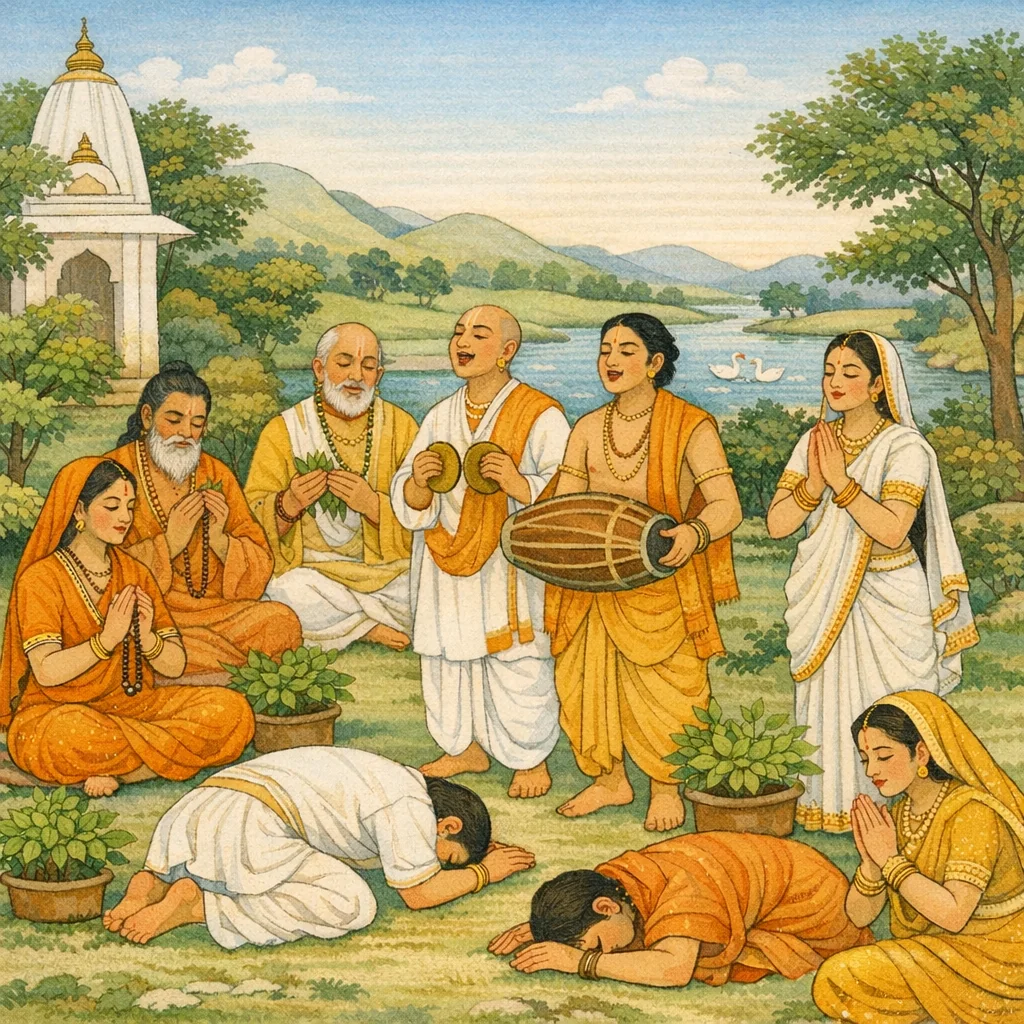
Always glorifying Me, striving with firm vows, and bowing to Me with devotion, ever steadfast, they worship Me.
Continually praising Me, striving, firm in their resolve, and paying homage to Me with devotion, always disciplined, they worship (Me).
The verse lists a triad of devotional disciplines: praise/recitation (kīrtana), effort (yatna), and reverent submission (namas). Translations differ mainly in whether “dṛḍha-vrata” is rendered as ‘vow’ or ‘resolve’.
FAQs
Repeated remembrance and praise can function as attentional training, reinforcing motivation and reducing inner conflict through stable routines.
The verse emphasizes relational participation in the divine (upāsanā) rather than abstract speculation alone.
It elaborates what ‘exclusive devotion’ looks like in lived practice: speech (praise), effort (discipline), and embodied reverence.
One may adapt it as a framework for consistent practice: reflective reading/chanting, ethical effort, and humility toward one’s guiding ideals.