
Shloka 9
Purushottama Yoga — Purushottama Yoga
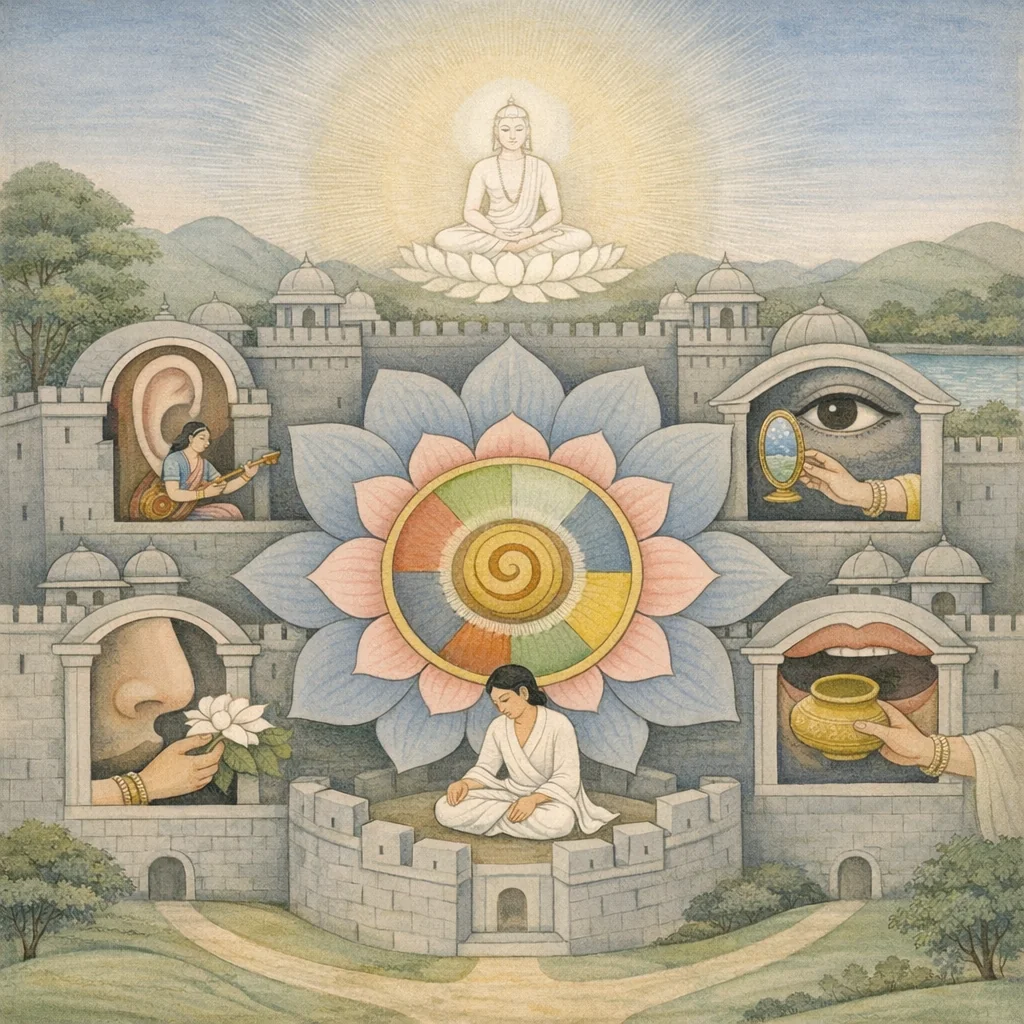
श्रोत्रं चक्षुः स्पर्शनं च रसनं घ्राणमेव च । अधिष्ठाय मनश्चायं विषयानुपसेवते ॥ १५.९ ॥
śrotraṁ cakṣuḥ sparśanaṁ ca rasanaṁ ghrāṇam eva ca | adhiṣṭhāya manaś cāyaṁ viṣayān upasevate || 15.9 ||

శ్రోత్రం, చక్షువు, స్పర్శ, రసన, ఘ్రాణం అనే ఇంద్రియాలను, అలాగే మనస్సును ఆధారంగా చేసుకొని, ఈ (జీవుడు) విషయాలను అనుభవిస్తుంది.
श्रवण, देखने, स्पर्श, स्वाद और सूँघने की इन्द्रियों तथा मन का आश्रय लेकर यह (जीव) विषयों का सेवन करता है।
Taking support of the ear, the eye, touch, taste, and smell—and also presiding over the mind—this (embodied self) engages with sense-objects.
Both renderings present the jīva/embodied self as engaging with objects through the five sense faculties and mind. The Gita Press-style translation often frames this as ‘enjoyment/consumption’ (सेवन), while a more literal academic rendering emphasizes ‘engagement/association’ (upasevate) without necessarily implying moral judgment. No major variant affecting meaning is typically noted for this verse in standard critical presentations.
FAQs
The verse outlines a classical Indian model of experience: sensory input (hearing, sight, touch, taste, smell) is coordinated by the mind, enabling attention and engagement with objects. Psychologically, it can be read as a description of how cognition and desire are shaped by sensory channels and mental processing rather than arising independently of them.
In the chapter’s broader framework, the ‘embodied self’ (jīva) is portrayed as operating through a psychophysical apparatus. The verse suggests that worldly experience is mediated: the self, when associated with body and mind, ‘inhabits’ the senses and thereby relates to sense-objects—supporting the text’s distinction between the changing field of experience and the enduring principle discussed in the chapter.
Chapter 15 discusses the relation between the perishable world, the imperishable principle, and the ‘supreme person’ (puruṣottama). Nearby verses describe how the jīva takes up a body and carries mental dispositions; 15.9 continues this by explaining the concrete mode of engagement—through the senses and mind—by which embodied life encounters and responds to the world.
The verse can inform practices of attention and self-regulation: noticing how perceptions and impulses arise through specific senses and are organized by the mind can support mindful consumption of media, food, and sensory stimulation. It also encourages reflective distance—recognizing that many reactions are conditioned by sensory contact and mental focus.