
Shloka 18
Purushottama Yoga — Purushottama Yoga
यस्मात्क्षरमतीतोऽहमक्षरादपि चोत्तमः ।
अतोऽस्मि लोके वेदे च प्रथितः पुरुषोत्तमः ॥ १५.१८ ॥
yasmāt kṣaram atīto 'ham akṣarād api cottamaḥ |
ato 'smi loke vede ca prathitaḥ puruṣottamaḥ || 15.18 ||

నేను క్షరాన్ని అతిక్రమించినవాడను; అక్షరానికన్నా కూడా ఉత్తముడను. అందువల్ల లోకంలోనూ వేదంలోనూ నేను ‘పురుషోత్తముడు’ అని ప్రసిద్ధుడను.
क्योंकि मैं क्षर से परे हूँ और अक्षर से भी उत्तम हूँ, इसलिए लोक में और वेद में मैं पुरुषोत्तम नाम से प्रसिद्ध हूँ।
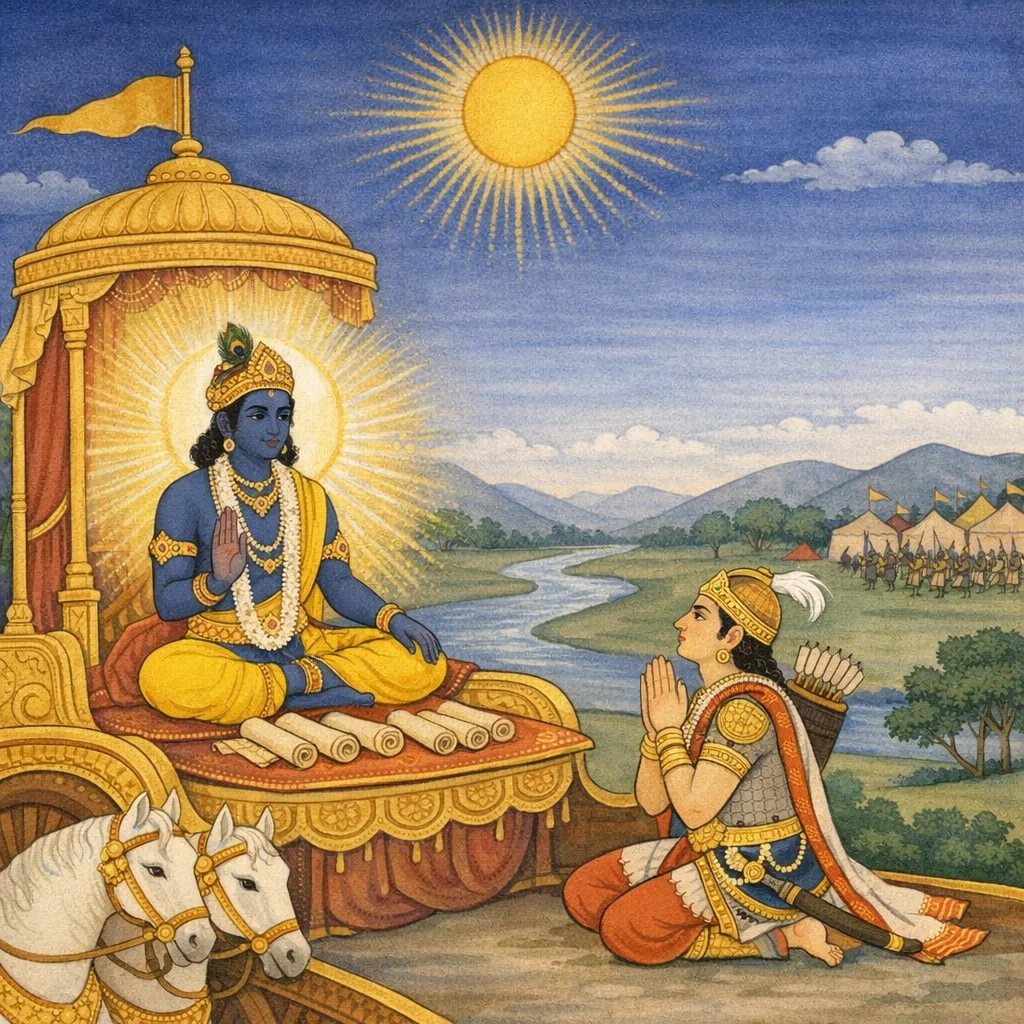
Because I transcend the perishable and am higher even than the imperishable, therefore in the world and in the Veda I am renowned as Puruṣottama.
The verse is programmatic for naming: ‘Puruṣottama’ is justified by surpassing both kṣara and akṣara categories. Commentarial traditions debate whether this indicates a personal theism, a highest Brahman, or a synthesis (personal absolute).
FAQs
It offers a cognitive anchor: rather than oscillating between attachment to change and retreat into detachment, it points to a ‘higher’ standpoint integrating both.
The supreme is defined as exceeding both the changing domain and the imperishable principle, establishing a highest ontological category identified with Krishna.
This is the chapter’s explicit definition of ‘Puruṣottama,’ linking the metaphysical hierarchy to scriptural and cultural recognition.
For readers, it can function as a framework for ultimate concern: clarifying what one treats as highest value beyond both transient success and mere withdrawal.