
Bhagavad Gita — Raja Vidya Raja Guhya Yoga, Shloka 34
Raja Vidya Raja Guhya Yoga
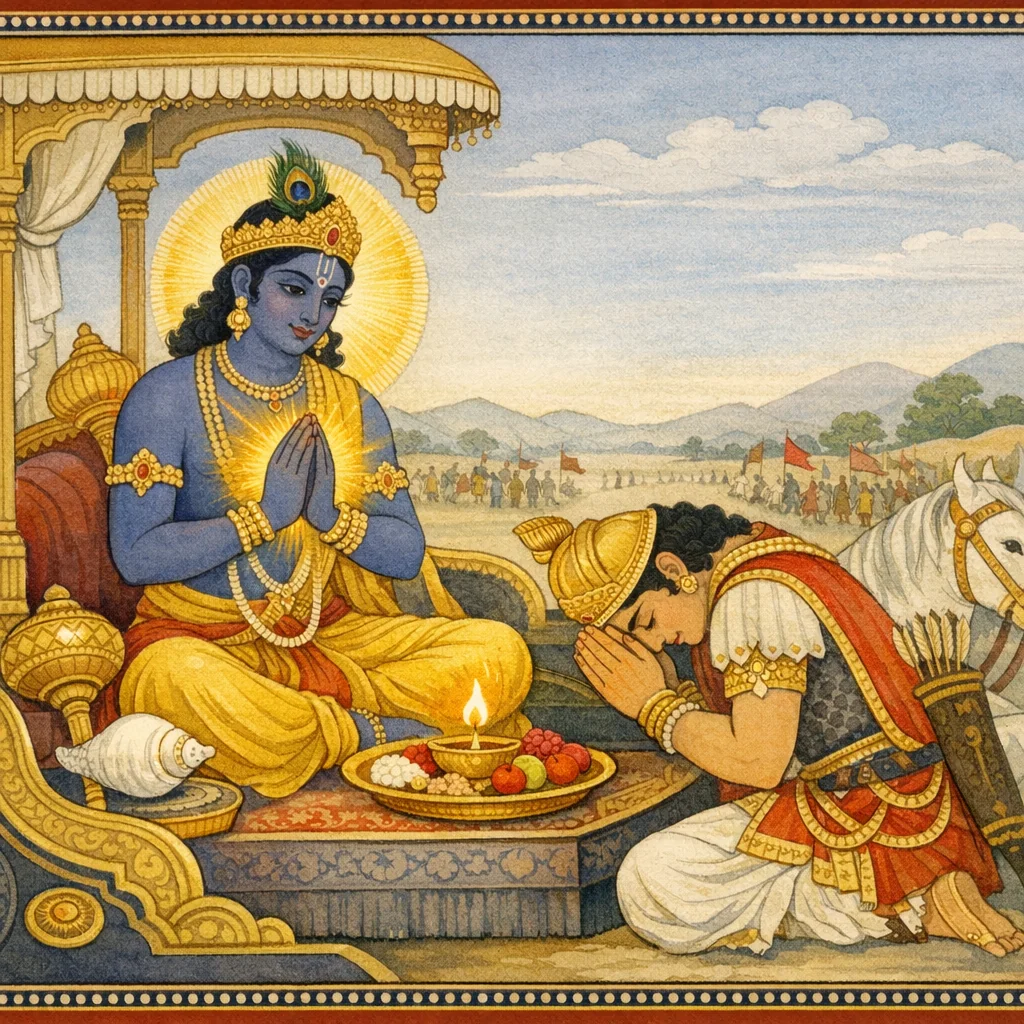
मन्मना भव मद्भक्तो मद्याजी मां नमस्कुरु । मामेवैष्यसि युक्त्वैवमात्मानं मत्परायणः ॥ ९.३४ ॥
man-manā bhava mad-bhakto mad-yājī māṁ namaskuru | mām evaiṣyasi yuktvaivam ātmānaṁ mat-parāyaṇaḥ || 9.34 ||

என் மீது மனத்தை நிலைநிறுத்து; என் பக்தனாகு; என்னை வழிபடு; எனக்கு வணங்கு. இவ்வாறு என்னோடு யோகமாக இணைந்து, என்னையே பரம இலக்கும் சரணமுமாகக் கொண்டு, நீ நிச்சயமாக என்னையே அடைவாய்.
Fix your mind on Me, be devoted to Me, worship Me, bow to Me; thus uniting yourself with Me and taking Me as the supreme goal, you shall come to Me alone.
Let your mind be on Me; become My devotee; be one who offers worship to Me; pay reverence to Me. Thus, having disciplined yourself in this way and making Me your highest end, you will come to Me.
Translations vary in how they render ‘mad-yājī’ (one who performs worship/sacrificial honoring for Me) and ‘yuktvā ātmanam’ (having yoked/disciplined the self). The verse functions as a compact practical program of bhakti: cognition (mind), affect/commitment (devotion), ritual/act (worship), and embodied humility (reverence).
FAQs
It outlines attentional training: sustained focus (‘mind on Me’) combined with habitual actions (worship, reverence) can stabilize motivation and reduce inner fragmentation.
The promise ‘you will come to Me’ expresses the text’s theistic soteriology: aligning mind and practice with the supreme reality culminates in proximity/union, understood variously across traditions (nearness, participation, or identity in devotion).
As the closing verse of Chapter 9, it serves as a summative injunction, condensing earlier teachings about devotion, grace, and accessibility into a directive formula.
It can be applied as a structured contemplative routine: daily remembrance, ethical devotion expressed as service, intentional rituals (broadly construed), and humility in interpersonal conduct.