
Shloka 8
Purushottama Yoga — Purushottama Yoga
शरीरं यदवाप्नोति यच्चाप्युत्क्रामतीश्वरः । गृहित्वैतानि संयाति वायुर्गन्धानिवाशयात् ॥ १५.८ ॥
śarīraṁ yad avāpnoti yac cāpy utkrāmatīśvaraḥ | gṛhītvaitāni saṁyāti vāyur gandhān ivāśayāt || 15.8 ||

இந்த ஈஸ்வரரூப ஜீவன் உடலை அடையும் போதும், உடலிலிருந்து புறப்படும் போதும், மனம் முதலிய இவற்றை எடுத்துக்கொண்டு செல்கிறது; வாசஸ்தலத்திலிருந்து மணத்தை காற்று எடுத்துச் செல்லும் போல.
जब यह जीवात्मा (ईश्वर) शरीर को प्राप्त होता है और जब शरीर से निकलता है, तब यह मन आदि इन्द्रियों को साथ लेकर जाता है, जैसे वायु आशय (फूल आदि के स्थान) से गन्ध को लेकर चली जाती है।
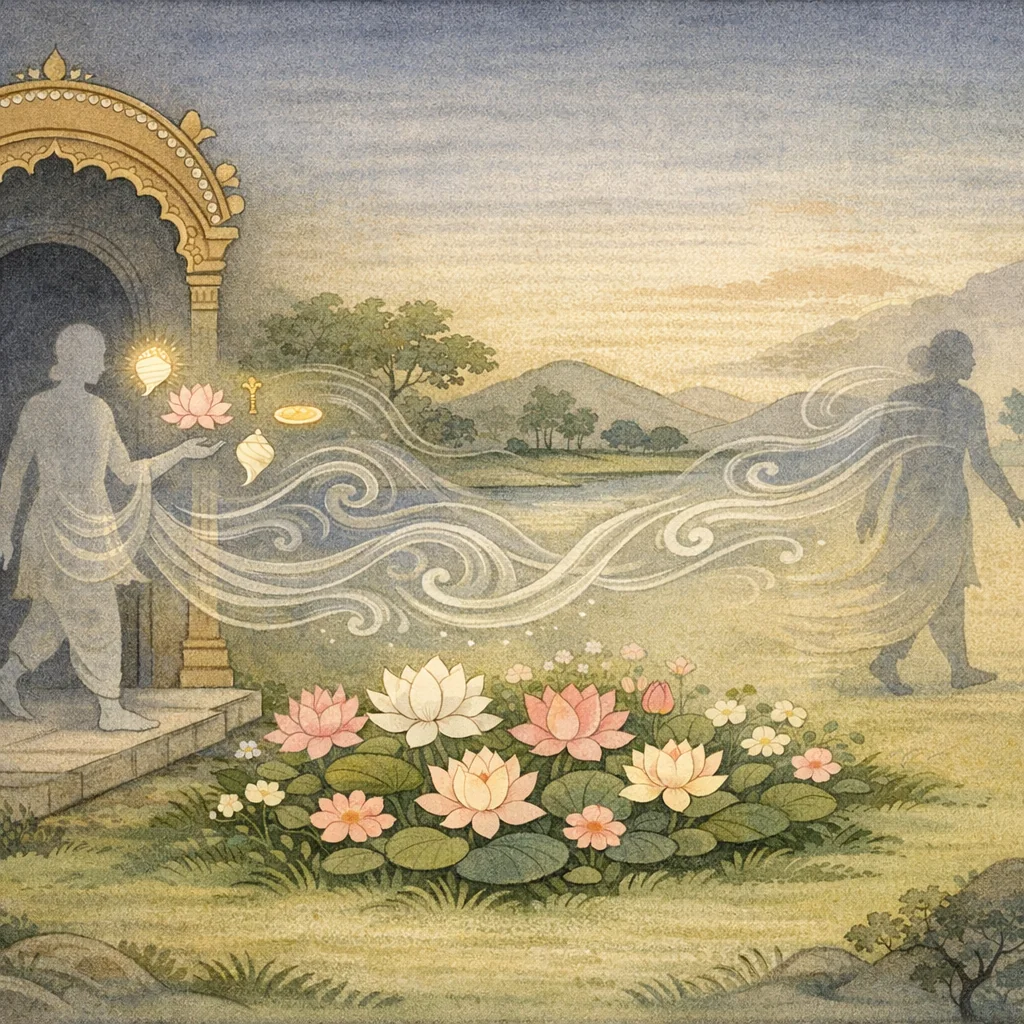
When the lordly self (īśvara, i.e., the embodied self) obtains a body, and also when it departs (from a body), it goes taking these (faculties) with it—just as wind carries fragrances from their source.
Most recensions read essentially the same. Interpretive differences center on (a) identifying īśvara here: many Vedāntic commentators take it as the jīva/embodied self under the Lord’s governance, while some devotional readings emphasize the Supreme’s supervision; (b) what “these” (etāni) refers to—commonly the mind and senses (made explicit in the next verse, 15.9). The simile of wind/fragrance is stable across traditional commentaries, used to explain continuity of subtle faculties across embodiment.
FAQs
The verse can be read as a model of how dispositions and cognitive habits persist through major life-transitions: the ‘wind carrying fragrance’ metaphor suggests that mental tendencies (memory, attention, desire) accompany the person, shaping experience even as external circumstances change.
In classical Indian metaphysics, it describes the jīva departing and entering bodies while carrying the subtle instruments—mind and sense-capacities—rather than the gross body. The simile explains continuity: just as scent is not the flower itself yet is carried from it, subtle faculties are not the physical body yet are associated with it and can continue onward.
Chapter 15 discusses the embodied being’s relation to the world-process and the ‘supreme person’ (puruṣottama). This verse supports the chapter’s account of embodiment by explaining how the individual self is linked to sensory and mental functions across birth and death, preparing for the subsequent verse’s explicit mention of ear, eye, etc. (15.9).
As a non-sectarian takeaway, it invites reflection on what we ‘carry’ through change—habits, values, and attention patterns—and encourages cultivating beneficial mental qualities, since these shape one’s ongoing life trajectory even when roles, environments, or circumstances shift.