
Bhagavad Gita — Karma Sannyasa Yoga, Shloka 9
Karma Sannyasa Yoga
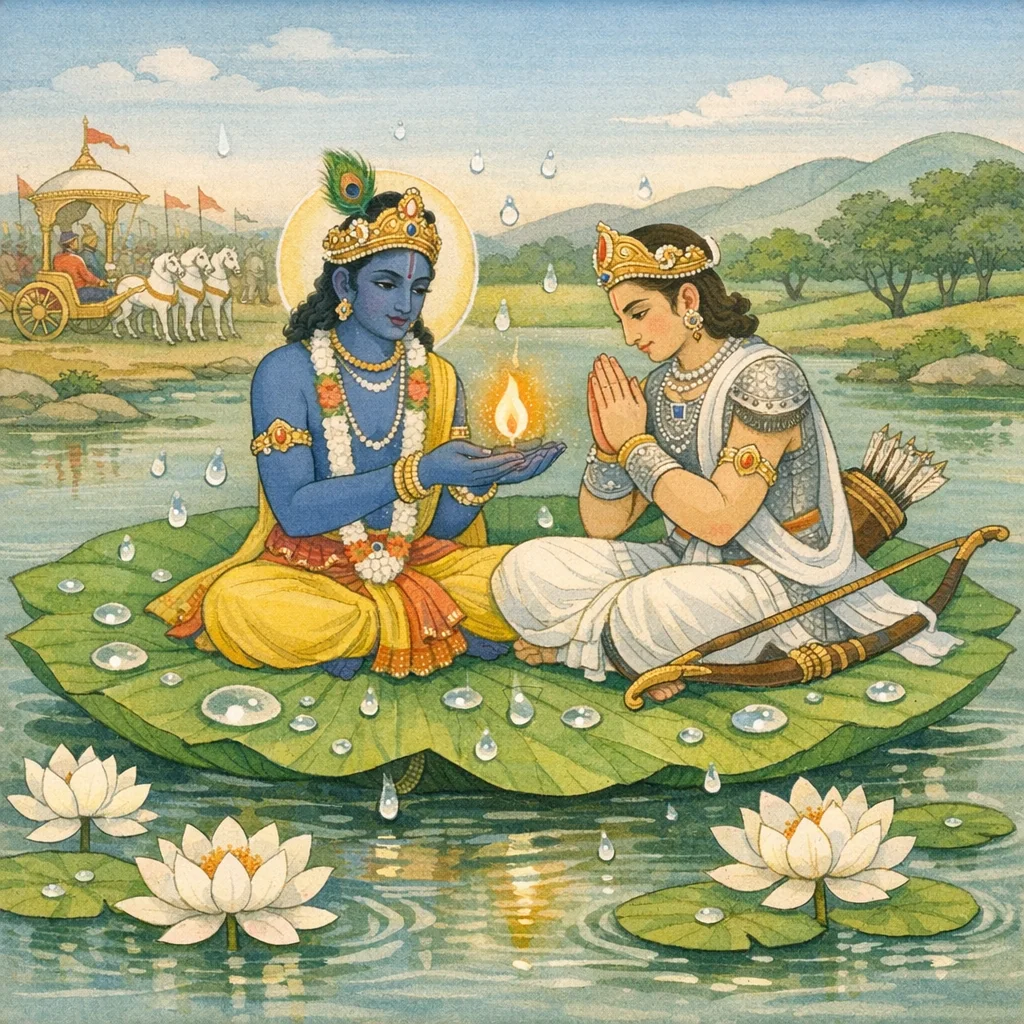
ब्रह्मण्याधाय कर्माणि सङ्गं त्यक्त्वा करोति यः । लिप्यते न स पापेन पद्मपत्रमिवाम्भसा ॥ ५.१० ॥
brahmaṇy ādhāya karmāṇi saṅgaṃ tyaktvā karoti yaḥ | lipyate na sa pāpena padmapatram ivāmbhasā || 5.10 ||

எவன் செயல்களைப் பிரம்மனில் அர்ப்பணித்து, பற்றுதலைத் துறந்து செய்கிறானோ, அவன் பாவத்தால் மாசுபடான்; நீரால் தாமரை இலை நனைவதில்லாததுபோல்.
जो पुरुष सब कर्मों को ब्रह्म में अर्पण करके और आसक्ति को त्यागकर कर्म करता है, वह पाप से वैसे ही लिप्त नहीं होता जैसे कमल का पत्ता जल से नहीं भीगता।
Whoever performs actions by placing them in Brahman (as an offering/ground) and abandoning attachment is not tainted by wrongdoing, like a lotus leaf by water.
“Brahmaṇi ādhāya” is variously glossed as (a) offering actions to Brahman/Īśvara (devotional-ethical emphasis) or (b) situating action in the knowledge of Brahman as the ultimate reality (nondual emphasis). The lotus-leaf simile supports the shared point: contact with action does not entail moral/psychic ‘sticking’ when attachment is absent.
FAQs
The lotus-leaf metaphor can be read as emotional non-stickiness: one engages fully in tasks yet avoids rumination, resentment, or self-congratulation that typically ‘clings’ to outcomes.
The verse suggests that when action is grounded in the ultimate (Brahman) and not in egoic appropriation, it does not generate binding residues (often framed as karmic or moral-psychic impressions).
It advances Chapter 5’s reconciliation: renunciation is redefined as renouncing attachment rather than renouncing action, allowing participation in worldly duties without inner bondage.
Before acting, set an intention of service or principle (“do the work well; release the credit”). After acting, review for learning rather than self-blame or self-praise.