
Bhagavad Gita — Moksha Sannyasa Yoga, Shloka 38
Moksha Sannyasa Yoga
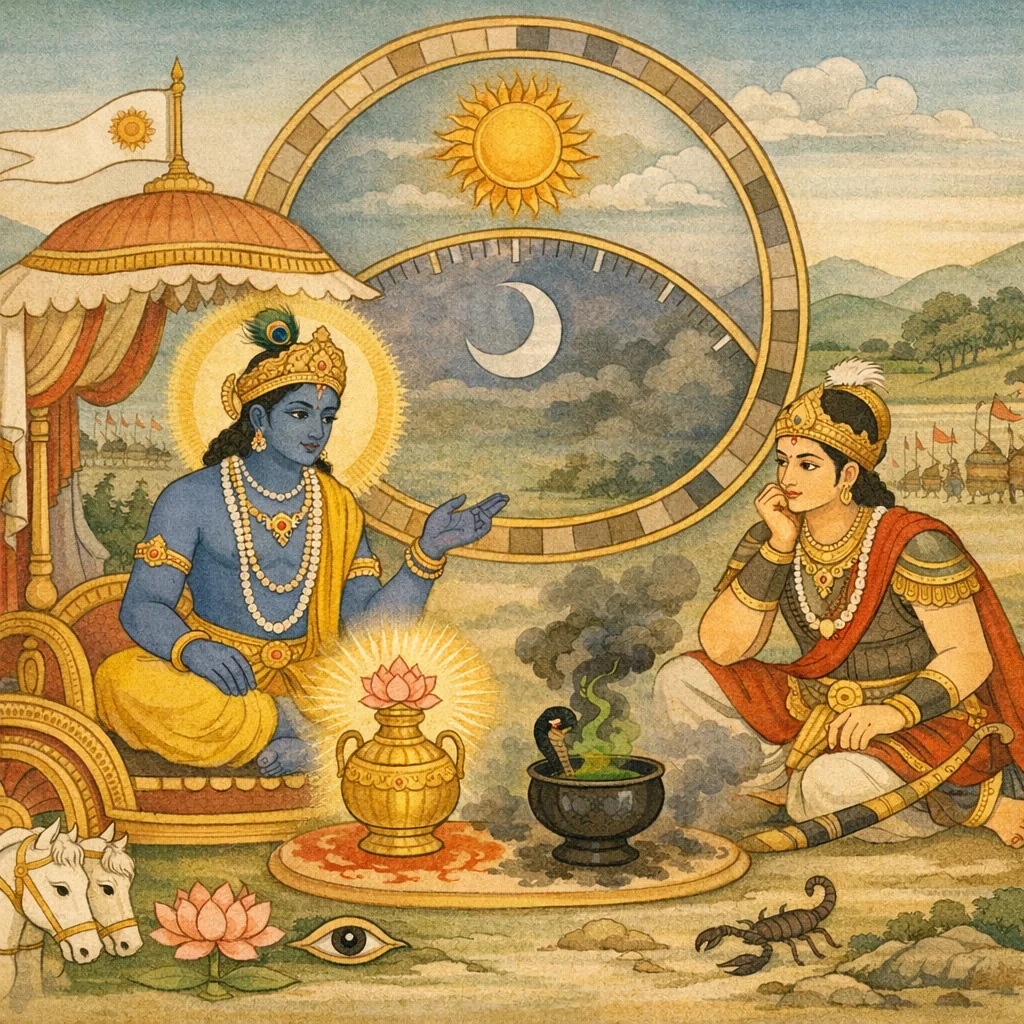
विषयेन्द्रियसंयोगाद्यत्तदग्रेऽमृतोपमम् । परिणामे विषमिव तत्सुखं राजसं स्मृतम् ॥ १८.३८ ॥
viṣayendriya-saṃyogād yat tad agre ’mṛtopamam | pariṇāme viṣam iva tat sukhaṃ rājasaṃ smṛtam || 18.38 ||

विषयेन्द्रियसंयोगाद्यत्तदग्रेऽमृतोपमम् । परिणामे विषमिव तत्सुखं राजसं स्मृतम् ॥
जो विषयों और इन्द्रियों के संयोग से उत्पन्न सुख आरम्भ में अमृत के समान प्रतीत होता है, परन्तु परिणाम में विष के समान होता है, वह राजस सुख कहा गया है।
That pleasure which arises from the conjunction of sense-organs with their objects—appearing at first like nectar but in its outcome like poison—is remembered as rājasa (passion-born) pleasure.
No major doctrinal divergence: both readings emphasize the temporal arc of sense-based enjoyment (initial attraction vs. later dissatisfaction). Minor translation choices include whether 'appears like nectar' is taken phenomenologically (seems) or evaluatively (is like).
FAQs
The verse describes a common cognitive pattern: immediate gratification feels rewarding initially, but later yields restlessness, dependency, or regret—marking it as rājasa due to its agitation-producing quality.
Pleasure tied to sense-contact is conditioned (prakṛti-based) and impermanent; it cannot provide stable well-being. The guṇa-analysis frames it as a mode of nature rather than the Self’s intrinsic bliss.
In Chapter 18’s taxonomy of guṇas, Krishna classifies happiness by its source and effect, preparing for guidance on right action aligned with one’s disposition.
It can be read as advice to evaluate choices by long-term outcomes (habits, health, attention) rather than initial allure, especially regarding consumption and stimulation.