
Shloka 42
Karma Yoga — Karma Yoga
इन्द्रियाणि पराण्याहुरिन्द्रियेभ्यः परं मनः । मनसस्तु परा बुद्धिर्यो बुद्धेः परतस्तु सः ॥ ३.४२ ॥
indriyāṇi parāṇy āhur indriyebhyaḥ paraṁ manaḥ | manasas tu parā buddhir yo buddheḥ paratas tu saḥ || 3.42 ||

इन्द्रियाणि पराण्याहुरिन्द्रियेभ्यः परं मनः । मनसस्तु परा बुद्धिर्यो बुद्धेः परतस्तु सः ॥
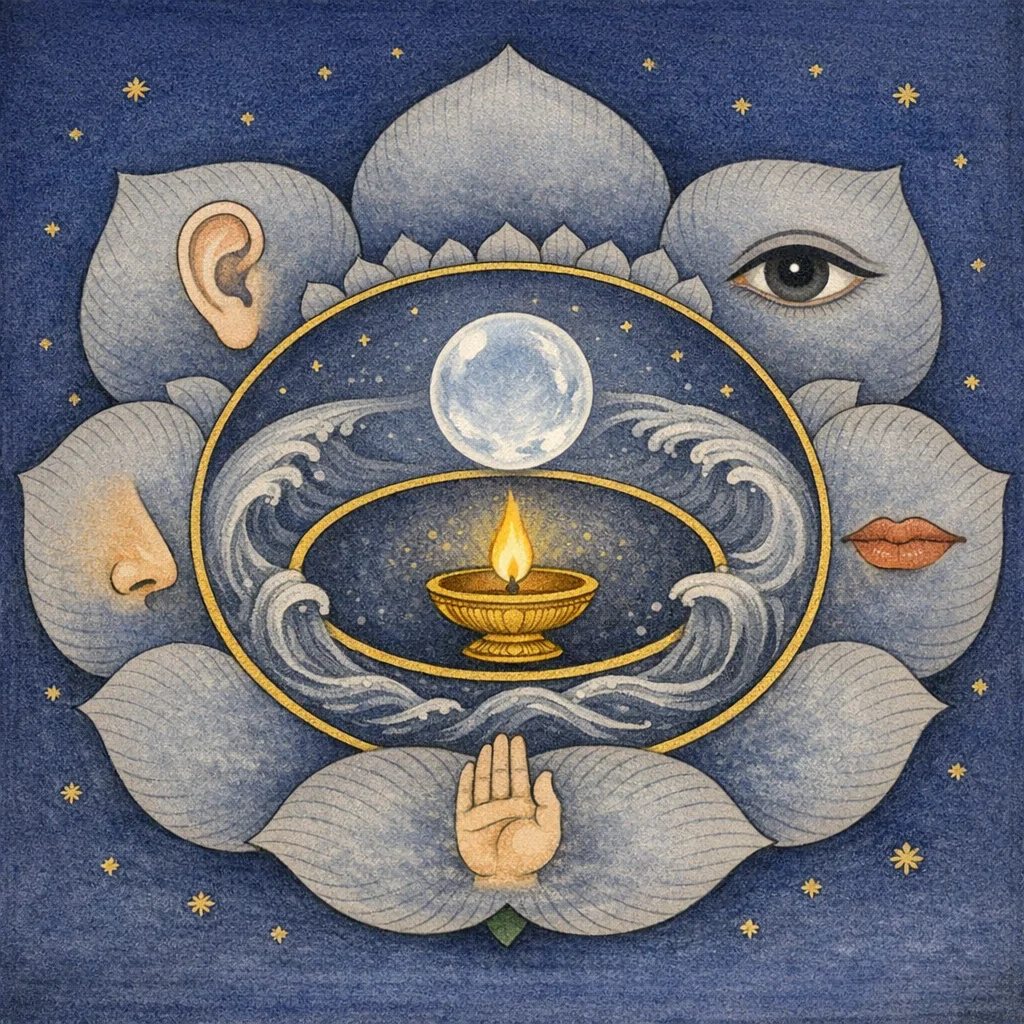
They say the senses are superior; superior to the senses is the mind; superior to the mind is the intellect; but superior to the intellect is That (the Self).
The senses are said to be higher (than the body); higher than the senses is mind; higher than mind is intellect; and higher than intellect is that (Self/person).
Most versions agree on a hierarchy of faculties culminating in the Self. Some commentators specify the implied lower term (body) for ‘senses are higher’; academic notes often treat this as a schematic psychology rather than a strict ontology.
FAQs
It presents a layered model of control: impulses at the senses can be regulated by attention (mind), guided by evaluation (intellect), and stabilized by deeper self-awareness.
The Self (puruṣa/ātman) is positioned as distinct from and superior to mental faculties, supporting a dual-aspect view common in Gītā’s synthesis.
It supports the practical strategy for overcoming desire by indicating where governance should be exercised—from higher faculties over lower ones.
Use top-down regulation: clarify principles (intellect), train attention (mindfulness), and reduce exposure to triggers (senses).