
Shloka 14
Karma Yoga — Karma Yoga
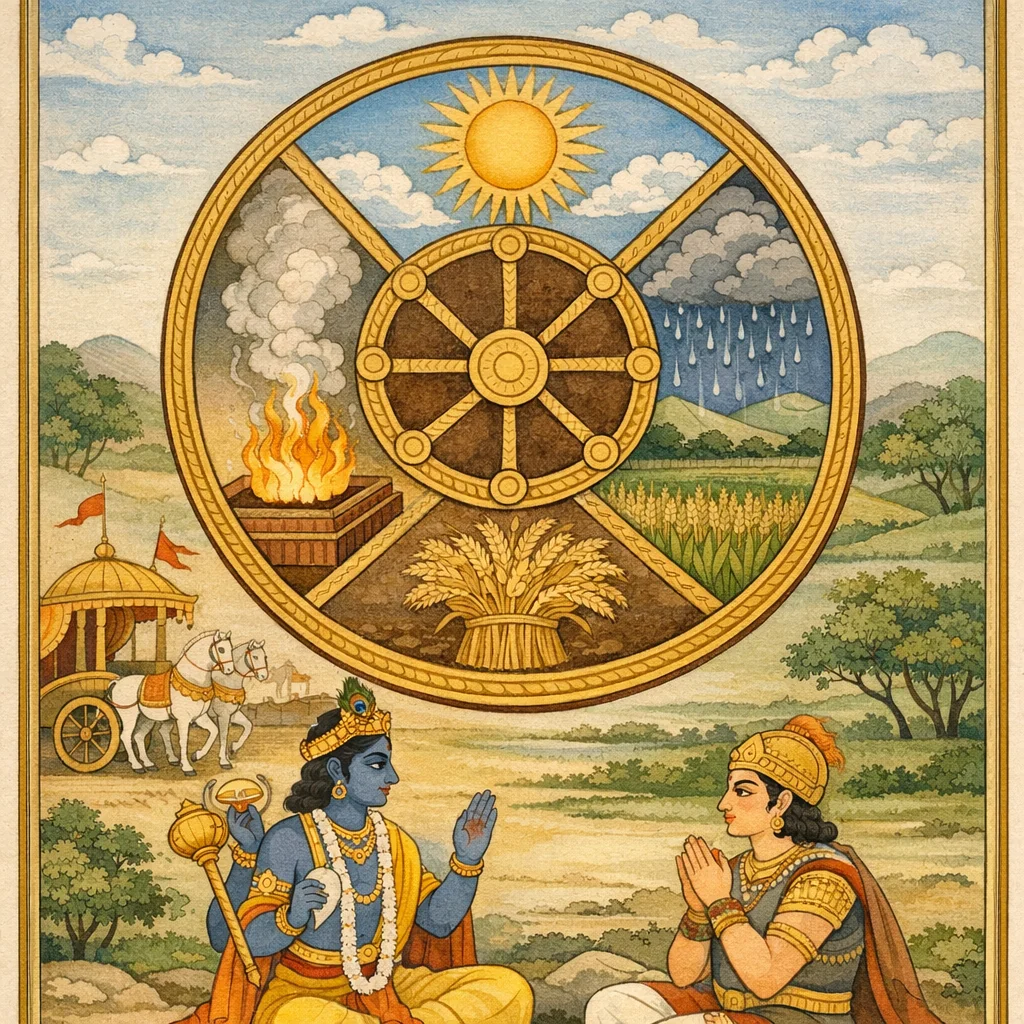
अन्नाद्भवन्ति भूतानि पर्जन्यादन्नसम्भवः । यज्ञाद्भवति पर्जन्यो यज्ञः कर्मसमुद्भवः ॥ ३.१४ ॥
annād bhavanti bhūtāni parjanyād anna-sambhavaḥ | yajñād bhavati parjanyo yajñaḥ karma-samudbhavaḥ || 3.14 ||

अन्नात् भवन्ति भूतानि, पर्जन्यात् अन्नसम्भवः; यज्ञात् भवति पर्जन्यः, यज्ञः कर्मसमुद्भवः।
From food beings arise; from rain food is produced; from sacrifice rain arises; and sacrifice is born of action.
Creatures come to be from food; food arises from rain; rain comes from yajña; and yajña arises from (prescribed) action.
Traditional readings take a cosmological-ritual causality (yajña → rain). Academic interpretations often treat this as a normative ‘world-maintaining cycle’: human participation through duty/ritual supports ecological and social order. The term yajña can be broadened to ‘offering’ or ‘cooperative obligation’ beyond strictly Vedic rites.
FAQs
It encourages an ‘interdependence mindset’: personal well-being is embedded in systems (food, climate, community), countering the illusion of isolated self-sufficiency.
The verse presents a structured chain linking human action to cosmic functioning, expressing a worldview where ethical-ritual order and natural order are mutually sustaining.
Krishna is grounding karma-yoga in a broader vision: action is not merely personal but contributes to sustaining the shared world (loka-saṅgraha).
It can be read as a template for ecological and civic responsibility: responsible work and sharing practices help sustain the conditions (resources, stability) that sustain life.