
Shloka 43
Dhyana Yoga — Atma Samyama Yoga
तत्र तं बुद्धिसंयोगं लभते पौर्वदेहिकम् । यतते च ततो भूयः संसिद्धौ कुरुनन्दन ॥ ६.४३ ॥
tatra taṁ buddhisaṁyogaṁ labhate paurvadehikam | yatate ca tato bhūyaḥ saṁsiddhau kurunandana || 6.43 ||

तत्र तं बुद्धिसंयोगं लभते पौर्वदेहिकम् । यतते च ततो भूयः संसिद्धौ कुरुनन्दन ॥
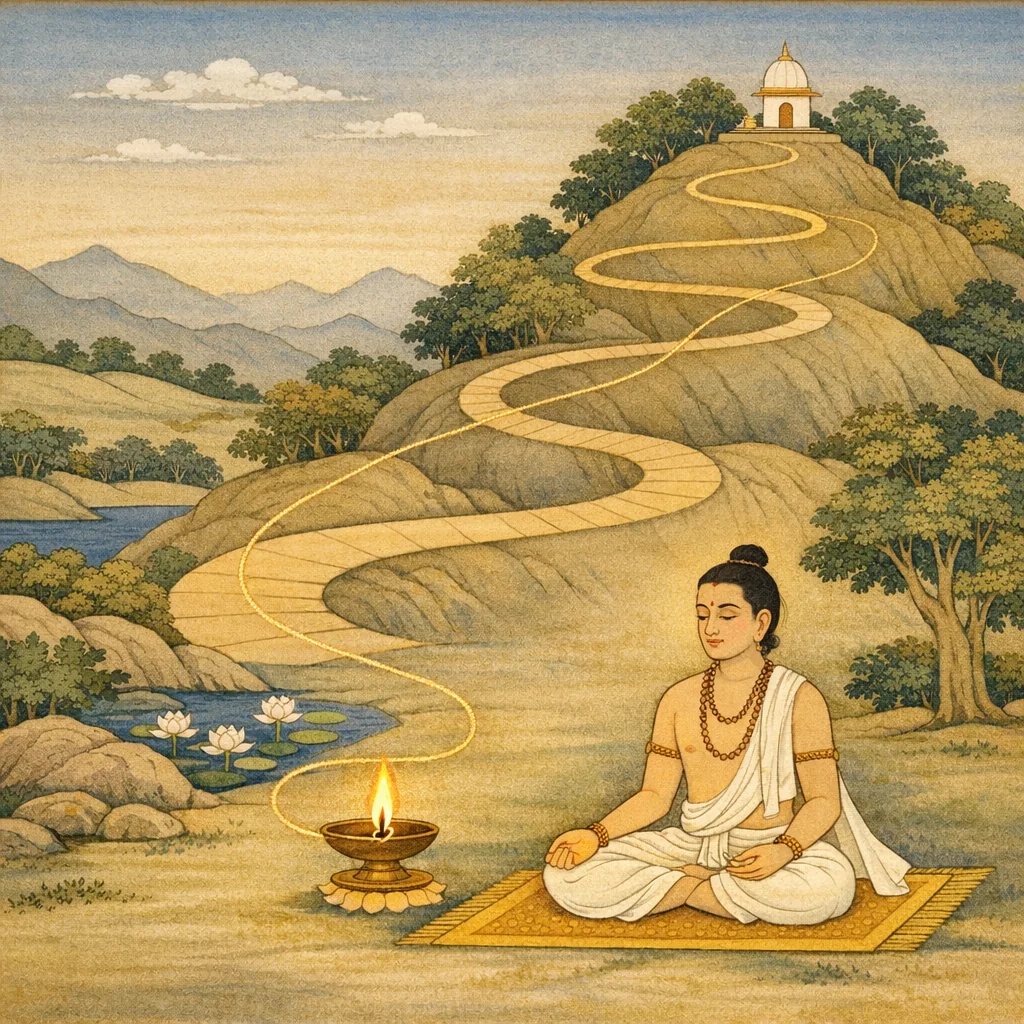
“There he regains the connection with that understanding from the former body, and then strives again for perfection, O joy of the Kurus.”
“There he obtains that linkage with insight belonging to the previous embodiment, and from that point he strives further toward full accomplishment.”
‘buddhi-saṁyoga’ is variously taken as ‘union with discriminative understanding,’ ‘yogic orientation of mind,’ or ‘connection to prior discipline’; the verse supports a continuity-of-dispositions reading.
FAQs
It resembles a theory of habit and skill retention: prior training leaves traces that re-emerge, making re-learning faster and more intuitive.
It presupposes continuity of dispositions beyond a single lifetime, consistent with broader Indian theories of karma and rebirth.
Kṛṣṇa explains how the yoga-bhraṣṭa resumes the path rather than starting from zero.
Even without rebirth assumptions, it supports the idea that early ethical or contemplative training can have long-term effects that return after lapses.