
Shloka 13
Dhyana Yoga — Atma Samyama Yoga
समं कायशिरोग्रीवं धारयन्नचलं स्थिरः । सम्प्रेक्ष्य नासिकाग्रं स्वं दिशश्चानवलोकयन् ॥ ६.१३ ॥
samaṃ kāya-śiro-grīvaṃ dhārayann acalaṃ sthiraḥ | samprekṣya nāsikāgraṃ svaṃ diśaś cānavalokayan || 6.13 ||

समं कायशिरोग्रीवं धारयन्नचलं स्थिरः । सम्प्रेक्ष्य नासिकाग्रं स्वं दिशश्चानवलोकयन् ॥ ६.१३ ॥
शरीर, सिर और ग्रीवा को समान और अचल धारण करके स्थिर होकर, अपनी नासिका के अग्रभाग को देखकर और दिशाओं को न देखते हुए।
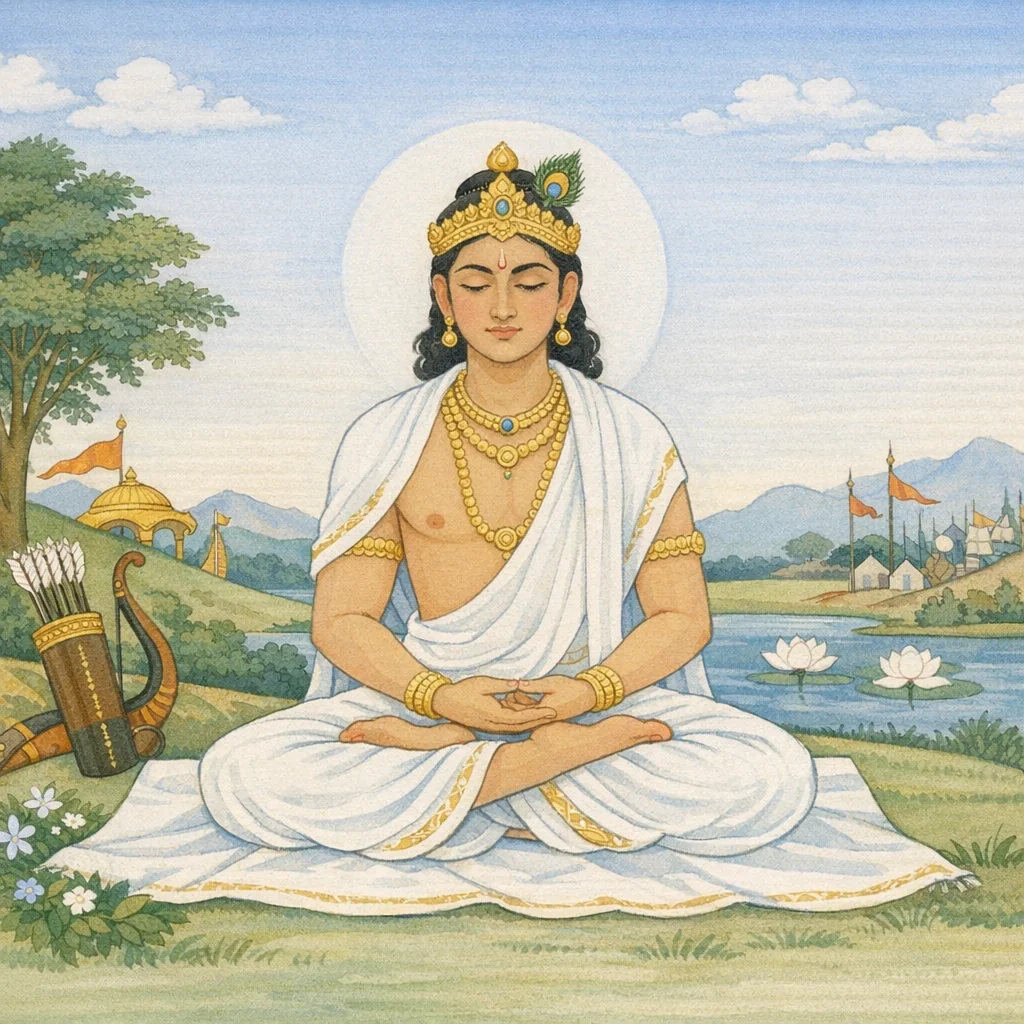
Holding the body, head, and neck aligned and motionless, steady; gazing at the tip of one’s nose and not looking around in directions.
Traditional yoga exegesis sometimes treats ‘nose-tip gaze’ as a specific technique (dṛṣṭi). Academic readings note it as a practical aid to prevent distraction; it need not imply a universal physiological claim.
FAQs
Postural stability and a fixed gaze reduce orienting reflexes and scanning behaviors, which can otherwise reinforce restlessness and distractibility.
The body is treated as an instrument: when steadied, it ceases to pull awareness outward, enabling inward attention conducive to self-knowledge.
The verse continues the chapter’s step-by-step meditation instructions, moving from environment and intention to precise bodily and attentional cues.
Maintain an upright, relaxed posture; choose a soft gaze or closed eyes if safer/more comfortable, keeping the underlying principle—reduced distraction—intact.