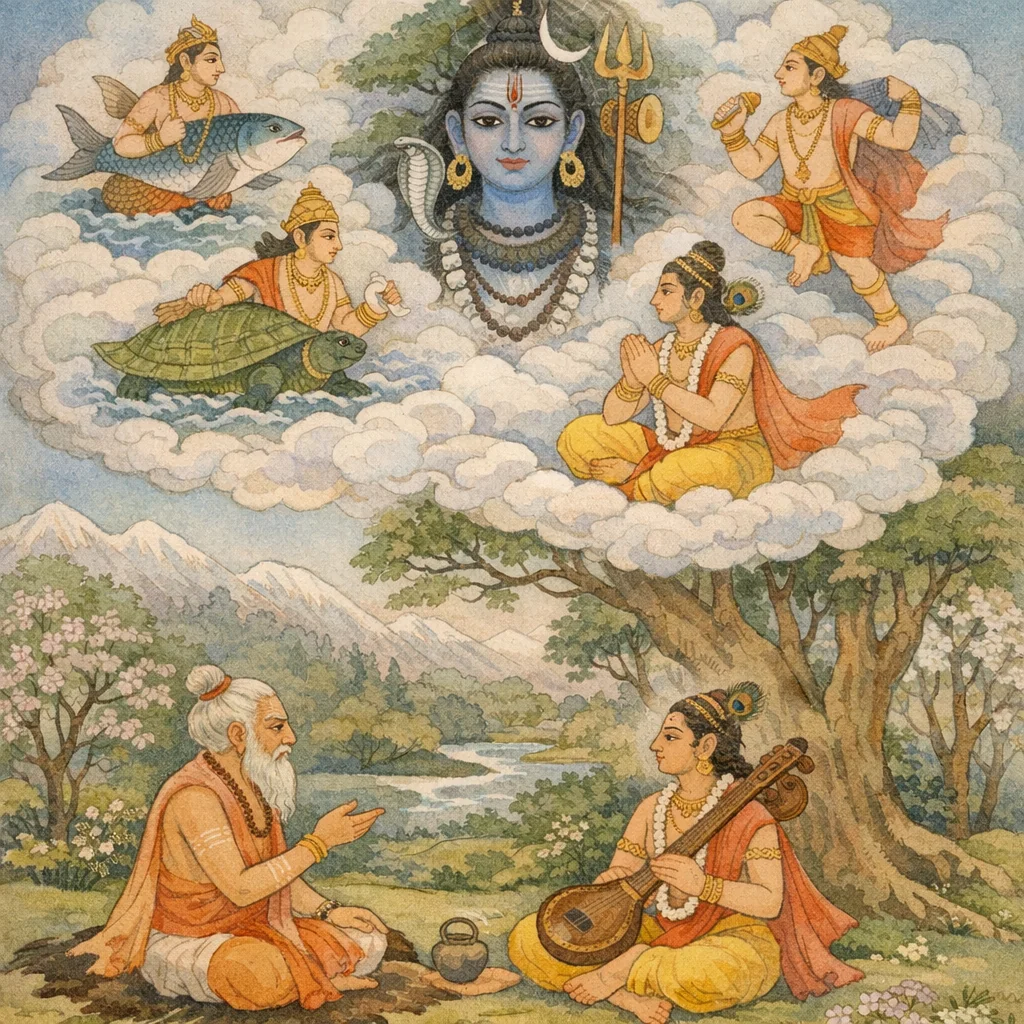
Adhyaya 61: The Second Sin-Destroying Hymn (Pāpaśamana Stava) and Syncretic Praise of Hari-Hara
द्वितीय-पापशमन-स्तवः (Dvitīya-Pāpaśamana-Stavaḥ)
Syncretic Praise of Hari-Hara
Adhyāya 61 of the Vāmana Purāṇa is framed as Pulastya’s instruction to Nārada, introducing a “second” pāpaśamana-stava whose correct study (samyag-adhyayana) is said to annihilate sin. The chapter is predominantly a litany of salutations that moves fluidly across Vaiṣṇava and Śaiva iconographic registers—Matsya, Kūrma, Hayagrīva, Trivikrama, Nārāyaṇa and Garuḍāsana appear alongside Śiva epithets such as Śrīkaṇṭha/Nīlakaṇṭha, Kapardin, Trinayana, Kālāgni, and Rudradeveśa, culminating in nirguṇa descriptors (nirākāra, nirañjana) that universalize the praised deity beyond sectarian form. This syncretic theology functions as a ritual technology of purification: recitation, remembrance, and hearing are explicitly valorized as salvific acts. Unlike the Purāṇa’s tirtha-oriented chapters, this unit is minimally topographical, emphasizing instead a pan-theistic, Harihara-compatible devotional grammar that integrates multiple divine forms into a single purificatory praise-cycle.
Divine Beings
Mortal & Asura Figures
Key Content Points
- Pulastya-to-Nārada transmission: the sage presents a second “sin-destroying hymn,” asserting that proper study and recitation lead to pāpa-nāśa.
- Iconographic catalog as syncretic theology: a continuous sequence of namas-kāras spans Vaiṣṇava avatāras (Matsya, Kūrma, Trivikrama, Hayagrīva) and Śaiva forms/epithets (Trinayana, Kapardin, Kālāgni, Rudradeveśa), implying Hari-Hara concord.
- Soteriology of sound and memory: the closing verse elevates saṃkīrtana (chanting), smaraṇa (remembering), and śravaṇa (hearing) as purificatory practices with ‘bahu-pāpa-nāśana’ efficacy.
Shlokas in Adhyaya 61
Verse 1
इति श्रीवामनपुराणे षष्ठितमो ऽध्यायः पुलस्त्य उवाच द्वितीयं पापशमनं स्तवं वक्ष्यामि ते मुने येन सम्यगधीतेन पापं नाशं तु गच्चति
Thus, in the Śrī Vāmana Purāṇa (ends) the sixtieth chapter. Pulastya said: ‘O sage, I shall tell you the second hymn that pacifies sin; when it is properly studied/recited, sin indeed goes to destruction.’
Verse 2
मत्स्यं नमस्ये देवेशं कूर्मं गोविन्दमेव च हयशीर्षं नमस्ते ऽहं भवं विष्णुं त्रिविक्रमम्
["mādhava", "īśāna", "hṛṣīkeśa", "kumārin", "nārāyaṇa", "garuḍāsana", "stuti adhyaya 61"]
Verse 4
ऊर्ध्वकेशं नृसिहं च रुपधारं कुरुध्वजम् कामपालमखण्डं च नमस्ये ब्राह्मणप्रियम्
I bow to the Upright-haired One, and to Narasiṃha; to the Form-bearer, to Him whose banner is the boar; to the guardian of desire, to the Indivisible One; I bow to Him who is dear to the brāhmaṇas.
Verse 7
नमस्ये च गदापाणिं नमस्ये च कुशोशयम् अर्धनारीश्वरं देवं नमस्ये पापनाशनम्
I bow to the mace-handed one; I bow to him who lies upon kuśa-grass; I bow to the god Ardhanārīśvara; I bow to the destroyer of sin.
Verse 8
गोपालं च सैवकुण्ठं नमस्ये चापराजितम् नमस्ये विश्वरूपं च सौगन्धिं सर्वदाशिवम्
I bow to Gopāla; I bow to Saiva-kuṇṭha; and I bow to the Unconquered (Aparājita). I bow to Viśvarūpa; to Saugandhi; and to Sarvadāśiva.
Verse 63
पाञ्चालिकं हयग्रीवं स्वयम्भुवममरेश्वरम् नमस्ये पुष्कराक्षं च पयोगन्धिं च केशवम्
avimuktaṃ ca lolaṃ ca jyeṣṭheyaṃ madhyamaṃ tathā upaśāntaṃ tamasye 'haṃ mārkaṇḍeyaṃ sajambukam
Verse "
नमस्ये पद्मकिरणं नमस्ये वडवामुखम् कार्त्तिकेयं नमस्ये ऽहं बाह्लीकं शिखिनं तथा
I bow to Sthāṇu, the sinless one; I bow to Vanamālin. I bow to Lāṅgalīśa; and I bow to the Lord of Śrī (Lakṣmī).
Verse No rivers, lakes, forests, or tīrthas are named in this verse
59
Adhyāya 59 — Stuti identifying Viṣṇu as Yajñapuruṣa (the sacrificial principle)
Verse 19
श्रीकण्ठं वासुदेवं नीलकण्ठं सदण्डिनम् नमस्ये सर्वमनघं गौरीशं नकुलीस्वरम्
কটাহ দেশত ‘গোমিত্ৰ’—পদ্মপ্ৰিয় (পঙ্কজপ্ৰিয়); সিংহলদ্বীপত ‘উপেন্দ্ৰ’; আৰু শক্রাহ্বত ‘কুন্দমালিন’ নামে জনা যায়।
Verse 25
अगस्तयं गरुडं विष्णुं कपिलं ब्रह्मवाङ्मयम् सनातनं च ब्रह्माणं नमस्ये ब्रह्मतत्परम्
I bow to Agastya; to Garuḍa; to Viṣṇu; to Kapila—whose form is Brahman expressed as sacred speech. And I bow to the eternal Brahmā, devoted to the Supreme Brahman.
Verse 26
अप्रतर्क्यं चतुर्बाहुं सहस्रांशुं तपोमयम् नमस्ये धर्मराजानं देवं गरुडवाहनम्
I bow to the Lord of Dharma—unfathomable to reasoning, four-armed, radiant with a thousand rays, constituted of ascetic splendor—unto that divine One whose vehicle is Garuḍa.
Verse 27
सर्वबूतगतं शान्तं निर्मलं सर्वलक्षणम् महायोगिनमव्यक्तं नमस्ये पापनाशनम्
জম্বূদ্বীপত তেওঁ ‘চতুৰ্বাহু’ নামে; কুশদ্বীপত ‘কুশেশয়’ (পদ্মত শয়নকাৰী) নামে; আৰু হে মুনিশ্ৰেষ্ঠ, প্লক্ষদ্বীপত ‘গৰুড়বাহন’ নামে খ্যাত।
Frequently Asked Questions
By structuring a single continuous stava that alternates and interweaves Vaiṣṇava avatāra-names (e.g., Matsya, Kūrma, Trivikrama, Keśava) with explicitly Śaiva epithets (e.g., Trinayana, Kapardin, Rudradeveśa, Kālāgni), the chapter models a Harihara-compatible devotional practice: multiple sectarian iconographies are treated as valid manifestations within one purificatory address.
This chapter contains no explicit tīrtha catalogue or Kurukṣetra/Sarasvatī-basin topography; its sanctifying force is primarily liturgical rather than locational, grounding purification in recitation (saṃkīrtana), remembrance (smaraṇa), and hearing (śravaṇa) of the stava.
Pulastya emphasizes correct learning/study (samyag-adhyayana) of the hymn, and the concluding verse explicitly adds saṃkīrtana, smaraṇa, and śravaṇa as efficacious modes—treating the stava as a portable ritual instrument of purification independent of pilgrimage setting.