
Bhagavad Gita — Raja Vidya Raja Guhya Yoga, Shloka 9
Raja Vidya Raja Guhya Yoga
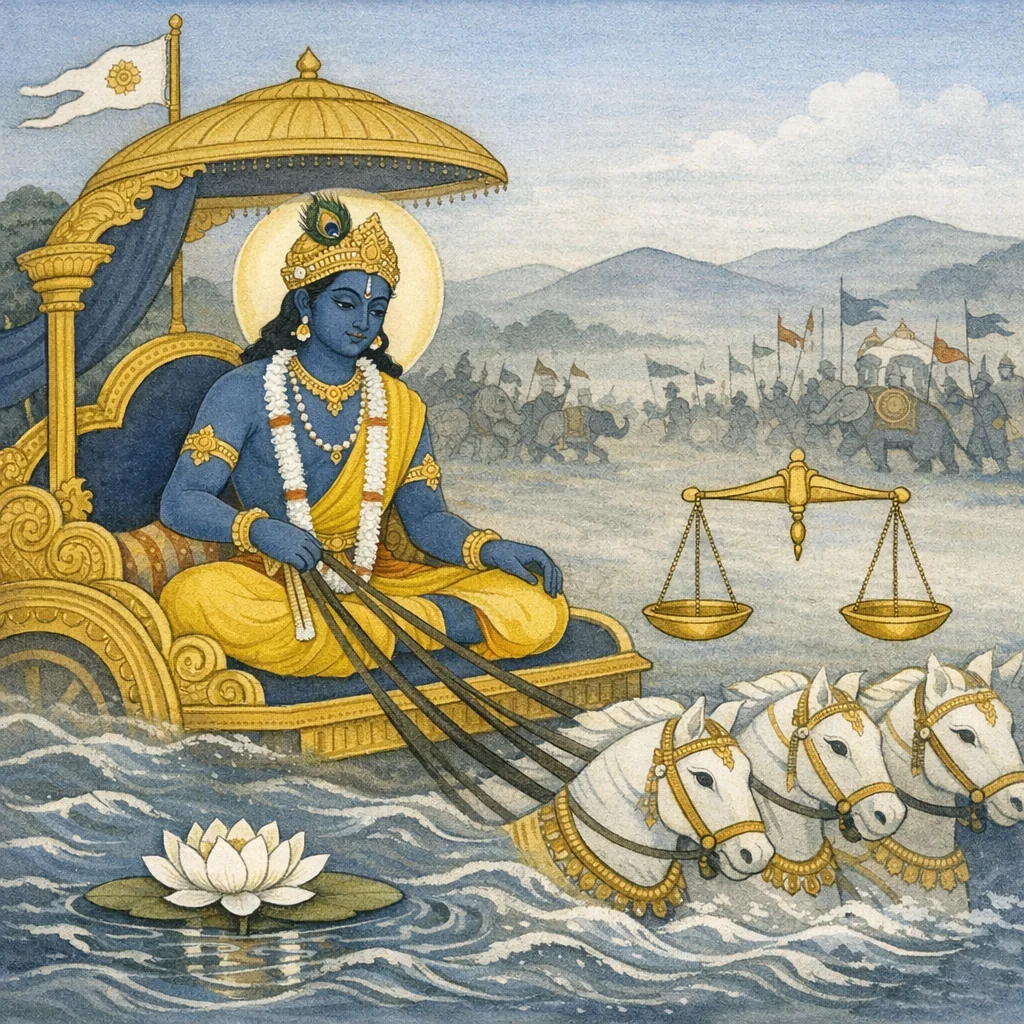
न च मां तानि कर्माणि निबध्नन्ति धनंजय । उदासीनवदासीनमसक्तं तेषु कर्मसु ॥ ९.९ ॥
na ca māṁ tāni karmāṇi nibadhnanti dhanañjaya | udāsīna-vad āsīnam asaktaṁ teṣu karmasu || 9.9 ||

О Дхананджая! Эти деяния не связывают Меня; Я пребываю в них непривязанным, как бы безучастным свидетелем.
हे धनञ्जय! वे कर्म मुझे नहीं बाँधते; मैं उन कर्मों में आसक्तिरहित और उदासीन के समान स्थित रहता हूँ।
And those actions do not bind Me, O Dhanañjaya; I remain as if indifferent, unattached to those actions.
The verse contrasts divine action with karmic bondage. In many interpretations, bondage arises from appropriation (ahaṅkāra) and attachment (saṅga), which are absent in the divine standpoint.
FAQs
It distinguishes activity from over-identification. One can act effectively while reducing self-binding narratives (guilt, pride, obsession) by cultivating non-attachment to outcomes.
The divine is portrayed as the ultimate source of cosmic processes yet not subject to karmic limitation, because karmic binding presupposes attachment and egoic appropriation.
Having described cyclic creation through prakṛti, Krishna clarifies that such ‘doing’ does not compromise divine freedom.
In professional or civic life, it can be used to articulate ‘responsible detachment’: doing one’s role conscientiously without being consumed by results.