
Shloka 17
Purushottama Yoga — Purushottama Yoga
उत्तमः पुरुषस्त्वन्यः परमात्मेत्युदाहृतः ।
यो लोकत्रयमाविश्य बिभर्त्यव्यय ईश्वरः ॥ १५.१७ ॥
uttamaḥ puruṣas tv anyaḥ paramātmety udāhṛtaḥ |
yo loka-trayam āviśya bibharty avyaya īśvaraḥ || 15.17 ||

Но есть иной, высший Пуруша, именуемый Параматманом: неистощимый Владыка, который, проникнув в три мира, поддерживает и хранит их.
परन्तु इन दोनों से अन्य उत्तम पुरुष परमात्मा कहा गया है, जो तीनों लोकों में प्रवेश करके अविनाशी ईश्वर के रूप में उनका पालन करता है।
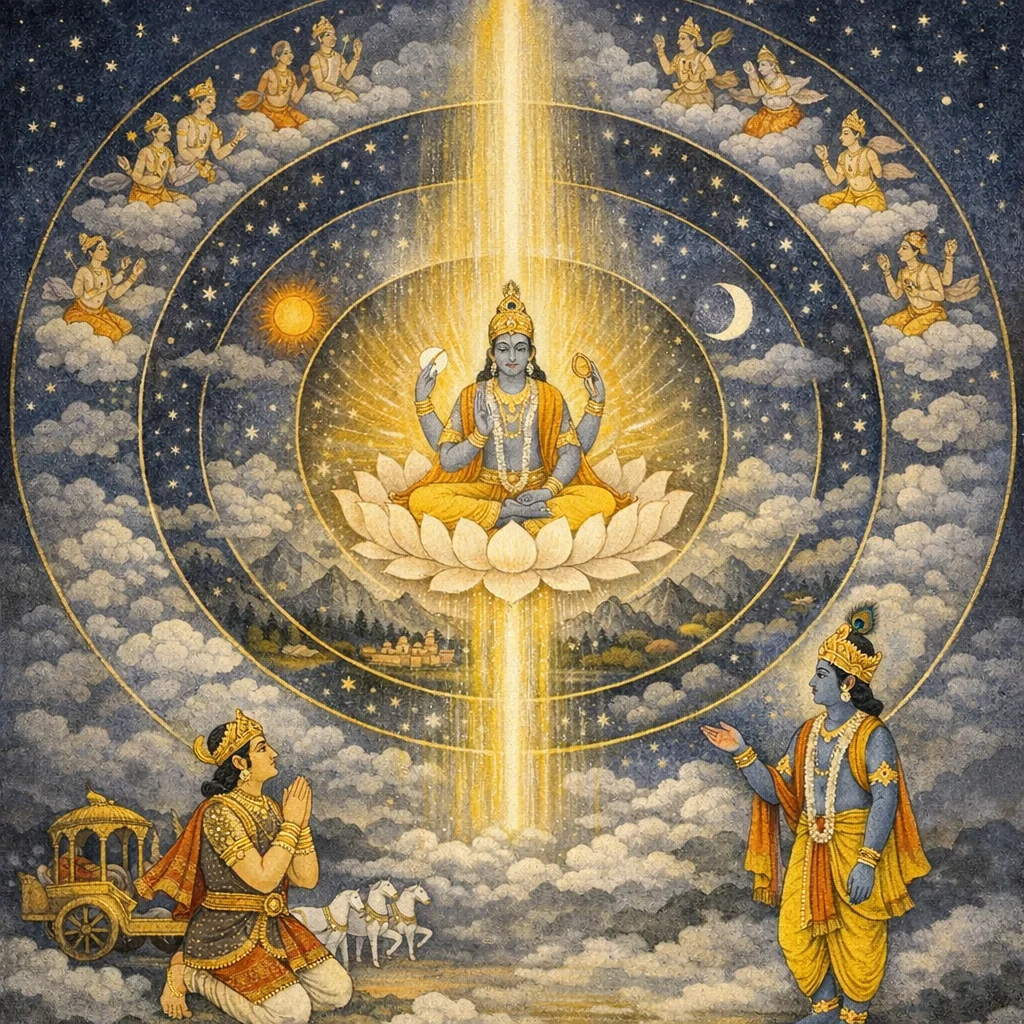
But distinct from those is the highest person, called the supreme self, who, entering the three worlds, sustains them as the imperishable lord.
The key interpretive issue is relation between ‘akṣara’ (15.16) and ‘paramātman’ here: some schools treat the imperishable as individual self and ‘paramātman’ as God; others map them to different levels of Brahman/Īśvara.
FAQs
It can be read as orienting the mind toward a highest integrative principle that ‘holds’ life together, countering fragmentation and despair.
The verse posits a supreme reality beyond both the mutable world and the merely imperishable witness, characterized as lordly sustainer present throughout the cosmos.
It completes the triadic structure introduced in 15.16 by introducing the ‘other’ highest person, central to the chapter’s title and argument.
As a worldview, it supports seeing order and meaning as grounded in a unifying principle, encouraging responsibility and steadiness in action.