
Shloka 16
Karma Yoga — Karma Yoga
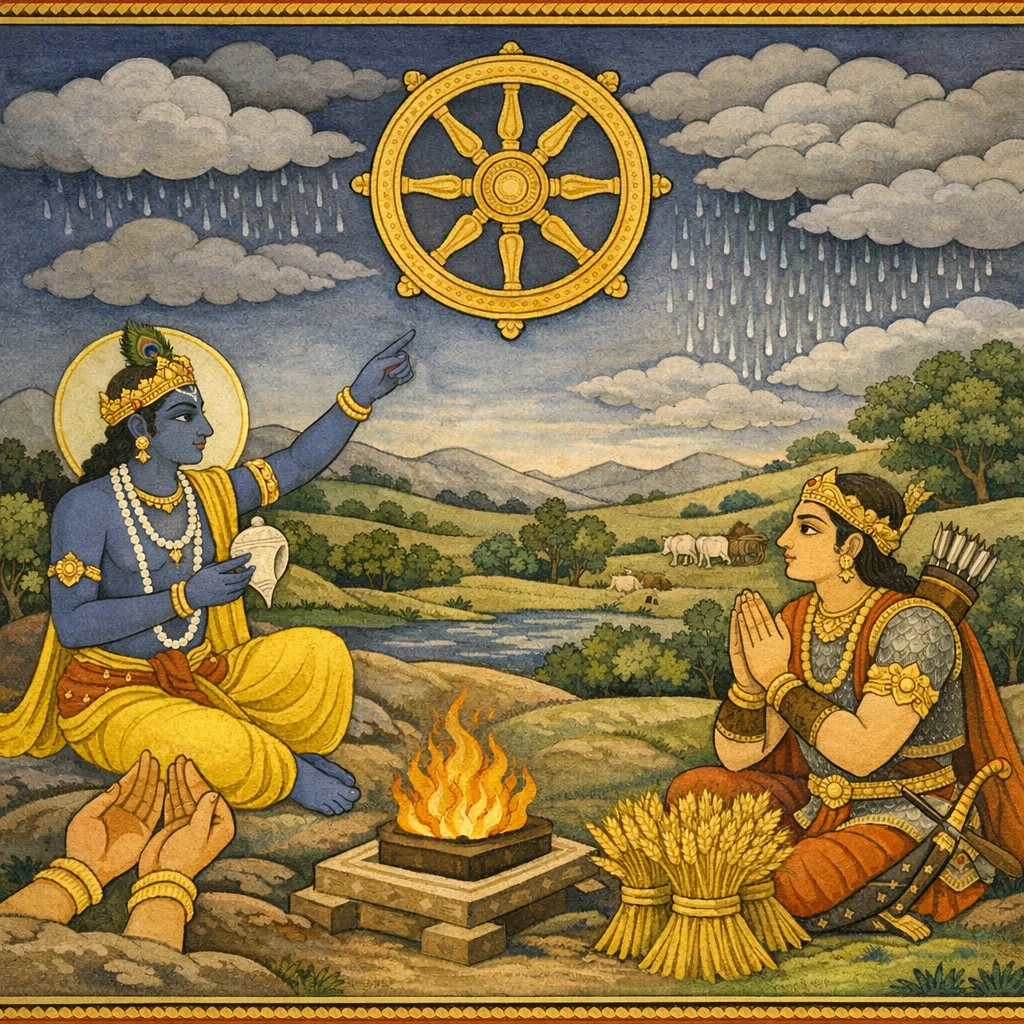
एवं प्रवर्तितं चक्रं नानुवर्तयतीह यः । अघायुरिन्द्रियारामो मोघं पार्थ स जीवति ॥ ३.१६ ॥
evaṁ pravartitaṁ cakraṁ nānuvartayatīha yaḥ | aghāyur indriyārāmo moghaṁ pārtha sa jīvati || 3.16 ||

Кто здесь не следует этому колесу, приведённому в движение, — живущий во грехе и услаждающийся чувствами, о Партха, — тот живёт напрасно.
He who does not follow here the wheel thus set in motion lives in vain, O Pārtha—living in sin and delighting in the senses.
Whoever in this world does not conform to this cycle set in motion—one whose life is directed toward wrongdoing, delighting in the senses—lives fruitlessly, O Pārtha.
Traditional translations moralize strongly (‘sinful life’). Academic readings often emphasize ‘non-participation in reciprocity’ (social/ritual/ecological duty) as ‘futility’: a life oriented only to sensory gratification fails to align with the sustaining order described in 3.14–15.
FAQs
It contrasts purposeful living with compulsive gratification: when attention is captured by sensory reward alone, life can feel ‘empty’ (mogha) despite activity.
The ‘wheel’ (cakra) symbolizes an order linking action, offering, and sustenance; ignoring it severs one from the pattern by which life is said to be supported.
This is the ethical pressure-point after describing the cycle (3.14–15): Krishna argues that opting out of duty disrupts the intended human role in that cycle.
It can be applied as a critique of purely extractive lifestyles: benefit received without contribution tends toward personal dissatisfaction and social instability.