
Bhagavad Gita — Karma Sannyasa Yoga, Shloka 26
Karma Sannyasa Yoga
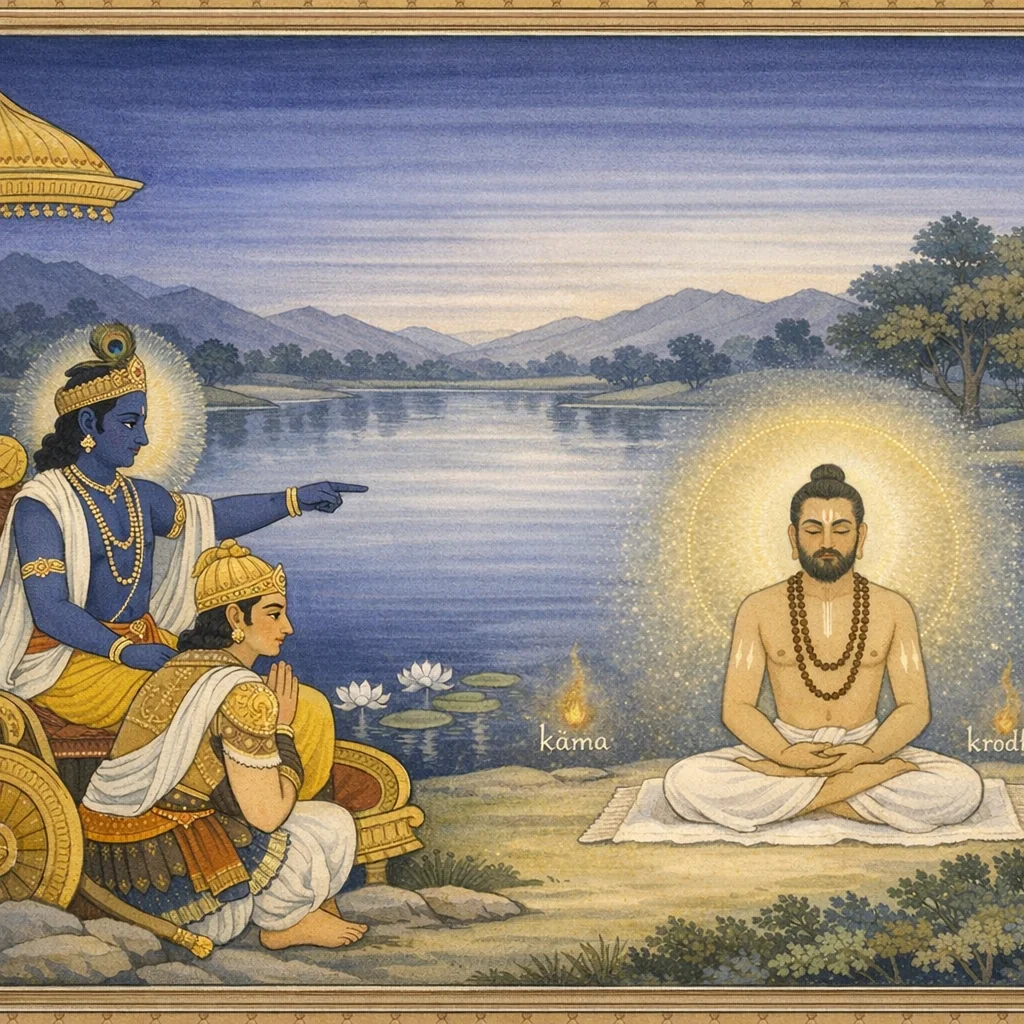
कामक्रोधवियुक्तानां यतीनां यतचेतसाम् । अभितो ब्रह्मनिर्वाणं वर्तते विदितात्मनाम् ॥ ५.२६ ॥
kāma-krodha-viyuktānāṃ yatīnāṃ yata-cetasām | abhito brahma-nirvāṇaṃ vartate viditātmanām || 5.26 ||

Для подвижников, свободных от вожделения и гнева, самообузданных, с укрощённым умом, познавших Атман, — Брахма-нирвана пребывает повсюду, всегда.
कामना और क्रोध से रहित, संयमी और मन को वश में करने वाले, आत्मतत्त्व को जानने वाले यतियों के लिए चारों ओर (सर्वदा) ब्रह्मनिर्वाण (परम शान्ति/मोक्ष) विद्यमान रहता है।
For ascetics who are free from desire and anger, whose minds are restrained, and who have known the self, the quiescence in Brahman (brahma-nirvāṇa) is present on all sides (i.e., in every respect/at all times).
Traditional renderings (e.g., Gītā Press) often gloss “abhitaḥ” as ‘always/everywhere’ and explain “brahma-nirvāṇa” as ‘supreme peace’ or ‘mokṣa’. A more literal academic translation keeps “nirvāṇa” as ‘extinguishing/quiescence’ and reads the verse as emphasizing the realized person’s pervasive access to liberation/peace. No major doctrinal divergence is required; the difference is mainly in interpretive paraphrase versus literal phrasing.
FAQs
The verse links well-being and clarity to the reduction of two destabilizing drives—craving (kāma) and anger (krodha)—and to sustained attentional regulation (yata-cetas). In psychological terms, it depicts a mind less governed by impulsive approach/avoidance reactions, enabling stable composure and reflective insight.
Metaphysically, it presents liberation (brahma-nirvāṇa) as closely tied to direct knowledge of the self (viditātman). Rather than treating liberation only as a future event, the phrasing suggests it is ‘present’ for the realized person—an experiential condition grounded in identification with Brahman/ultimate reality.
Chapter 5 discusses the relationship between renunciation (saṃnyāsa) and disciplined action (karma-yoga). This verse reinforces that inner renunciation—freedom from desire and anger, and mastery of mind—supports the state of liberation/peace, aligning with the chapter’s broader reconciliation of contemplative and practical paths.
Applied today, it can be read as recommending practices that reduce compulsive desire and anger (e.g., mindful pause, ethical reflection, contemplative routines) and cultivate steady attention. The emphasis is not withdrawal from life per se, but training the mind so that equanimity and insight become more available in daily situations.