Adhyaya 24
Arjuna’s Surrender and Kṛṣṇa’s Instruction on the Imperishable Self, Svadharma, and Karma-Yoga (Bhīṣma-parva 24.0)
Upa-parva: Bhagavad Gītā (Gītā-parvan) — Arjuna-viṣāda and Sāṅkhya–Karma-yoga Instruction (Chapter 24.0)
Sañjaya describes Arjuna overwhelmed by compassion, tears, and despondency. Kṛṣṇa rebukes the collapse as ignoble and contrary to Arjuna’s station, urging him to abandon weakness and stand. Arjuna articulates the ethical dilemma of opposing Bhīṣma and Droṇa, arguing that worldly sovereignty and even divine rulership cannot remove his grief; he confesses confusion about what is truly beneficial and requests instruction as a surrendered disciple. Kṛṣṇa then introduces a metaphysical analysis: the wise do not grieve for the living or the dead; the self persists across time and bodily changes; sensory opposites are transient and to be endured; the real is indestructible, bodies are perishable, and the self is not slain. A sequence of analogies (changing garments; weapons/fire/water/wind not harming the self) consolidates the doctrine of the imperishable. Kṛṣṇa then pivots to svadharma: for a kṣatriya, a rightful battle is a privileged duty; withdrawal yields social dishonor and moral fault. The teaching expands into karma-yoga and buddhi-yoga: act without entitlement to results, cultivate equanimity, critique reward-driven ritual speech, and define the sthitaprajña through desirelessness, emotional steadiness, sensory restraint, and inner peace culminating in brahmī-sthiti.
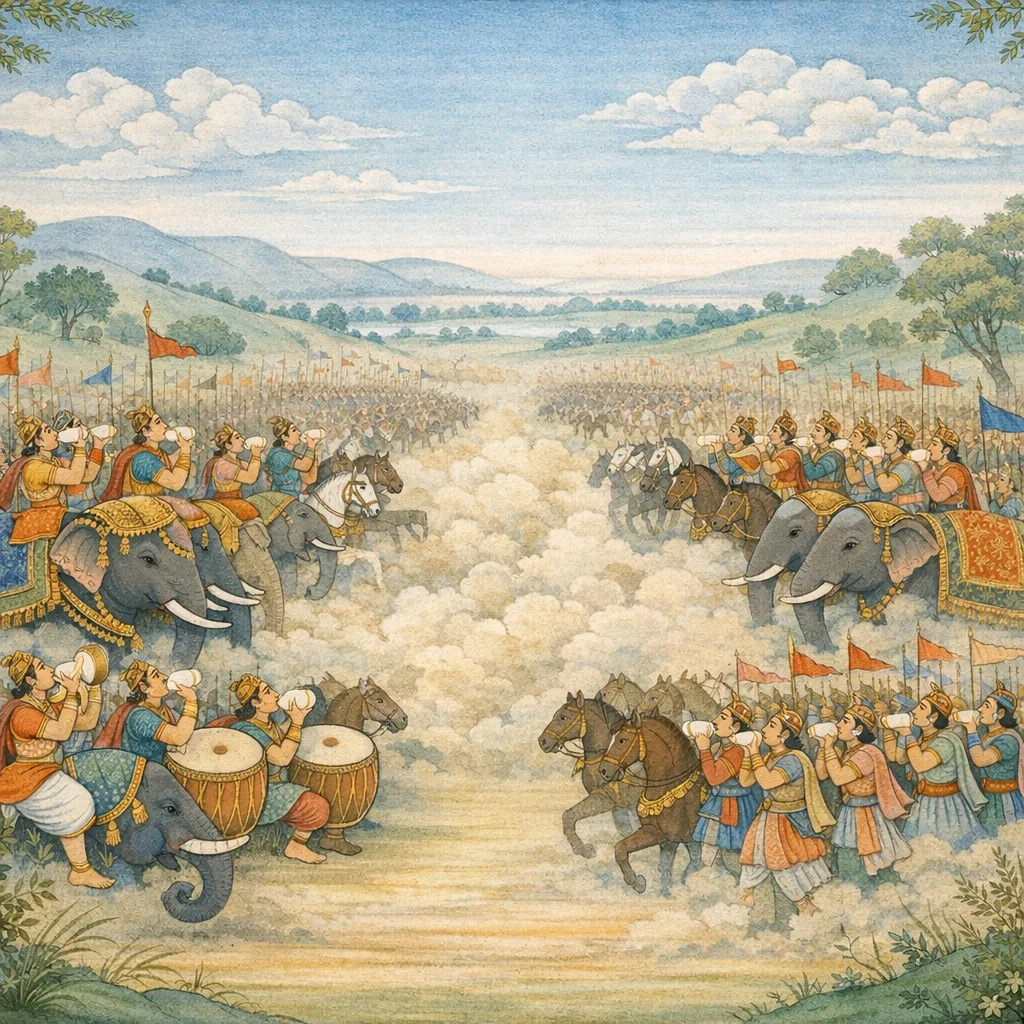
Chapter Arc: धृतराष्ट्र, भीतर से काँपते हुए, संजय से पूछते हैं—उस हृदय-कम्पनकारी संग्राम में पहले किसने प्रहार किया: मेरे पुत्रों ने या पाण्डवों ने? → वे संकेतों और शकुनों की ओर भी ध्यान दिलाते हैं—किसकी सेना में सुगन्धित पुष्पमालाओं का प्रादुर्भाव हुआ, किस पक्ष के योद्धाओं की गर्जना और प्रदक्षिणा-सी गति अधिक प्रबल दिखी; मानो युद्ध का भाग्य पहले ही बोल उठा हो। → संजय युद्धभूमि का विराट ध्वनि-चित्र खींचते हैं—शंख-भेरी का तुमुल नाद, रणशूरों की परस्पर गर्जना, हाथियों की चिंघाड़, व्यूहबद्ध सेनाओं का आमने-सामने आकर घर्षण; और बताते हैं कि दोनों पक्षों में समान हर्ष-उत्साह उमड़ पड़ा। → निष्कर्ष यह कि संगठित, व्यूहबद्ध, उत्साह से उद्यत दोनों सेनाओं के संसर्ग से महान् विमर्द आरम्भ हो गया—यह अध्याय युद्ध के ‘पहले स्पर्श’ और उसकी सामूहिक उन्माद-ध्वनि को स्थिर कर देता है। → युद्ध का कोलाहल उठ चुका है—अब अगले क्षणों में कौन-सा शस्त्र किस वीर पर गिरेगा, यह प्रश्न खुला रह जाता है।
Shlokas
Verse 1
ऑपन--माजल बछ। अफि<-छऋाल चतुर्विशो$ध्याय: सैनिकोंके हर्ष और उत्साहके विषयमें धृतराष्ट्र और संजयका संवाद धृतराष्ट उवाच केषां प्रह्ृष्टास्तत्राग्रे योधा युध्यन्ति संजय । उदग्रमनस: के वा के वा दीना विचेतस:
Dhṛtarāṣṭra disse: “Sañjaya, naquele momento, de que lado estavam os guerreiros que, tomados de exultação, avançaram primeiro para lutar? De quem se elevaram as mentes com ardorosa determinação — e quem, ao contrário, se abateu e se confundiu?”
Verse 2
के पूर्व प्राहरंस्तत्र युद्धे हृदयकम्पने । मामका: पाण्डवेया वा तन्ममाचक्ष्व संजय,संजय! हृदयको कम्पित कर देनेवाले संग्राममें किन्होंने पहले संग्राम किया, मेरे पुत्रोंने या पाण्डवोंने? यह मुझे बताओ
Dhṛtarāṣṭra disse: “Nessa batalha que faz tremer o coração, quem desferiu o primeiro golpe: meus filhos ou os filhos de Pāṇḍu? Dize-me, Sañjaya.”
Verse 3
कस्य सेनासमुदये गन्धमाल्यसमुद्धव: । वाच: प्रदक्षिणाश्वैव योधानामभिगर्जताम्
Dhṛtarāṣṭra disse: “No ajuntamento de qual exército surgiram fragrâncias e apareceram grinaldas de flores? E de que lado as vozes dos guerreiros que rugiam foram auspiciosas, de bom presságio—cheias de confiança, largueza de espírito e ardor—prenunciando vantagem moral e marcial?”
Verse 4
संजय उवाच उभयो: सेनयोस्तत्र योधा जहृषिरे तदा । सत्रज: समा: सुगन्धानामुभयत्र समुद्धव:
Sañjaya disse: “Ó rei, ali os guerreiros de ambos os exércitos estavam tomados de exultação. Em ambos os lados, igualmente, surgiram perfumes e grinaldas de flores em abundância.”
Verse 5
संहतानामनीकानां व्यूढानां भरतर्षभ । संसर्गात् समुदीर्णानां विमर्द: सुमहानभूत्
Sañjaya disse: “Ó touro dos Bhāratas, quando as massas em formação—compactas, dispostas em fileiras e inflamadas para o combate—entraram em contato cerrado, ergueu-se uma refrega imensa e esmagadora.”
Verse 6
वादित्रशब्दस्तुमुल: शड्खभेरीविमिश्रित: । शूराणां रणशूराणां गर्जतामितरेतरम् । उभयो: सेनयो राजन् महान् व्यतिकरो5भवत्
Sañjaya disse: Ó rei, o estrondo tremendo—feito da mistura dos sons de instrumentos como as conchas e os grandes tambores—uniu-se aos brados, como de leão, dos heróis guerreiros que se desafiavam mutuamente; e assim, em ambos os exércitos, ergueu-se um grande tumulto e um violento choque.
Verse 7
अन्योन्यं वीक्षमाणानां योधानां भरतर्षभ । कुण्जराणां च नदतां सैन्यानां च प्रहृष्पताम्
Ó touro dos Bhāratas, um brado tumultuoso espalhava-se por toda parte: o dos guerreiros que se fitavam mutuamente, o dos elefantes que bramiam e o dos exércitos exultantes.
Verse 24
इति श्रीमहा भारते भीष्मपर्वणि श्रीमद्भगवद्गीतापर्वणि धृतराष्ट्रसंजयसंवादे चतुर्विशो5ध्याय:
Assim, no venerável Mahābhārata—no Bhīṣma Parva, na seção conhecida como Śrīmad Bhagavad Gītā Parva, no diálogo entre Dhṛtarāṣṭra e Sañjaya—encerra-se o vigésimo quarto capítulo.
Frequently Asked Questions
Arjuna’s dharma-saṅkaṭa is whether engaging in sanctioned warfare is righteous when it requires opposing and potentially killing revered elders and teachers (Bhīṣma, Droṇa), thereby seeming to violate gratitude, kinship duty, and moral restraint.
The self is not subject to destruction, while bodies and experiences are transient; therefore one should perform obligatory duty with disciplined equanimity and without attachment to outcomes, cultivating steady wisdom and inner peace.
There is no explicit phalaśruti formula; the internal meta-conclusion is doctrinal: establishment in brahmī-sthiti (the stable state of wisdom) yields non-delusion and culminates in brahma-nirvāṇa, presented as the soteriological horizon of the teaching.
Read Mahabharata in the Vedapath app
Scan the QR code to open this directly in the app, with audio, word-by-word meanings, and more.