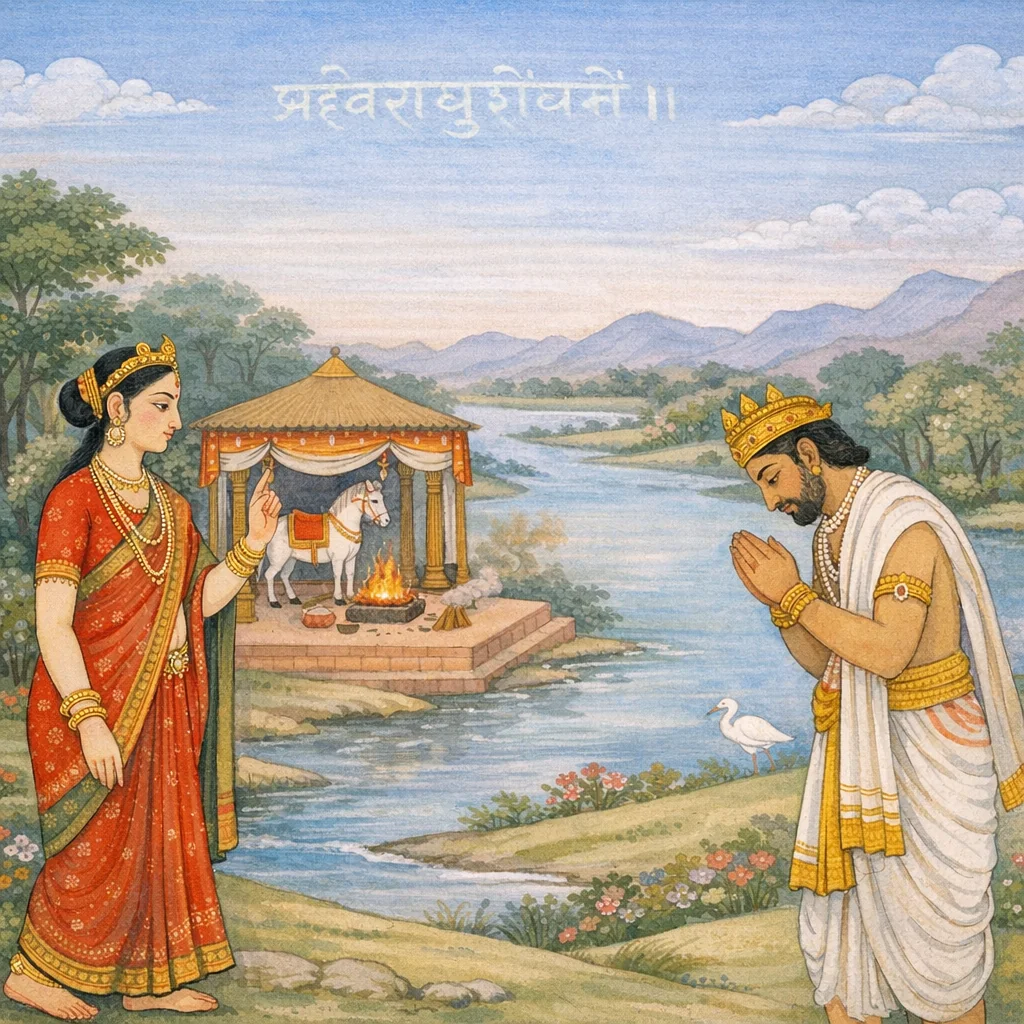
Adhyaya 83: The Daśāśvamedhika Tīrtha on the Gautamī: Completing Ten Aśvamedhas and the Supremacy of Annavidāna
O Adhyāya 83 apresenta o tīrtha-māhātmya do vau sagrado Daśāśvamedhika no rio Gautamī (Godāvarī), afirmando que até mesmo ouvir sua glória concede o fruto de um Aśvamedha. Brahmā narra o dilema ritual do rei Bhauvana, descendente de Viśvarūpa (filho de Viśvakarman), tendo Kaśyapa como seu purohita. O rei deseja realizar dez Aśvamedhas simultaneamente, mas repetidas tentativas não se completam por impedimentos atribuídos ao lugar, ao tempo ou a falhas humanas. Buscando orientação, o rei e Kaśyapa procuram Saṃvarta, que os encaminha a Brahmā; então Brahmā prescreve a região da Gautamī como intrinsecamente “kratu-puṇyavat”, capaz de aperfeiçoar os ritos por meio do sacrifício ou mesmo pelo banho. Após o Aśvamedha bem-sucedido, Bhauvana quer doar a terra, mas uma voz do céu (ākāśavāṇī) e a Terra personificada o direcionam ao annadāna, declarando a doação de alimento como mérito insuperável. O capítulo conclui estabelecendo o nome do tīrtha e sua promessa: banhar-se ali confere o fruto de dez Aśvamedhas.
Chapter Arc
{"opening_hook":"The chapter opens in tīrtha-māhātmya mode: merely hearing of the Daśāśvamedhika ford on the Gautamī is proclaimed to yield Aśvamedha-fruit, immediately enticing the listener with “effortless” sacrificial merit.","rising_action":"A royal-ritual problem intensifies the narrative: King Bhauvana, with Kaśyapa as purohita, attempts to complete ten Aśvamedhas at once, yet each time the rite breaks down—blamed variously on deśa (place), kāla (time), and human/ritual fault—forcing a search for higher authority and a truly efficacious landscape.","climax_moment":"Brahmā’s decisive revelation: the Gautamī region is intrinsically kratu-puṇyavat—so potent that sacrifice is perfected there, and even snāna can ‘set right’ what is obstructed; the Aśvamedha succeeds, and the chapter pivots to its central dharma-teaching that annadāna surpasses even earth-gifts and sacrificial grandeur.","resolution":"The tīrtha receives its naming rationale—Daśāśvamedhika—because bathing there grants the fruit of ten Aśvamedhas; the narrative closes by sealing the promise of the place (śravaṇa and snāna as equivalent to great kratu-merit) and by enthroning food-giving as the universally accessible, unsurpassed dāna.","key_verse":"“अन्नदानात् परं दानं न भूतं न भविष्यति—There has been no gift, nor will there be, superior to the gift of food.” (Teaching-summary of the chapter’s dāna-pivot; phrasing varies across recensions.)"}
Thematic Essence
{"primary_theme":"गौतमी-माहात्म्य (Gautamī tīrtha-māhātmya): Daśāśvamedhika as a place where snāna/śravaṇa equals great sacrifice.","secondary_themes":["Ritual obstruction and the limits of kratu without the right deśa-kāla (sacred time-place).","Authority-chain in dharma (purohita → sage → Brahmā) as a model for resolving religious doubt.","Ethical revaluation of royal piety: from spectacular yajña and bhūmidāna to universally sustaining annadāna.","Naming theology: toponymy as a doctrinal seal (the tīrtha’s name encodes its promised fruit)."],"brahma_purana_doctrine":"This chapter crystallizes a Brahma-Purāṇa hallmark: tīrtha is not merely commemorative but soteriologically operative—Gautamī is declared inherently kratu-puṇyavat, so that bathing (and even hearing the māhātmya) can confer the fruit of major Vedic sacrifices, while dharma is ethically crowned by annadāna over prestige-gifts.","adi_purana_significance":"As ‘Ādi Purāṇa,’ it models the Purāṇic synthesis of Vedic ritual and accessible devotion: it preserves the grandeur of Aśvamedha yet relocates salvific power into sacred geography and compassionate giving, making primordial dharma practicable for all."}
Emotional Journey
{"opening_rasa":"अद्भुत (adbhuta)","climax_rasa":"शान्त (śānta)","closing_rasa":"शान्त (śānta)","rasa_transitions":["adbhuta → चिन्ता/भय (bhayānaka undertone of failure) → अद्भुत → शान्त → करुण/प्रसाद (karuṇa-softened benevolence) → शान्त"],"devotional_peaks":["Brahmā’s proclamation of Gautamī as kratu-puṇyavat (awe at sacred landscape).","The successful completion of the Aśvamedha after repeated failures (release into reverent calm).","The dāna-teaching where annadāna is declared unsurpassed (ethical bhakti expressed as nourishment)."]}
Tirtha Focus
{"tirthas_covered":["गौतमी (Godāvarī)","गौतमीतट / गौतमीतीर","दशाश्वमेधिकं तीर्थम्","गङ्गातीर (as comparative locus for dāna teaching)"],"jagannath_content":null,"surya_content":null,"cosmology_content":null}
Shlokas in Adhyaya 83
Verse 1
ब्रह्मोवाच दशाश्वमेधिकं तीर्थं तच् छृणुष्व महामुने यस्य श्रवणमात्रेण हयमेधफलं लभेत् //
Este verso (nº 1) é tido como palavra sagrada no Purāṇa, digno de veneração e estudo.
Verse 7
पूर्णतां नाययुस् तानि दृष्ट्वा चिन्तापरो नृपः विहाय देवयजनं पुनर् अन्यत्र तान् क्रतून् //
Este verso (nº 7) é uma enunciação sagrada do Purāṇa, apropriada à devoção e ao estudo erudito.
Verse 8
उपाक्रामत् तथा तत्र विघ्नदोषास् तम् आययुः दृष्ट्वापूर्णांस् ततो यज्ञान् राजा गुरुम् अभाषत //
Este verso (nº 8) é venerado como palavra sacra do Purāṇa, clara e solene.
Verse 9
राजोवाच देशदोषात् कालदोषान् मम दोषात् तवापि वा पूर्णतां नाप्नुवन्ति स्म दशमेधानि वाजिनः //
Este verso (nº 9) é palavra sagrada do Purāṇa e deve ser lido com reverência.
Verse 10
ब्रह्मोवाच ततश् च दुःखितो राजा कश्यपेन पुरोधसा गीष्पतेर् भ्रातरं ज्येष्ठं गत्वा संवर्तम् ऊचतुः //
Este verso (nº 10) é transmitido como palavra sagrada do Purāṇa, para a devoção e o conhecimento.
Verse 11
कश्यपभौवनाव् ऊचतुः भगवन् युगपत् कार्याण्य् अश्वमेधानि मानद दश संपूर्णतां यान्ति तं देशं तं गुरुं वद //
O verso 83.11 é apresentado como palavra sagrada no Purāṇa, de tom doutrinal e solene.
Verse 12
ब्रह्मोवाच ततो ध्यात्वा ऋषिश्रेष्ठः संवर्तो भौवनं तदा अब्रवीद् गच्छ ब्रह्माणं गुरुं देशं वदिष्यति //
O verso 83.12 dá continuidade ao ensinamento elevado no estilo purânico, com clareza e sacralidade.
Verse 13
भौवनो ऽपि महाप्राज्ञः कश्यपेन महात्मना आगत्य माम् अब्रवीच् च गुरुं देशादिकं च यत् //
O verso 83.13 é tido como lembrança do Dharma e da retidão, conforme o espírito do Purāṇa.
Verse 14
ततो ऽहम् अब्रवं पुत्र भौवनं कश्यपं तथा गौतमीं गच्छ राजेन्द्र स देशः क्रतुपुण्यवान् //
O verso 83.14 revela um sentido profundo para que o ouvinte o compreenda com reverência e atenção.
Verse 15
अयम् एव गुरुः श्रेष्ठः कश्यपो वेदपारगः गुरोर् अस्य प्रसादेन गौतम्याश् च प्रसादतः //
O verso 83.15 conclui com pureza e oferece orientação para a prática do Dharma na vida.
Verse 16
एकेन हयमेधेन तत्र स्नानेन वा पुनः सेत्स्यन्ति तत्र यज्ञाश् च दशमेधानि वाजिनः //
Este verso afirma que o Dharma e a disciplina sagrada são o alicerce que sustenta o universo.
Verse 17
तच् छ्रुत्वा भौवनो राजा गौतमीतीरम् अभ्यगात् कश्यपेन सहायेन हयमेधाय दीक्षितः //
Os sábios devem honrar o Dharma com sinceridade e com prática correta.
Verse 18
ततः प्रवृत्ते यज्ञेशे हयमेधे महाक्रतौ संपूर्णे तु तदा राजा पृथिवीं दातुम् उद्यतः //
Ao seguir o Dharma, a honra e a bem-aventurança surgem neste mundo e no que há de vir.
Verse 19
ततो ऽन्तरिक्षे वाग् उच्चैर् उवाच नृपसत्तमम् पूजयित्वा स्थितं विप्रान् ऋत्विजो ऽथ सदस्पतीन् //
Quem abandona o Dharma cai na escuridão, como alguém que se perde numa grande floresta.
Verse 20
आकाशवाग् उवाच पुरोधसे कश्यपाय सशैलवनकाननाम् पृथिवीं दातुकामेन दत्तं सर्वं त्वया नृप //
Portanto, conserve-se sempre o Dharma com mente serena e reverência, para alcançar o bem supremo.
Verse 21
भूमिदानस्पृहां त्यक्त्वा अन्नं देहि महाफलम् नान्नदानसमं पुण्यं त्रिषु लोकेषु विद्यते //
Este verso apresenta apenas o número “21”, sem o texto em sânscrito; assim, não é possível traduzir o seu sentido.
Verse 22
विशेषतस् तु गङ्गायाः श्रद्धया पुलिने मुने त्वया तु हयमेधो ऽयं कृतः सबहुदक्षिणः कृतकृत्यो ऽसि भद्रं ते नात्र कार्या विचारणा //
Este verso apresenta apenas o número “22”, sem o texto em sânscrito; assim, não é possível traduzir o seu sentido.
Verse 23
ब्रह्मोवाच तथापि दातुकामं तं मही प्रोवाच भौवनम् //
Este verso apresenta apenas o número “23”, sem o texto em sânscrito; assim, não é possível traduzir o seu sentido.
Verse 24
पृथिव्य् उवाच विश्वकर्मज सार्वभौम मा मां देहि पुनः पुनः निमज्जे ऽहं सलिलस्य मध्ये तस्मान् न दीयताम् //
Este verso apresenta apenas o número “24”, sem o texto em sânscrito; assim, não é possível traduzir o seu sentido.
Verse 25
ब्रह्मोवाच ततश् च भौवनो भीतः किं देयम् इति चाब्रवीत् पुनश् चोवाच सा पृथ्वी भौवनं ब्राह्मणैर् वृतम् //
Este verso apresenta apenas o número “25”, sem o texto em sânscrito; assim, não é possível traduzir o seu sentido.
Verse 26
भूम्य् उवाच तिला गावो धनं धान्यं यत् किंचिद् गौतमीतटे सर्वं तद् अक्षयं दानं किं मां भौवन दास्यसि //
Este trecho apresenta apenas o número “26” e não traz o texto em sânscrito; assim, não é possível traduzir fielmente o original.
Verse 27
गङ्गातीरं समाश्रित्य ग्रासम् एकं ददाति यः तेनाहं सकला दत्ता किं मां भौवन दास्यसि //
Aqui consta apenas o número “27”, sem o texto em sânscrito; portanto não se pode oferecer uma tradução fiel.
Verse 28
ब्रह्मोवाच तद् भुवो वचनं श्रुत्वा भौवनः सार्वभौवनः तथेति मत्वा विप्रेभ्यो ह्य् अन्नं प्रादात् सुविस्तरम् //
A fonte traz apenas o número “28” e não inclui o texto em sânscrito; assim, não é possível traduzir o sentido original.
Verse 29
ततः प्रभृति तत् तीर्थं दशाश्वमेधिकं विदुः दशानाम् अश्वमेधानां फलं स्नानाद् अवाप्यते //
Esta parte apresenta apenas o número “29”, sem o texto em sânscrito; portanto não é possível fornecer uma tradução precisa.
Frequently Asked Questions
The chapter pivots from ritual ambition to ethical giving: while it validates Aśvamedha efficacy through the Gautamī tīrtha, it ultimately elevates annadāna (food-giving) as the unsurpassed merit across the three worlds, discouraging repeated bhūmidāna and emphasizing practical, universally sustaining charity.
The Daśāśvamedhika Tīrtha on the Gautamī is glorified. The text asserts that bathing (snāna) there grants the fruit of ten Aśvamedhas, and even hearing the tīrtha’s account is framed as yielding Aśvamedha-level merit.
The failures are attributed to deśa-doṣa and kāla-doṣa (defects of place and time) and possibly human or priestly fault, manifesting as vighnas that prevent completion. Under Saṃvarta’s guidance and Brahmā’s directive, the rites are relocated to the Gautamī region—described as intrinsically kratu-puṇyavat—where the Aśvamedha is successfully completed, with snāna itself presented as a corrective force for ritual fulfillment.
Read Brahma Purana in the Vedapath app
Scan the QR code to open this directly in the app, with audio, word-by-word meanings, and more.