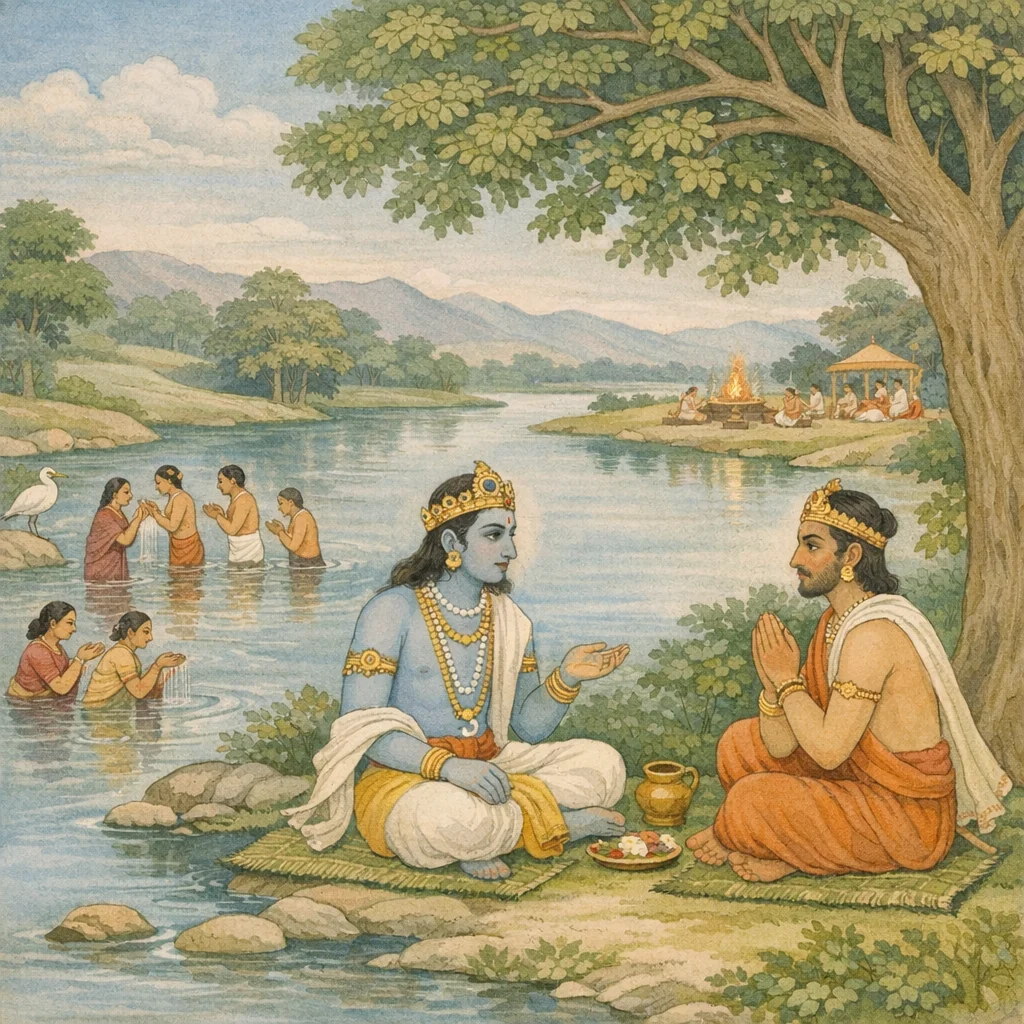
Adhyaya 88: Janasthana Tirtha: Varuna’s Teaching on Karma, Bhukti, and Mukti
O Adhyaya 88 apresenta um ensinamento de topografia sagrada por meio de uma indagação filosófica sobre a relação entre bhukti (fruição mundana) e mukti (libertação). O rei Janaka, nascido na linhagem de Vaivasvata e casado com Guṇārṇavā—filha de Varuṇa, Apāṃpati—procura seu purohita Yājñavalkya com uma questão central do dharma: como alcançar a libertação “facilmente” sem o severo sofrimento da renúncia total. Yājñavalkya o encaminha a Varuṇa, que expõe um caminho sancionado pelos Vedas, no qual a libertação é compreendida pela “porta do karma”, rejeitando uma doutrina simplista de não-ação. Varuṇa então ancora esse ensinamento soteriológico na geografia sagrada, louvando Bhāratavarṣa—em especial a região de Daṇḍaka—e elevando a Gautamī Gaṅgā como tīrtha supremo, onde yajña, dāna e a observância ritual concedem tanto bhukti quanto mukti. O capítulo culmina na nomeação e glorificação de Janasthāna, uma extensão de quatro yojanas lembrada como o assento sacrificial dos Janakas, onde a lembrança devota, a peregrinação, o banho, as oferendas e os ritos aos ancestrais removem o pecado e concedem os fins desejados e a libertação.
Chapter Arc
{"opening_hook":"A practical dharma-crisis opens the chapter: King Janaka asks how mokṣa can be attained “easily,” without the crushing hardship of total renunciation—framing a tension between royal life (bhukti) and liberation (mukti).","rising_action":"Yājñavalkya refuses a simplistic answer and redirects Janaka to Varuṇa (Apāṃpati), whose authority as Vedic lord of waters and dharma-guardian raises the stakes: the question is not merely personal but doctrinal—whether liberation can be grounded in Vedic action rather than flight from action.","climax_moment":"Varuṇa’s central teaching: mokṣa is intelligible through the “gateway of karma,” and the Veda does not endorse a naïve non-action doctrine; properly ordered Vedic duty (especially within the āśrama system, with gārhasthya highlighted) can yield both bhukti and mukti when performed as dharma rather than as craving.","resolution":"The philosophical resolution is sealed by sacred geography: Varuṇa praises Bhāratavarṣa and the Daṇḍaka region, exalting the Gautamī Gaṅgā as a premier liberating tīrtha; the chapter culminates by naming and glorifying Janasthāna—four yojanas wide—as the Janakas’ yajña-seat where remembrance, pilgrimage, bathing, dāna, and pitṛ-rites destroy sin and grant desired ends and liberation.","key_verse":"“Liberation is not won by mere non-action; it is approached through the gate of Vedic karma—when duty is performed as ordained, it bestows both enjoyment and release.” (Teaching-summary of Varuṇa; chapter’s doctrinal refrain)"}
Thematic Essence
{"primary_theme":"Karma as the Vedic gateway reconciling bhukti and mukti (tīrtha-grounded soteriology).","secondary_themes":["Āśrama-dharma as structured ‘gateways’ of karma, with gārhasthya praised","Gautamī Gaṅgā (Godāvarī) as a premier liberating river-tīrtha","Bhāratavarṣa/Daṇḍaka praise as moral-sacred geography","Janasthāna as yajña-sad of the Janakas; merit through snāna, dāna, pitṛ-tarpaṇa, smaraṇa"],"brahma_purana_doctrine":"This chapter insists that mokṣa is not opposed to Vedic action: karma, when performed as śāstra-ordained duty (and intensified through tīrtha-sevā), becomes a soteriological instrument yielding both bhukti and mukti—rejecting a simplistic ‘non-action alone’ claim.","adi_purana_significance":"As ‘Adi Purāṇa,’ it models the Purāṇic synthesis: philosophical inquiry (mokṣa) is resolved not abstractly but by embedding dharma in place—Bhāratavarṣa and the Gautamī network—showing how primordial teaching becomes lived practice through pilgrimage and rite."}
Emotional Journey
{"opening_rasa":"चिन्ता (a shade of karuṇa/śānta-adjacent concern)","climax_rasa":"शान्त","closing_rasa":"अद्भुत","rasa_transitions":["चिन्ता → जिज्ञासा → शान्त → अद्भुत → शान्त"],"devotional_peaks":["Varuṇa’s pronouncement that Vedic karma can open to mokṣa (a stabilizing śānta peak)","The exaltation of Gautamī Gaṅgā as a liberating river where yajña and dāna bear soteriological fruit","The naming of Janasthāna and the promise that smaraṇa, snāna, dāna, and pitṛ-kriyā remove sin and grant liberation"]}
Tirtha Focus
{"tirthas_covered":["भारतवर्ष (Bhāratavarṣa)","दण्डक (Daṇḍaka region/forest tract)","गौतमी गङ्गा (Gautamī Gaṅgā / Godāvarī)","जनस्थान-तीर्थ (Janasthāna Tīrtha)","गङ्गातीर (riverbank setting for rites)"],"jagannath_content":null,"surya_content":null,"cosmology_content":null}
Shlokas in Adhyaya 88
Verse 1
ब्रह्मोवाच तस्माद् अप्य् अपरं तीर्थं जनस्थानम् इति श्रुतम् चतुर्योजनविस्तीर्णं स्मरणान् मुक्तिदं नृणाम् //
Isto é apenas o número «1» do capítulo 88; sem o verso em sânscrito, não há como traduzir como escritura.
Verse 2
वैवस्वतान्वये जातो राजाभूज् जनकः पुरा सो ऽपांपतेस् तु तनुजाम् उपयेमे गुणार्णवाम् //
Este item traz apenas o número «2»; sem o sânscrito completo, não se pode oferecer uma tradução condizente com o teor sagrado.
Verse 3
धर्मार्थकाममोक्षाणां जनकां जनको नृपः अनुरूपगुणत्वाच् च तस्य भार्या गुणार्णवा //
Aqui consta apenas o número «3»; por favor forneça o verso sânscrito completo para que se possa traduzir com fidelidade e tom sagrado.
Verse 4
याज्ञवल्क्यश् च विप्रेन्द्रस् तस्य राज्ञः पुरोहितः तम् अपृच्छन् नृपश्रेष्ठो याज्ञवल्क्यं पुरोहितम् //
O verso 88.4 consta na fonte apenas como «4»; não foi fornecido o texto sânscrito completo para tradução.
Verse 5
जनक उवाच भुक्तिमुक्ती उभे श्रेष्ठे निर्णीते मुनिसत्तमैः दासीदासेभतुरगरथाद्यैर् भुक्तिर् उत्तमा //
O verso 88.5 no original aparece apenas como «5»; sem o sânscrito completo, não é possível traduzir com precisão.
Verse 6
किंत्व् अन्तविरसा भुक्तिर् मुक्तिर् एका निरत्यया भुक्तेर् मुक्तिः श्रेष्ठतमा भुक्त्या मुक्तिं कथं व्रजेत् //
Quanto ao 88.6, a fonte registra apenas «6»; não há texto sânscrito para traduzir.
Verse 7
सर्वसङ्गपरित्यागान् मुक्तिप्राप्तिः सुदुःखतः तद् ब्रूहि द्विजशार्दूल सुखान् मुक्तिः कथं भवेत् //
O 88.7 está assinalado apenas como «7»; sem o texto sânscrito, não se pode apresentar tradução.
Verse 8
याज्ञवल्क्य उवाच अपांपतिस् तव गुरुः श्वशुरः प्रियकृत् तथा तं गत्वा पृच्छ नृपते उपदेक्ष्यति ते हितम् //
Para 88.8, a fonte apresenta apenas «8»; por favor, forneça o texto sânscrito completo para uma tradução fiel.
Verse 9
याज्ञवल्क्यश् च जनको राजानं वरुणं तदा गत्वा चोचतुर् अव्यग्रौ मुक्तिमार्गं यथाक्रमम् //
O verso (9) do Brahma Purana expõe um sentido sagrado e um saber antigo.
Verse 15
चतुर्णाम् आश्रमाणां च गार्हस्थ्यं पुण्यदं स्मृतम् तस्माद् भुक्तिश् च मुक्तिश् च भवतीति मतिर् मम //
O verso (15) do Brahma Purana expõe o Dharma e a ordem do mundo com solenidade.
Verse 16
ब्रह्मोवाच एतच् छ्रुत्वा तु जनको याज्ञवल्क्यश् च बुद्धिमान् वरुणं पूजयित्वा तु पुनर् वचनम् ऊचतुः //
O verso (16) prossegue expondo a verdade antiga e a reverência ao Dharma.
Verse 17
को देशः किं च तीर्थं स्याद् भुक्तिमुक्तिप्रदायकम् तद् वदस्व सुरश्रेष्ठ सर्वज्ञो ऽसि नमो ऽस्तु ते //
O verso (17) oferece orientação ao buscador do Dharma, honrando a tradição antiga.
Verse 18
वरुण उवाच पृथिव्यां भारतं वर्षं दण्डकं तत्र पुण्यदम् तस्मिन् क्षेत्रे कृतं कर्म भुक्तिमुक्तिप्रदं नृणाम् //
O verso (18) conclui louvando o Dharma e o fruto meritório da prática sincera.
Verse 19
तीर्थानां गौतमी गङ्गा श्रेष्ठा मुक्तिप्रदा नृणाम् तत्र यज्ञेन दानेन भोगान् मुक्तिम् अवाप्स्यति //
O verso 88.19 aparece apenas como “19”; não foi fornecido o texto sânscrito completo para uma tradução fidedigna.
Verse 20
ब्रह्मोवाच याज्ञवल्क्यश् च जनको वाचं श्रुत्वा ह्य् अपांपतेः वरुणेन ह्य् अनुज्ञातौ स्वपुरीं जग्मतुस् तदा //
O verso 88.20 traz apenas “20”; sem o sânscrito completo, não é possível traduzir com exatidão.
Verse 21
अश्वमेधादिकं कर्म चकार जनको नृपः याजयाम् आस विप्रेन्द्रो याज्ञवल्क्यश् च तं नृपम् //
O verso 88.21 está apenas como “21”; sem o texto sânscrito, não se pode verter o seu sentido.
Verse 22
गङ्गातीरं समाश्रित्य यज्ञान् मुक्तिम् अवाप राट् तथा जनकराजानो बहवस् तत्र कर्मणा //
O verso 88.22 traz apenas “22”; sem o sânscrito completo, não se pode traduzir o significado.
Verse 23
मुक्तिं प्रापुर् महाभागा गौतम्याश् च प्रसादतः ततः प्रभृति तत् तीर्थं जनस्थानेति विश्रुतम् //
O verso 88.23 aparece apenas como “23”; por favor, forneça o texto sânscrito para uma tradução exata.
Verse 24
जनकानां यज्ञसदो जनस्थानं प्रकीर्तितम् चतुर्योजनविस्तीर्णं स्मरणात् सर्वपापनुत् //
Este verso (nº 24) é enunciado no Purana, preservando seu caráter sagrado e seu sentido enciclopédico com clareza reverente.
Verse 25
तत्र स्नानेन दानेन पितॄणां तर्पणेन तु तीर्थस्य स्मरणाद् वापि गमनाद् भक्तिसेवनात् //
Este verso (nº 25) prossegue a exposição segundo a tradição purânica, honrando o Dharma e a sacralidade do relato.
Verse 26
सर्वान् कामान् अवाप्नोति मुक्तिं च समवाप्नुयात् //
Este verso (nº 26) resume um sentido profundo em linguagem sagrada, para que o leitor o compreenda com clareza e reverência.
Frequently Asked Questions
The chapter centers on mokṣa-access through Vedic karma: it addresses Janaka’s concern that full renunciation is difficult and presents Varuṇa’s doctrine that properly performed Vedic action—supported by yajña, dāna, and āśrama-dharma—can yield both bhukti (legitimate prosperity/enjoyment) and mukti (liberation).
Janasthāna is glorified as a four-yojana sacred expanse identified as the Janakas’ sacrificial seat (yajña-sad). Its distinctive claim is that mere remembrance, as well as pilgrimage, bathing, gifting, pitṛ-tarpaṇa, and devotional service there, removes sin and grants desired aims culminating in liberation.
The chapter recommends yajña and dāna at the Gautamī Gaṅgā, and at Janasthāna it prescribes tīrtha-based observances: snāna (bathing), dāna (charitable giving), pitṛ-tarpaṇa (ancestral offerings), smaraṇa (remembrance of the tīrtha), gamana (pilgrimage/going there), and bhakti-sevā (devotional attendance).