
Shloka 7
Sankhya Yoga — Sankhya Yoga
कार्पण्यदोषोपहतस्वभावः पृच्छामि त्वां धर्मसम्मूढचेताः । यच्छ्रेयः स्यान्निश्चितं ब्रूहि तन्मे शिष्यस्तेऽहं शाधि मां त्वां प्रपन्नम् ॥ २.७ ॥
kārpaṇya-doṣopahata-svabhāvaḥ pṛcchāmi tvāṃ dharma-sammūḍha-cetāḥ | yac chreyaḥ syān niścitaṃ brūhi tan me śiṣyas te 'haṃ śādhi māṃ tvāṃ prapannam || 2.7 ||

Meu ser está oprimido pelo defeito da fraqueza; minha mente está confusa quanto ao dharma. Suplico-te: diz-me com certeza o que é o melhor para mim. Sou teu discípulo; instrui-me, a mim que me refugiei em ti.
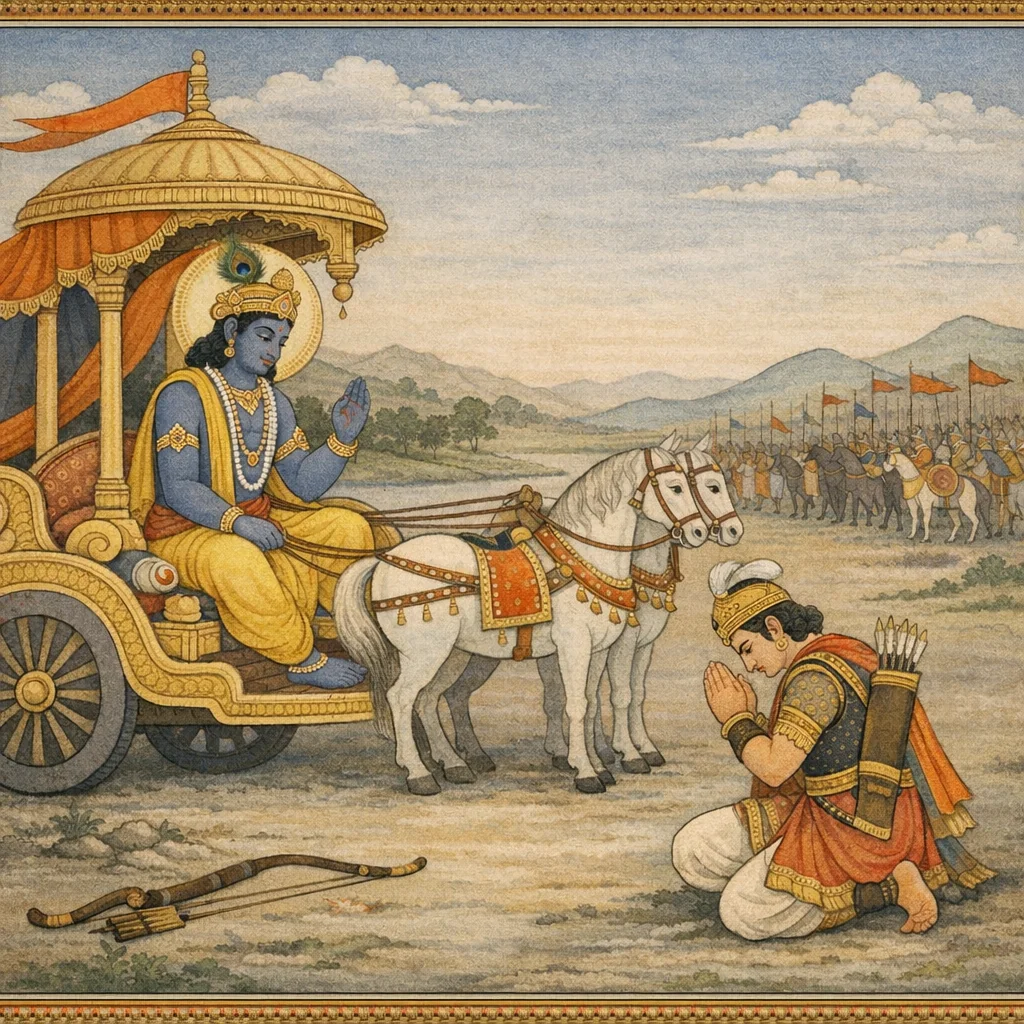
Arjuna says his nature is overwhelmed by weakness and his mind is confused about duty; he asks Krishna to tell him decisively what is best, declaring himself Krishna’s disciple and seeking instruction.
Arjuna states: ‘My disposition is overcome by the fault of despondency; my mind is bewildered regarding dharma. Tell me decisively what would be for my good. I am your student; instruct me—I have taken refuge in you.’
‘Śreyaḥ’ is often translated as ‘the good’ or ‘the highest good,’ while some devotional translations read it as ‘what is most beneficial spiritually.’ The key institutional shift is explicit: Arjuna moves from friend/ally to formal disciple (śiṣya) seeking authoritative guidance.
FAQs
Arjuna recognizes impaired judgment (‘overwhelmed nature’) and explicitly seeks help—an important move from rumination to consultation and learning.
The verse inaugurates the pedagogical setting for teachings on self, action, and liberation: ‘śreyas’ signals a turn from immediate preference (preyas) toward a deeper criterion of well-being.
This is the pivot that authorizes Krishna’s discourse: the narrative frames the Gita as instruction given in response to a disciple’s request for clarity about dharma.
It supports the idea that ethical competence can require mentorship and disciplined inquiry, especially when one’s emotions distort decision-making.