
Shloka 19
Purushottama Yoga — Purushottama Yoga
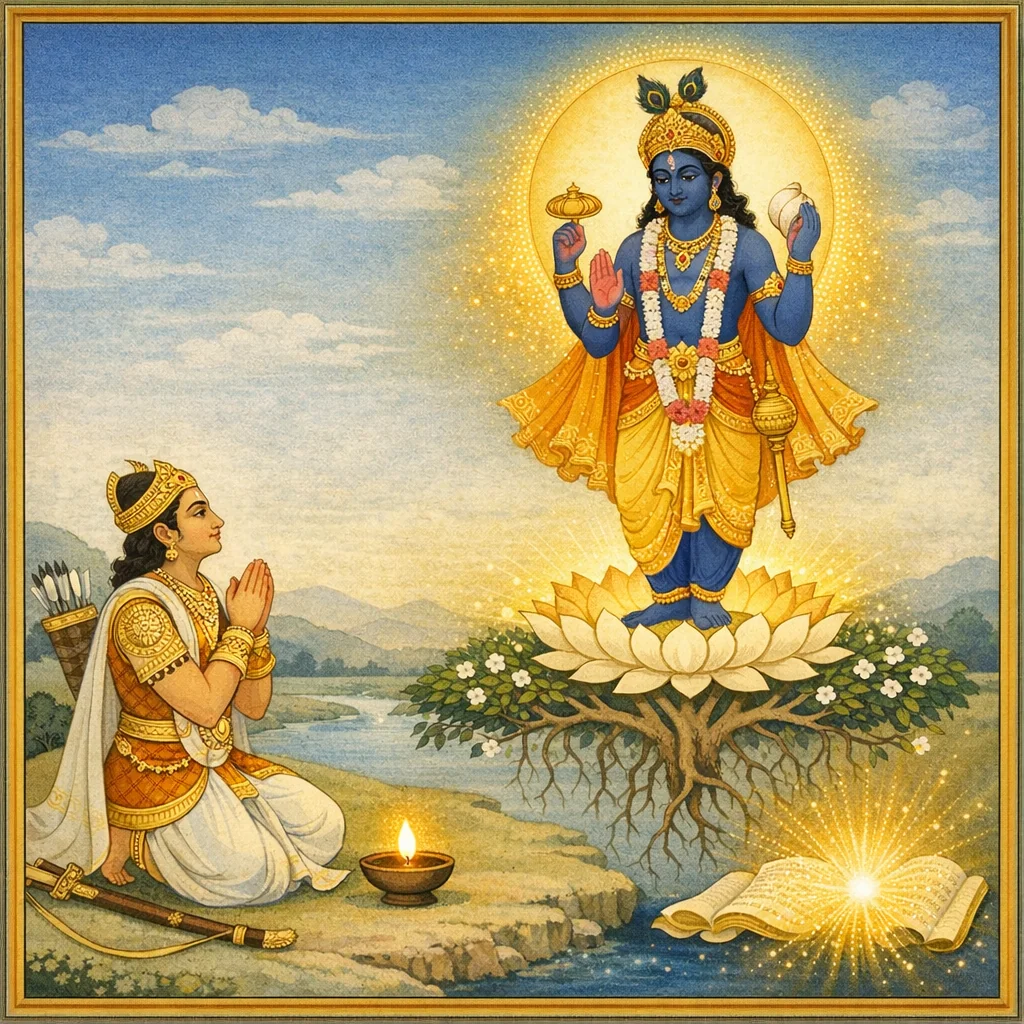
यो मामेवमसंमूढो जानाति पुरुषोत्तमम् ।
स सर्वविद्भजति मां सर्वभावेन भारत ॥ १५.१९ ॥
yo mām evam asaṃmūḍho jānāti puruṣottamam |
sa sarvavid bhajati māṃ sarva-bhāvena bhārata || 15.19 ||

Aquele que, sem ilusão, assim me conhece como Puruṣottama, esse conhece tudo; e me adora com todo o seu ser, ó Bhārata.
जो मनुष्य मुझे इस प्रकार असम्मूढ होकर पुरुषोत्तम जानता है, वह सर्वज्ञ होकर (अर्थात् सब कुछ जानने वाला होकर) सम्पूर्ण भाव से मेरा भजन करता है, हे भारत!
Whoever, undeluded, thus knows me as Puruṣottama—he is ‘knower of all’ and worships/participates in me with his whole being, O Bhārata.
‘sarvavit’ may be taken strictly (‘knower of all’) or functionally (‘knower of what is essential’). ‘bhajati’ ranges from devotional worship to wholehearted participation/commitment depending on interpretive tradition.
FAQs
It links clarity of understanding with wholehearted orientation: when one’s core framework is coherent, motivation and conduct become more integrated and less conflicted.
Knowing the supreme as Puruṣottama is presented as culminating knowledge that naturally issues in ‘bhajana’—a comprehensive relation to the supreme (devotion, alignment, or participation).
As the chapter’s closing claim (before 15.20), it states the practical consequence of the metaphysical teaching: recognition leads to complete commitment.
It can be read as recommending value-clarity: identify one’s highest principle and live consistently with it—ethically, intellectually, and emotionally.