
Shloka 7
Karma Sannyasa Yoga — Karma Sannyasa Yoga
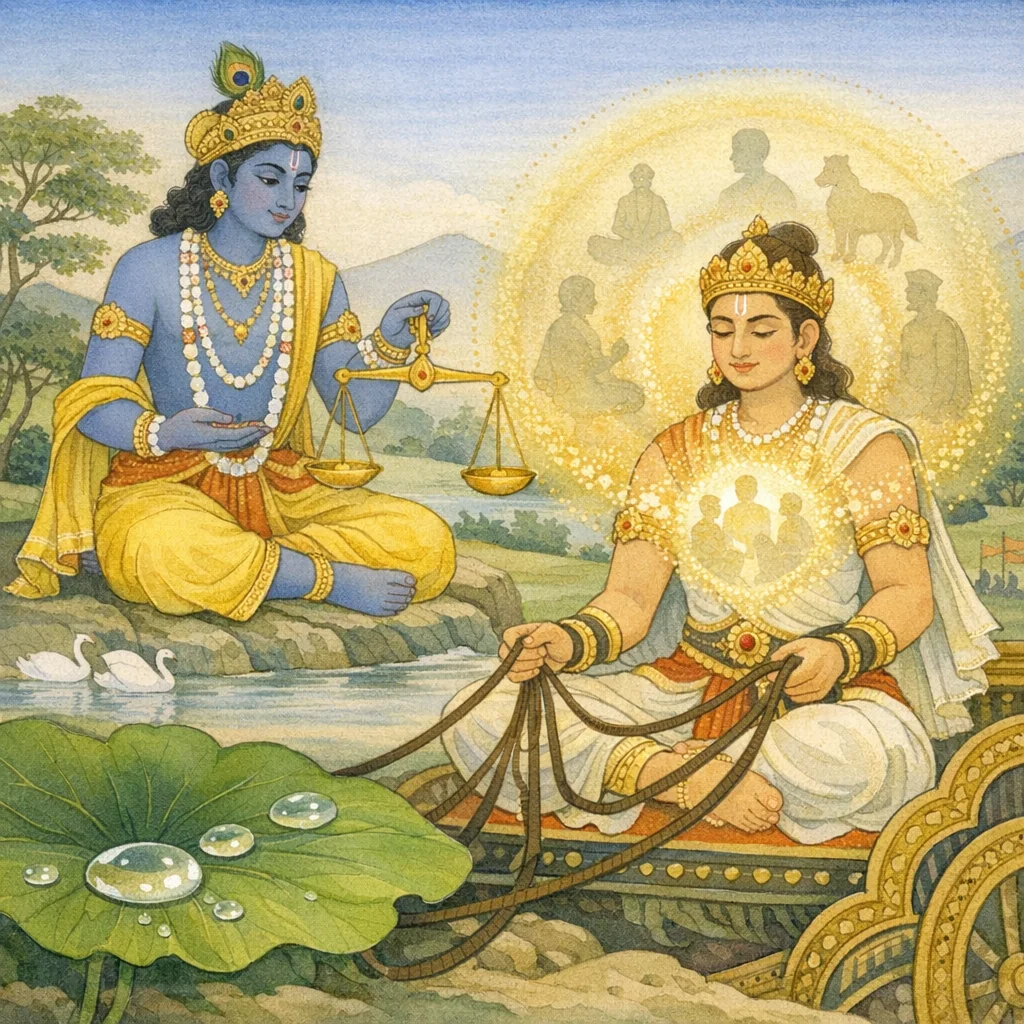
योगयुक्तो विशुद्धात्मा विजितात्मा जितेन्द्रियः । सर्वभूतात्मभूतात्मा कुर्वन्नपि न लिप्यते ॥ ५.७ ॥
yogayukto viśuddhātmā vijitātmā jitendriyaḥ | sarvabhūtātmabhūtātmā kurvann api na lipyate || 5.7 ||

O yogin, unido ao yoga, de mente purificada, senhor de si, com os sentidos vencidos, cujo Ser se tornou o Ser de todos os seres — mesmo agindo, não se mancha.
The yogin, purified in mind, self-controlled, and with senses conquered, whose self has become the self of all beings—though acting, he is not tainted.
Disciplined in yoga, with a purified inner instrument, self-mastered, senses restrained—one whose self is attuned to the self in all beings—though acting, is not stained (by action).
Sarvabhūtātmabhūtātmā is interpreted as an experiential identification with, or empathy toward, all beings grounded in Self-knowledge. 'Na lipyate' echoes the idea that action without appropriation does not produce binding residue.
FAQs
Purification and restraint are presented as conditions for acting without inner disturbance. A broadened sense of self (concern for others) reduces egocentric reactivity and supports stable well-being.
When agency is not appropriated to the ego and the Self is understood as non-separate from the ground of all beings, action does not generate binding consequences in the same way; it leaves no 'stain' of attachment.
This verse articulates the ideal outcome of karma-yoga: continued action accompanied by purification, self-mastery, and a universalized standpoint.
It can guide professional and civic life: cultivate self-regulation and ethical clarity, act with a wider concern for others, and reduce fixation on personal reward or status.