
Shloka 29
Karma Sannyasa Yoga — Karma Sannyasa Yoga
भोक्तारं यज्ञतपसां सर्वलोकमहेश्वरम् । सुहृदं सर्वभूतानां ज्ञात्वा मां शान्तिमृच्छति ॥ ५.२९ ॥
bhoktāraṁ yajña-tapasāṁ sarva-loka-maheśvaram | suhṛdaṁ sarva-bhūtānāṁ jñātvā māṁ śāntim ṛcchati || 5.29 ||

Conhecendo-Me como o desfrutador dos sacrifícios e das austeridades, como o grande Senhor de todos os mundos e como o amigo benevolente de todos os seres, o praticante alcança a paz.
मुझे यज्ञ और तपस्याओं का भोक्ता, समस्त लोकों का महान् ईश्वर तथा समस्त प्राणियों का सुहृद् (हितैषी) जानकर (साधक) शान्ति को प्राप्त होता है।
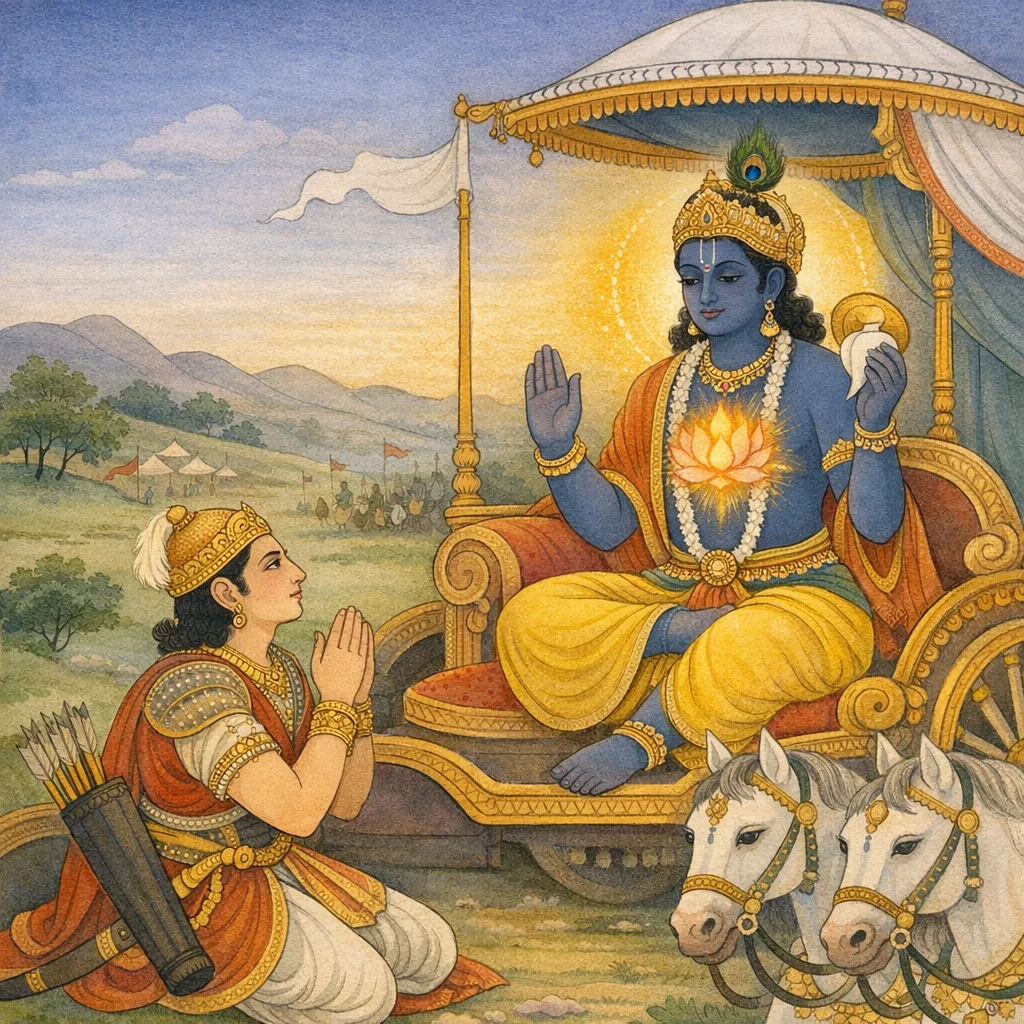
Knowing me as the enjoyer/recipient of sacrifices and austerities, as the great lord of all worlds, and as the well-wisher of all beings, one attains peace.
Key interpretive nuance lies in “bhoktā”: often taken devotionally as God receiving offerings, but it can also be read as a theological claim that ultimate fruition is grounded in the supreme principle, not in egoic agency.
FAQs
The verse redirects the sense of control and ownership away from the individual ego toward a larger framework, which can reduce anxiety and promote inner peace.
It asserts a supreme ordering principle (personally as Krishna/Īśvara in the text) as the ultimate recipient and ruler, and frames that principle as benevolent toward all beings.
As the concluding verse of Chapter 5, it summarizes how disciplined action and renunciation culminate in peace: through knowledge of the supreme as lord and friend.
It can be applied as a practice of relinquishing possessiveness over outcomes and cultivating goodwill, supporting resilience and cooperative social behavior.