
Bhagavad Gita — Karma Sannyasa Yoga, Shloka 16
Karma Sannyasa Yoga
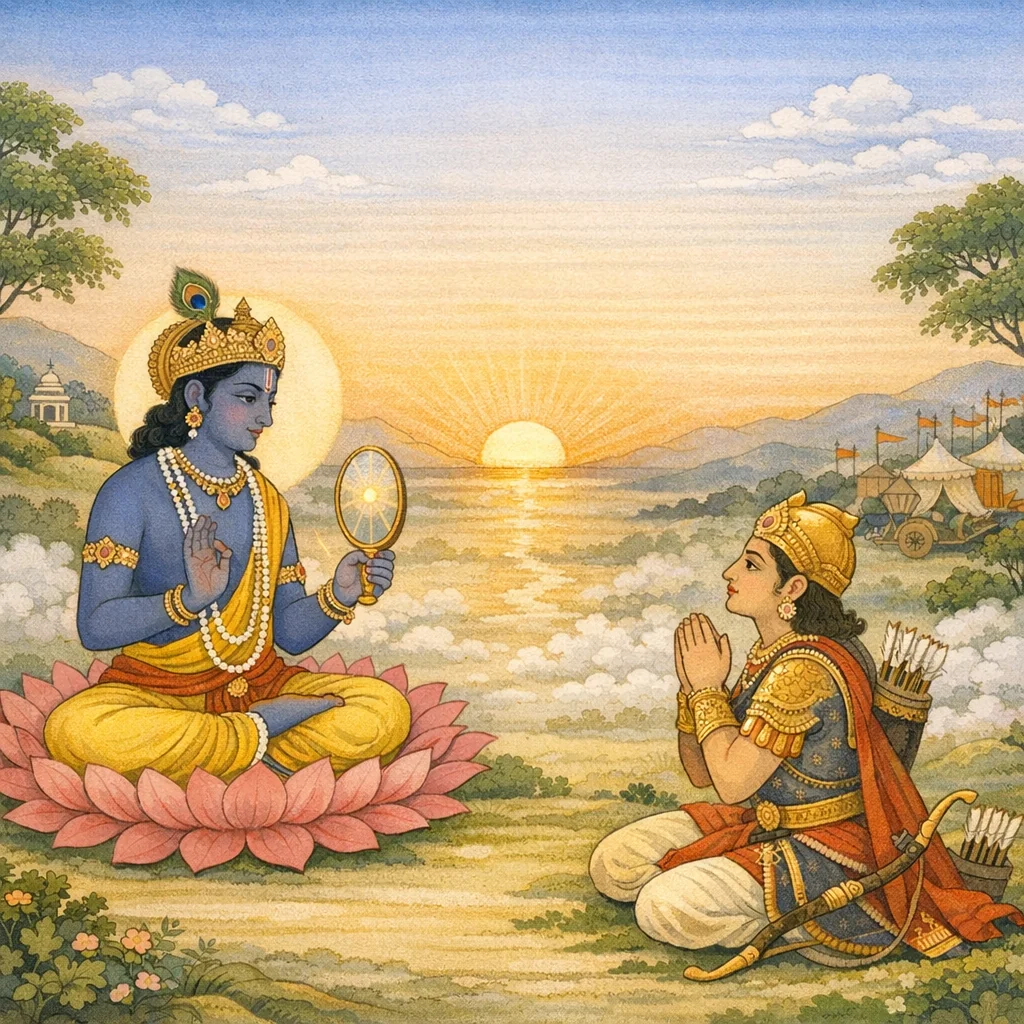
तद्बुद्धयस्तदात्मानस्तन्निष्ठास्तत्परायणा: । गच्छन्त्यपुनरावृत्तिं ज्ञाननिर्धूतकल्मषा: ॥ ५.१७ ॥
tad-buddhayas tad-ātmānas tan-niṣṭhās tat-parāyaṇāḥ | gacchanty apunarāvṛttiṃ jñāna-nirdhūta-kalmaṣāḥ || 5.17 ||

Aqueles cuja inteligência está em Isso, cujo ser está em Isso, firmes em Isso, que tomam Isso como refúgio supremo — purificados de toda mácula pelo conhecimento, alcançam o estado sem retorno (ao ciclo de renascimentos).
जिनकी बुद्धि उस (परम) में है, जिनका मन उस (परम) में है, जो उसी में निष्ठा रखने वाले हैं, जो उसी को परम लक्ष्य मानने वाले हैं—वे ज्ञान से पापरहित होकर अपुनरावृत्ति (पुनर्जन्म-रहित अवस्था) को प्राप्त होते हैं।
Those whose intellect is set on That, whose self is oriented to That, who are established in That, who take That as the supreme refuge/goal—having their impurities shaken off by knowledge—go to non-return.
“Apunarāvṛtti” is commonly interpreted as liberation (mokṣa) understood as no return to cyclical rebirth, though some theistic readings nuance it as reaching the Lord’s state/abode. “Kalmaṣa” can mean moral-psychic impurities broadly; the verse emphasizes knowledge as the purifier in continuity with 5.16.
FAQs
The verse describes deep value-integration: when cognition, identity, and commitment align around a highest principle, inner conflict diminishes and behavior becomes steadier.
It presents liberation as the culmination of knowledge and steadfast orientation toward the ultimate reality (‘That’), with ‘non-return’ indicating release from repetitive existential cycles.
This verse concludes the immediate sequence (5.15–5.17): ignorance causes delusion, knowledge removes ignorance, and sustained orientation to the ultimate leads to liberation.
Clarify a ‘highest commitment’ (truthfulness, compassion, or contemplative insight) and align daily decisions with it; the text suggests that such alignment reduces fragmentation and regret.