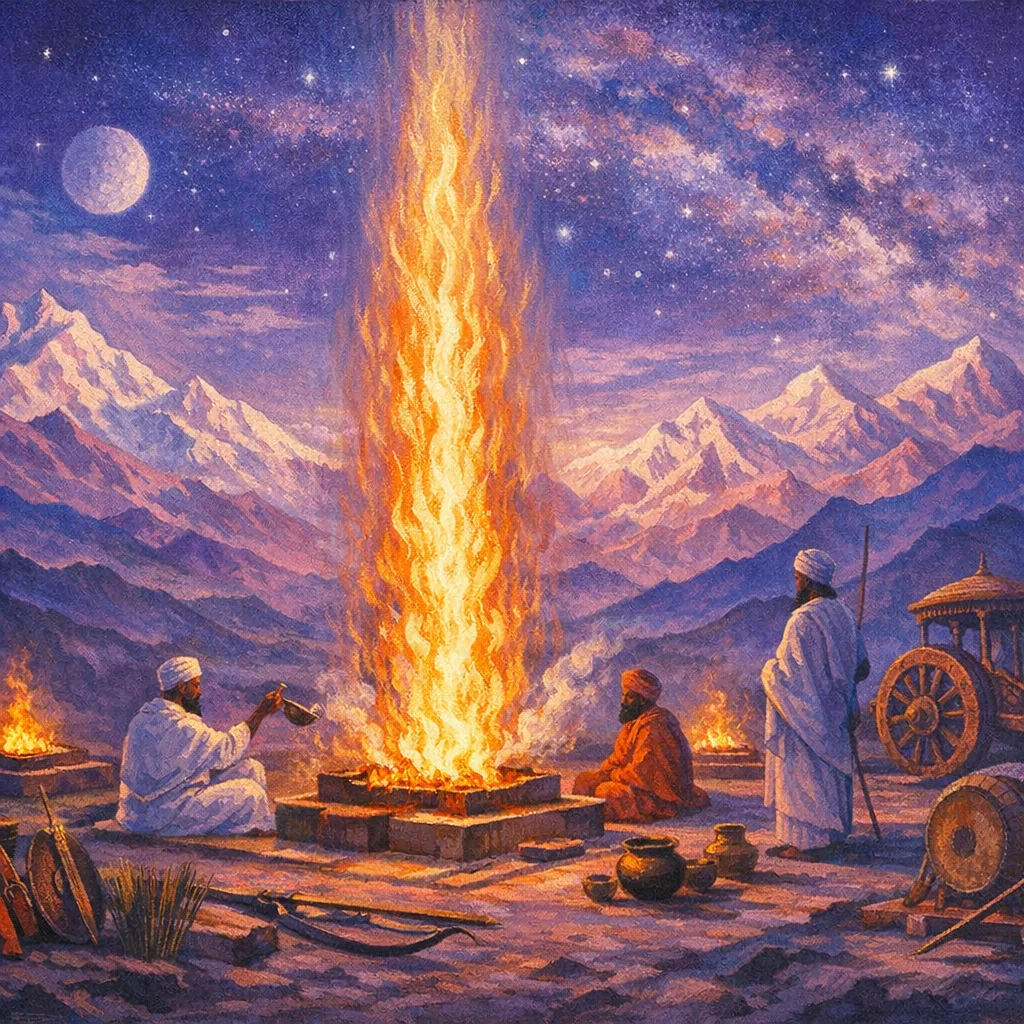
Prapathaka 6
Agnicayana / Soma-sacrifice continuum: mid–Kāṇḍa 4 material typically belongs to the Śrauta complex of Soma-yajña with its ancillary rites (dīkṣā–upasad–pravargya–savana framework) and the Agnicayana-oriented handling of fires, oblations, and priestly functions; this prapāṭhaka is best read as part of the operational liturgy that stabilizes the yajamāna’s consecration and the regulated offering-sequence around the principal savanas.
Kṛṣṇa-Yajurveda (Taittirīya Saṃhitā) 4.6 belongs to the dense Śrauta liturgical stratum in which mantra and brāhmaṇa-style prose cooperate to operationalize the Soma-sacrifice environment. The chapter’s concern is not speculative theology but the controlled production of ritual efficacy: it coordinates priestly roles, fire-management, and the sequencing of oblations so that the yajamāna’s consecrated status is maintained while the sacrifice advances through its regulated stations. Characteristic of the Black Yajurvedic idiom, the text interleaves formulae for offering, apportioning, and securing ritual “wholeness” (sarvatva) with pragmatic directions that prevent fault (doṣa) and restore continuity when transitions occur. The chapter thus exemplifies how the Taittirīya tradition encodes a performative grammar: mantras mark boundaries, authorize transfers (of heat, speech, and offering), and ritually “bind” the rite into a coherent whole. Its theology is implicit—Agni and Soma as mediators—yet its primary achievement is procedural precision.
Anuvakas
Anuvakas for this prapathaka are loading. Please check back soon.