
Bhagavad Gita — Raja Vidya Raja Guhya Yoga, Shloka 15
Raja Vidya Raja Guhya Yoga
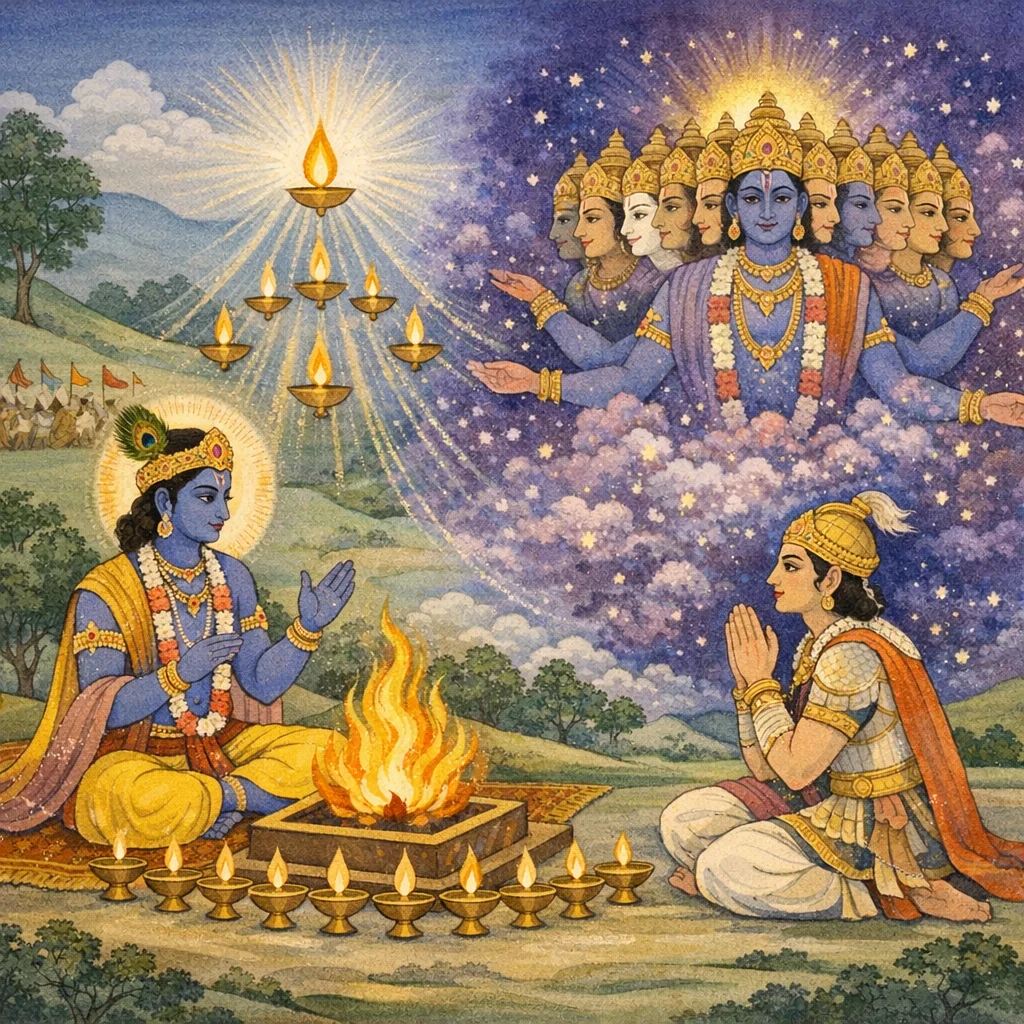
ज्ञानयज्ञेन चाप्यन्ये यजन्तो मामुपासते । एकत्वेन पृथक्त्वेन बहुधा विश्वतोमुखम् ॥ ९.१५ ॥
jñāna-yajñena cāpy anye yajanto mām upāsate | ekatvena pṛthaktvena bahudhā viśvato-mukham || 9.15 ||

ଅନ୍ୟେ କେହି ଜ୍ଞାନଯଜ୍ଞ ଦ୍ୱାରା ମୋତେ ଯଜି ଉପାସନା କରନ୍ତି; ସେମାନେ ମୋତେ ଏକତ୍ୱରେ, ପୃଥକ୍ତ୍ୱରେ ଏବଂ ବହୁରୂପରେ—ସର୍ବଦିକ୍ମୁଖ ବିଶ୍ୱରୂପ ଭାବେ—ଆରାଧନା କରନ୍ତି।
Others, worshipping Me through the sacrifice of knowledge, adore Me as one, as distinct, and as manifold, facing all directions.
Others, offering the ‘knowledge-sacrifice,’ worship Me—(some) in oneness, (some) in separateness, (some) in many ways—(Me) whose face is toward all (i.e., the all-facing).
The verse accommodates multiple theological-philosophical standpoints: nondual (ekatva), dualist/separative (pṛthaktva), and plural or many-formed devotion (bahudhā). “viśvato-mukham” is interpreted as omniform/omnipresent rather than a literal physical image.
FAQs
It recognizes diverse cognitive styles: some relate through unity, others through distinction, and others through multiple symbolic forms—each can stabilize meaning-making.
Krishna is portrayed as compatible with both monistic and theistic frameworks, suggesting a layered ontology (one reality, many relations/forms).
Chapter 9 broadens devotion beyond ritual, presenting knowledge-oriented contemplation as a sacrificial offering.
The verse can support inter-philosophical dialogue: differing metaphysical models may be treated as complementary lenses rather than purely rival claims.