
Bhagavad Gita — Moksha Sannyasa Yoga, Shloka 19
Moksha Sannyasa Yoga
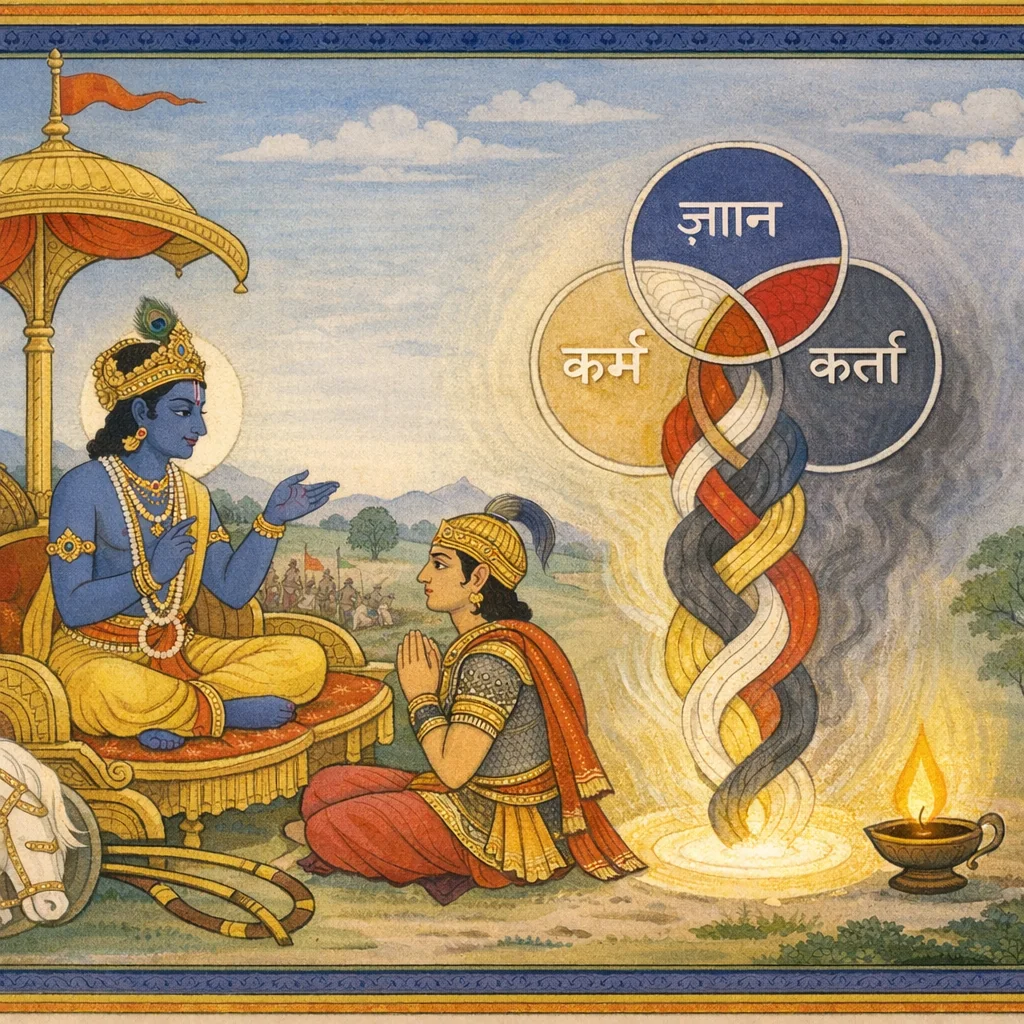
ज्ञानं कर्म च कर्ता च त्रिधैव गुणभेदतः । प्रोच्यते गुणसंख्याने यथावच्छृणु तान्यपि ॥ १८.१९ ॥
jñānaṁ karma ca kartā ca tridhaiva guṇabhedataḥ | procyate guṇasaṅkhyāne yathāvac chṛṇu tāny api || 18.19 ||

ଜ୍ଞାନ, କର୍ମ ଓ କର୍ତ୍ତା—ଏ ତିନୋଟି ଗୁଣଭେଦ ଅନୁସାରେ ତିନି ପ୍ରକାର ବୋଲି କୁହାଯାଏ; ଗୁଣମାନଙ୍କର ବିବେଚନାରେ ଶାସ୍ତ୍ର ଯେପରି ଯଥାବତ୍ କହିଛି, ସେହିପରି ସେଗୁଡ଼ିକୁ ମଧ୍ୟ ଯଥାର୍ଥ ଶୁଣ।
ज्ञान, कर्म और कर्ता—ये तीनों ही गुणों के भेद से तीन प्रकार के कहे जाते हैं; गुणों के विवेचन में जैसा (शास्त्र में) कहा गया है, उन्हें भी यथार्थ सुनो।
Knowledge, action, and agent are each described as threefold, by distinction of the guṇas; as stated in the enumeration of guṇas, hear them as they are.
Traditional translations sometimes paraphrase ‘guṇasaṅkhyāna’ as ‘the teaching that counts/explains the guṇas (e.g., Sāṅkhya-like analysis)’. Academic translations preserve the technical sense of ‘enumeration/classification’ without committing to a specific school beyond the Gītā’s own usage.
FAQs
The verse proposes that cognition, behavior, and the sense of self-as-agent vary with temperament (guṇas). It anticipates a nuanced psychology in which motives and clarity differ across sattva, rajas, and tamas.
By tying knowledge and agency to guṇas, the text treats embodied experience as conditioned by prakṛti-like qualities, while still allowing for a higher standpoint (later associated with renunciation and steadiness).
It introduces the next sequence (18.20 onward) where each category—knowledge, action, and agent—is defined under the three guṇas.
It supports self-assessment: one can examine whether one’s understanding, work-style, and self-image are driven by clarity, restlessness, or inertia, and adjust habits accordingly.
Ask anything about this verse
Curious about the meaning, context, or a word? Ask, and continue the conversation in the Vedapath app.
A free Google sign-in keeps your chat saved across web and the app.
Read Bhagavad Gita in the Vedapath app
Scan the QR code to open this directly in the app, with audio, word-by-word meanings, and more.