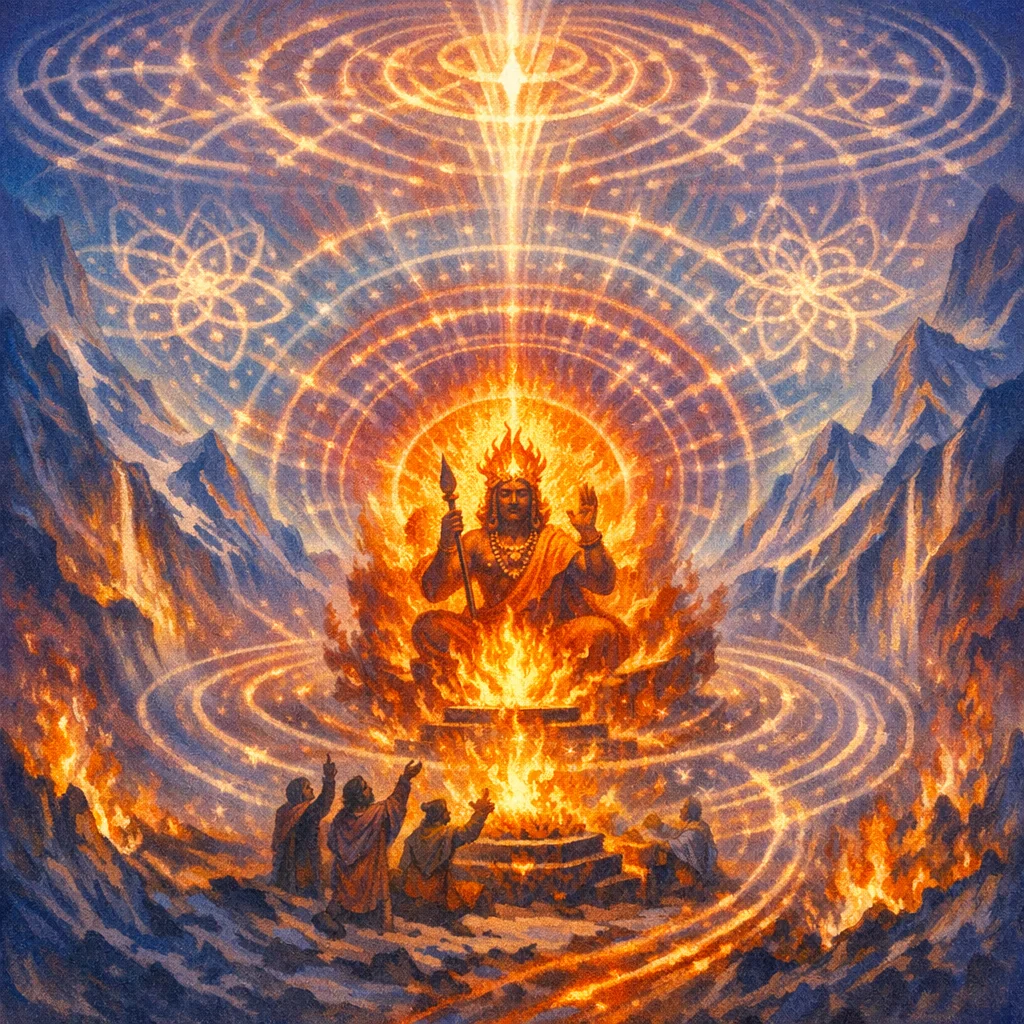
Dashati 18
Agni as Hotṛ and guardian of the sacrifice
Agni
Bright urgent and protective—praise that turns into confident petition for safeguarding
The ṛg-source seer is not identifiable from the provided excerpt alone; the hymn language aligns with Agni-stotra diction often associated with priestly families (Aṅgiras/Gautama traditions) but precise attribution needs Rigvedic cross-reference.
Applicable within Soma-yajña as an Agni-stotra/Hotṛ-praise used to secure smooth offering and remove antarāyas (ritual impediments).
Mantras
Mantra 1
अग्निं होतारं मन्ये दास्वन्तं वसोः सूनुं सहसो जातवेदसं विप्रं य ऊर्ध्वरो स्वध्वरो देवो देवाच्या कृपा घृतस्य विभ्राष्टिमनु शुक्रशोचिष आजुह्वानस्य सर्पिषः
I deem Agni to be the Hotṛ, the bounteous, the son of wealth, Jātavedas, born of strength, the wise; who, upright and of well-ordered sacrifice, by divine appointment, follows the shining stream of clarified butter, bright-flamed, as the offerer pours the melted oblation.
Mantra 2
यजिष्ठं त्वा यजमाना हुवेम ज्येष्ठमङ्गिरसां विप्र मन्मभिर्विप्रेभिः परिज्मानमिव द्यां होतारं चर्षणीनाम् शोचिष्केशं वृषणं यमिमा विशः प्रावन्तु जूतये विशः
The sacrificers invoke thee, the most worshipful, the chief of the Aṅgirases, O wise one, with the hymns of the seers; thee, the Hotṛ of the tribes, all-pervading as heaven, flame-crested and vigorous: may these peoples promote (our rite) for succour, may the peoples (promote it).
Mantra 3
स हि पुरू चिदोजसा विरुक्मता दीद्यानो भवति द्रुहन्तरः परशुर्न द्रुहन्तरः वीडु चिद्यस्य समृतौ श्रुवद्वनेव यत्स्थिरम् निष्षहमाणो यमते नायते धन्वासहा नायते
For he, though many (oppose), by his might, blazing with radiant splendour, becomes the destroyer of the injurer; as with an axe he is the destroyer: even the firm (adversary) in the encounter is (as it were) fixed like a tree in the forest; overpowering, he restrains (him), he comes not nigh—(the foe) comes not nigh.
Frequently Asked Questions
It praises Agni as the divine Hotṛ who carries offerings upward, shines with ghee-fed brilliance, and protects the sacrifice by destroying obstacles and hostile forces.
Hotṛ highlights Agni’s priestly role as the one who conveys offerings to the gods; Jātavedas emphasizes his all-knowing nature—he “knows births,” meaning he comprehends origins and the right ordering of the rite.
Agni is described as druhantara, the remover of injurers, cutting down impediments like an axe; this imagery assures the singers that opposition cannot approach when Agni is firmly established in the ritual.