Dashati 8
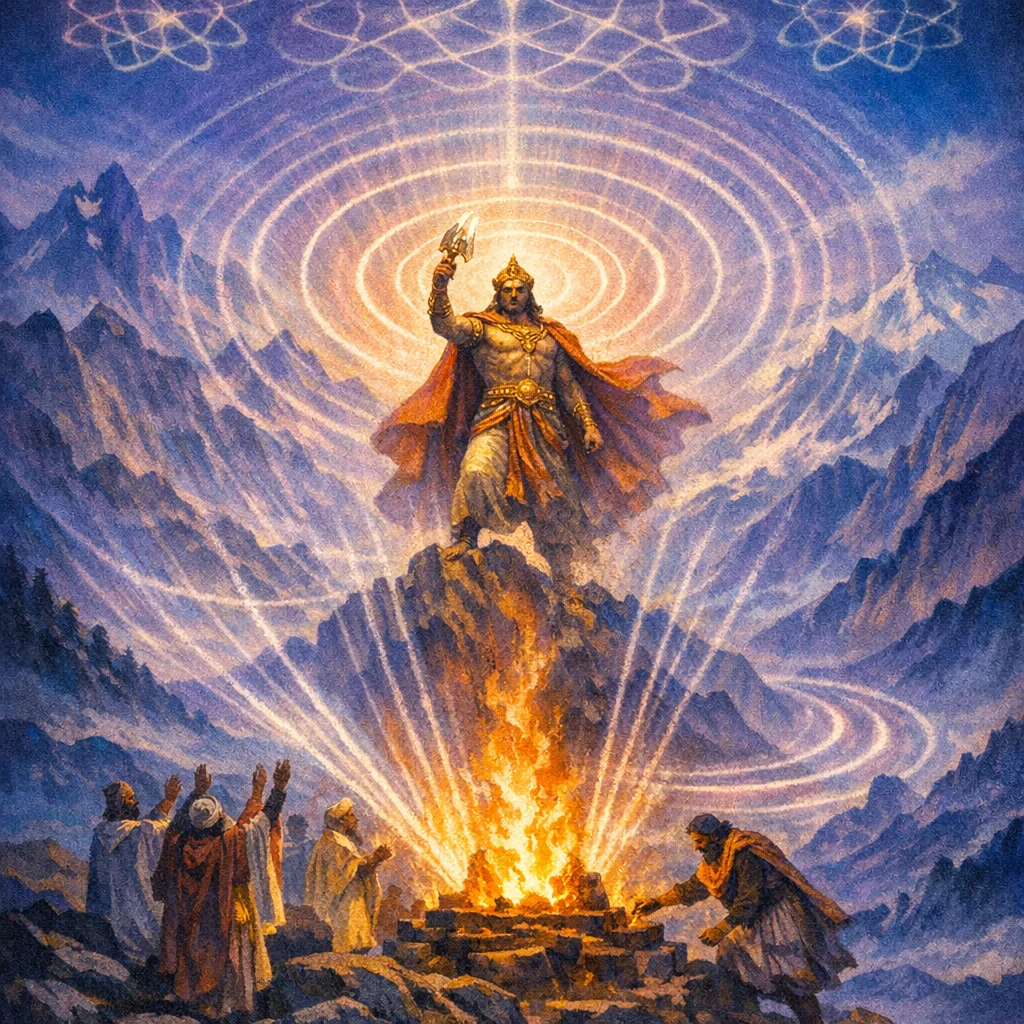
Aindra praise: Indra’s primordial heroic act and his empowering presence in the sacrifice
Indra
Vīra-stuti with ritual urgency—exultant praise moving toward assured invocation
R̥gvedic seer-attribution is not provided in the input; identification requires concordance with the corresponding RV hymn sources for these mantras.
Applicable to Soma-stotra performance where Indra (often with Vāyu) is invited to drink Soma and remove obstacles; Agni is affirmed as the carrying priestly fire.
Mantras
Mantra 1
त्रिकद्रुकेषु महिषो यवाशिरं तुविशुष्मस्तृम्पत्सोममपिबद्विष्णुना सुतं स ईं ममाद महि कर्म कर्त्तवे महामुरुं सैनं सश्चद्देवो देवं सत्य
At the Trikadrukas the mighty (Indra), of vast vigour, was satisfied; he drank the Soma mingled with barley, pressed by Viṣṇu; he verily exulted, that he might accomplish a great work; the true god approached that god (the worshipper’s invoked deity) for the mighty boon.
Mantra 2
अयं सहस्रमानवो दृशः कवीनां मतिर्ज्योतिर्विधर्म ब्रध्नः समीचीरुषसः समैरयदरेपसः सोचेतसः स्वसरे मन्युमन्तश्चिता
This (divine power), of thousand-fold greatness for men, is the vision and the thought of the sages, the light, the upholder of ordinance; he hath impelled the well-directed Dawns; (he impelleth) the stainless, the bright-minded, self-resplendent, and ardent (powers) that are manifested.
Mantra 3
एन्द्र याह्युप नः परावतो नायमच्छा विदथानीव सत्पतिरस्ता राजेव हवामहे त्वा प्रयस्वन्तः सुतेष्वा पुत्रासो न पितरं वाजसातये मंहिष्ठं
Indra, come near unto us from afar; as a good lord (cometh) to the rites, as a king to his dwelling: we, provided with oblations, invoke thee at the Soma-pressings, as sons (invoke) a father, the most bountiful, for the attainment of victory and spoil.
Mantra 4
तमिन्द्रं जोहवीमि मघवानमुग्रं सत्रा दधानमप्रतिष्कुतं श्रवांसि मंहिष्ठो गीर्भिरा च यज्ञियो ववर्त्त राये नो विश्वा सुपथा कृणोतु वज्री
Him, Indra, the bountiful, the strong, bestowing ever, irresistible, do I repeatedly invoke; most liberal, (approach) with hymns; worthy of sacrifice, may the thunderbolt-bearer turn (towards us) for our wealth, and make all paths auspicious.
Mantra 5
अस्तु श्रौष्ट्पुरो अग्निं धिया दध आ नु त्यच्छर्धो दिव्यं वृणीमह इन्द्रवायू यद्ध क्राणा विवस्वते नाभा सन्दाय नव्यसे अध प्र नूनमुप यन्ति धीतयो देवांअच्छा न धीतयः
Let there be (favour); set Agni in place with sacred thought: we choose that divine host. Indra and Vāyu, when indeed ye have accomplished (your office) for Vivasvat, uniting at the navel (centre) for the new (rite), then now our devout thoughts draw near unto the gods, even our hymns (approach) the gods.
Mantra 6
प्र वो महे मतयो यन्तु विष्णवे मरुत्वते गिरिजा एवयामरुत् प्र शर्धाय प्र यज्यवे सुखादये तवसे भन्ददिष्टये धुनिव्रताय शवसे
May our great hymns go forth unto Viṣṇu, accompanied by the Maruts, mountain-born; come hither, O Marut: (go) forth unto the host, forth unto the worshipful, the giver of happiness, unto the mighty, the most bountiful, whose ordinance is impetuous, unto strength.
Mantra 7
अया रुचा हरिण्या पुनानो विश्वा द्वेषांसि तरति सयुग्वभिः सूरो न सयुग्वभिः धारा पृष्ठस्य रोचते पुनानो अरुषो हरिः विश्वा यद्रूपा परियास्यृक्वभिः सप्तास्येभिरृक्वभिः
Purifying with this golden lustre, (Soma) overcometh all hostilities with his well-yoked (powers), as the sun with his well-yoked (steeds). The stream upon the filter shineth; purifying, the ruddy-tawny (Soma) goeth around all forms with the Ṛks, with the seven-mouthed Ṛks.
Mantra 8
अभि त्यं देवं सवितारमोण्योः कविक्रतुमर्चामि सत्यसवं रत्नधामभि ऊर्ध्वा यस्यामतिर्भा अदिद्युतत्सवीमनि हिरण्यपाणिरमिमीत सुक्रतुः कृपा
I adore that god Savitṛ, the sage in counsel, of true impulsion, the abode of treasures. Upward is his purpose; his splendour hath shone forth in (his) quickenings: the golden-handed, of good resolve, hath measured out (his) ordinances with benignity.
Mantra 9
अग्निं होतारं मन्ये दास्वन्तं वसोः सूनुं सहसो जातवेदसं विप्रं न य ऊर्ध्वया स्वध्वरो देवो देवाच्या कृपा घृतस्य विभ्राष्टिमनु शुक्रशोचिष आजुह्वानस्य सर्पिषः
I deem Agni the Hotṛ, the bountiful, the son of wealth, the offspring of strength, Jātavedas; as a sage, who, with uplifted flame, of excellent sacrifice, the god, with benignity, (goeth) unto the gods, following the radiance of ghee, the bright-flamed, as he offers with butter.
Mantra 10
तव त्यन्नर्यं नृतो ऽप इन्द्र प्रथमं पूर्व्यं दिवि प्रवाच्यं कृतम् यो देवस्य शवसा प्रारिणा असु रिणन्नपः भुवो विश्वमभ्यदेवमोजसा विदेदूर्जं शतक्रतुर्विदेदिषम्
This thy heroic deed, O Indra, is the first and most ancient, to be proclaimed in heaven; for thou, by the might of the deity, didst set free the waters, and with energy didst pervade all beings; the wielder of a hundred sacrifices found nourishment, and found the object of desire.
Frequently Asked Questions
It celebrates Indra’s most ancient heroic act—freeing the waters and restoring nourishment—and shows how that same power is invoked and made effective through the ordered sacrifice.
Agni is the Hotṛ and messenger who carries offerings to the gods, while Indra–Vāyu represent swift, coordinated divine arrival and support within the ritual, complementing Indra’s main sovereignty.
It points to the central organizing point of the rite—often understood as the altar/pressing-center—where the components of worship are ‘joined’ so that prayers (dhītis) effectively reach the gods.