Dashati 9
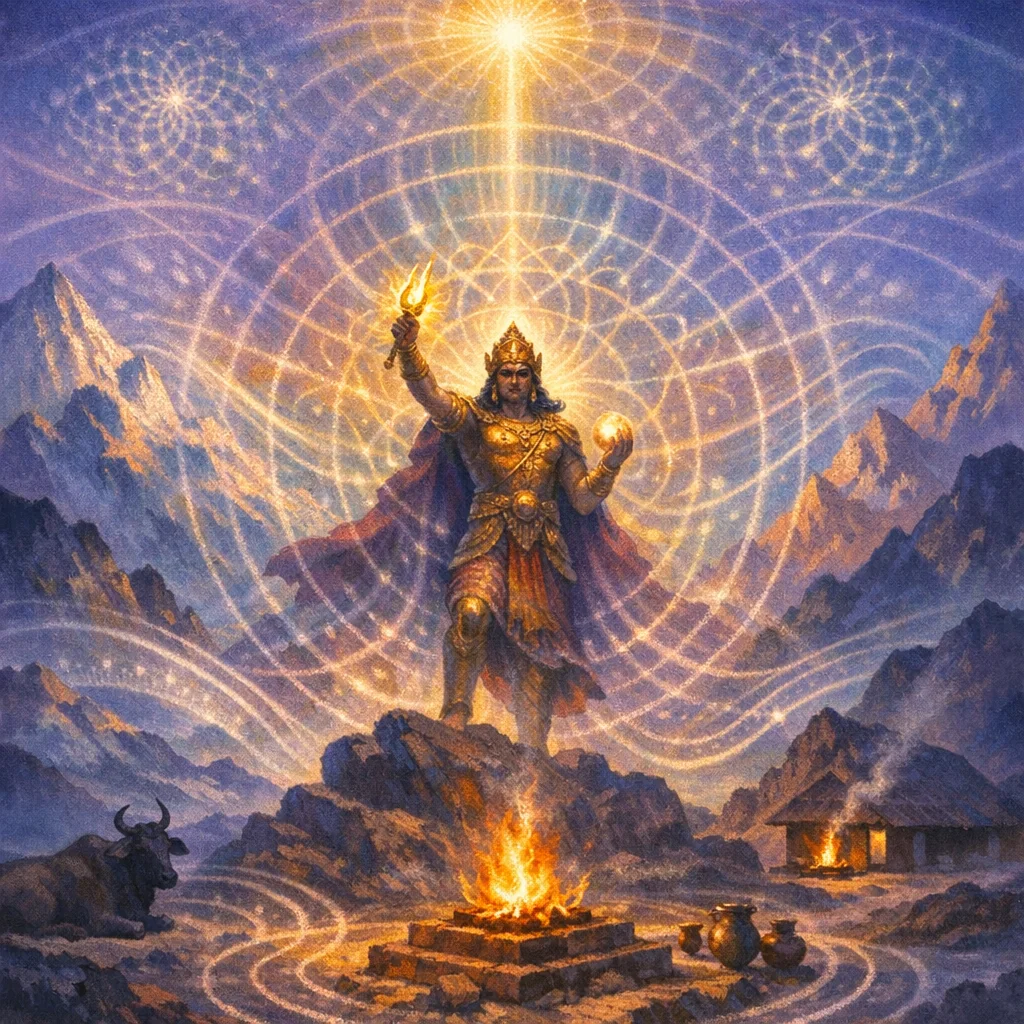
Aindra stuti as protective and cosmic sovereignty—Indra’s might expressed through solar greatness, household stability, and riddle-like ritual symbolism
Indra (Aindra focus; often identified through epithets such as Vāstoṣpati)
Uplifting forceful laudation with moments of contemplative mystery (in the riddle-like Indrāgnī verse)
R̥ṣi and chandas are not specified in the provided input; the decad reflects a mixed Aindra collection where individual verses may trace to different Ṛgvedic seers. Identification requires arcika-to-Ṛgveda concordance.
Applied within Soma-stotra performance to strengthen the satra (Soma session) and ensure protection and victorious progress of the rite.
Mantras
Mantra 1
यो राजा चर्षणीनां याता रथेभिरध्रिगुः विश्वासां तरुता पृतनानां ज्येष्ठं यो वृत्रहा गृणे
He who is king of men, who comes with chariots, unconquered; the chief overcomer in all battles; he, the slayer of Vṛtra, is hymned.
Mantra 2
यत इन्द्र भयामहे ततो नो अभयं कृधि मघवञ्छग्धि तव तन्न ऊतये वि द्विषो वि मृधो जहि
From whatsoever (cause), Indra, we are afraid, from that make thou for us fearlessness; O Maghavan, be thou able for our succour: smite utterly the haters, smite the assailants.
Mantra 3
वास्तोष्पते ध्रुवा स्थूणां सत्रं सोम्यानाम् द्रप्सः पुरां भेत्ता शश्वतीनामिन्द्रो मुनीनां सखा
O lord of the dwelling, (be) the firm pillar (of our abode); (protect) the session of the Soma-rites: Indra, the brilliant one, the breaker of enduring forts, the friend of sages.
Mantra 4
बण्महां असि सूर्य बडादित्य महां असि महस्ते सतो महिमा पनिष्टम मह्ना देव महां असि
Thou art great, O Sūrya; thou art great, O Āditya: great is thy true majesty, most excellent; by thy greatness, O god, thou art great.
Mantra 5
अश्वी रथी सुरूप इद्गोमां यदिन्द्र ते सखा श्वात्रभाजा वयसा सचते सदा चन्द्रैर्याति सभामुप
Horse-yoked, car-borne, of comely form, and rich in kine, that friend of thine, O Indra, the partaker of valour, ever attends thee with vigour, and with bright (prosperities) approaches the assembly.
Mantra 6
यद्द्याव इन्द्र ते शतं शतं भूमीरुत स्युः न त्वा वज्रिन्त्सहस्रं सूर्या अनु न जातमष्ट रोदसी
Although, O Indra, the heavens and the earths were a hundred and a hundred, yet, O wielder of the thunderbolt, not even a thousand suns would equal thee; the two worlds have not produced (aught) like unto thee.
Mantra 7
यदिन्द्र प्रागपागुदग्न्यग्वा हूयसे नृभिः सिमा पुरू नृषूतो अस्यानवे ऽसि प्रशर्ध तुर्वशे
When, O Indra, thou art invoked by men from the east, the west, the north, or the south, then, urged by many (worshippers), thou art the helper of the suppliant; thou art the smiter, (granting aid) to Turvaśa.
Mantra 8
कस्तमिन्द्र त्वा वसवा मर्त्यो दधर्षति श्रद्धा हि ते मघवन्पार्ये दिवि वाजी वाजं सिषासति
Who, O Indra, (though) wealthy, among mortals dares (to rival) thee? for faith in thee, O Maghavan, in the highest heaven, the vigorous (worshipper) seeks to win the prize.
Mantra 9
इन्द्राग्नी अपादियं पूर्वागात्पद्वतीभ्यः हित्वा शिरो जिह्वया रारपच्चरत्त्रिंशत्पदा न्यक्रमीत्
Indra and Agni—(as) the footless—went foremost from among the footed; abandoning the head, with the tongue it crept and moved; the thirty-footed advanced.
Mantra 10
इन्द्र नेदीय एदिहि मितमेधाभिरूतिभिः आ शं तम शं तमाभिरभिष्टिभिरा स्वापे स्वापिभिः
Indra, come yet nearer, with measured (wise) aids; come with the most auspicious welfare, with the most desired blessings; come with good repose, with soothing rests.
Frequently Asked Questions
“Aindra” names the dominant liturgical orientation and melody-family centered on Indra. A dashati can include allied praises (like Sūrya/Āditya) that reinforce the same theme of greatness and dependable power used in Indra’s stuti.
It is riddle-like praise (arthavāda) often interpreted ritually: images such as “tongue” point to Agni’s flame or to the chant/speech that carries the sacrifice forward. The paradoxes intensify attention and encode ritual correspondences rather than plain narrative.
“Baṭ” is an emphatic musical interjection. It strengthens the praise, marks cadences, and gives rhythmic lift so the repeated laudatory phrases land with greater ceremonial force.