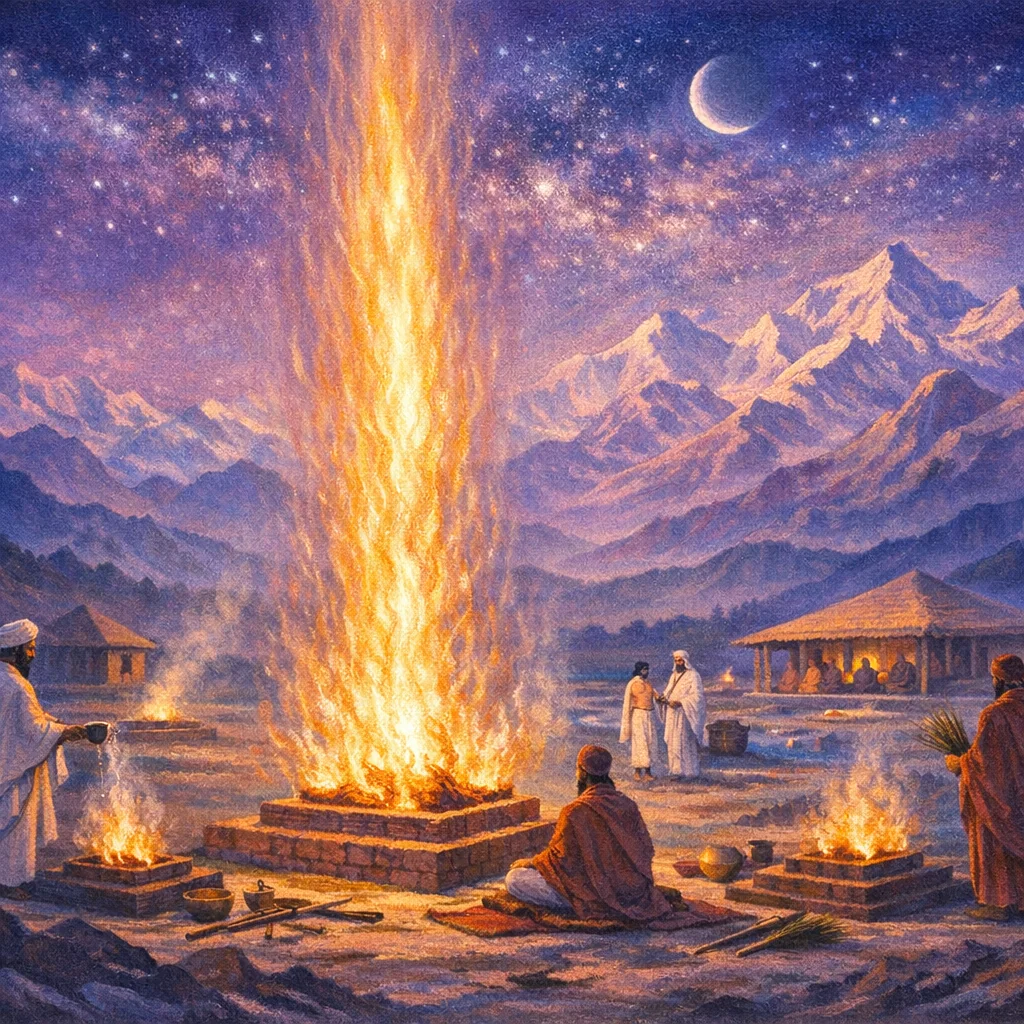
Prapathaka 2
Darśa–Pūrṇamāsa (New- and Full-Moon sacrifices) within the Śrauta Agnihotra–Iṣṭi complex; preparatory and consecratory acts for the monthly iṣṭi, especially the handling of fires, implements, and the initial offering-formulas that establish the yajña as a regulated exchange with the deities.
Kṛṣṇa Yajurveda 1.2 continues the programmatic establishment of the Darśa–Pūrṇamāsa iṣṭi by integrating mantra and brāhmaṇa-style directions characteristic of the Taittirīya Saṃhitā. The chapter consolidates the sacrificial agent’s relationship to Agni as mouth of the gods and to Soma as the paradigmatic oblation, while simultaneously regulating the material culture of the rite—fires, ladles, fuel, and the spatial ordering of the vedi. Its mantras articulate key Śrauta concerns: purity and delimitation (pavitra/pari-dhā), correct address (devatā-sambandha), and the transformation of domestic resources into ritually valid offerings. Theologically, the text frames the sacrifice as a reconstitution of cosmic order (ṛta) through measured speech (yajus) and controlled heat (tapas/Agni). Philologically, the prapāṭhaka exemplifies the Kṛṣṇa Yajurveda’s interleaving of injunction and recitation, revealing an early ritual hermeneutic where efficacy depends on precise sequencing and semantic alignment of mantra with act.
Anuvakas
Anuvakas for this prapathaka are loading. Please check back soon.