
Bhagavad Gita — Moksha Sannyasa Yoga, Shloka 77
Moksha Sannyasa Yoga
तच्च संस्मृत्य संस्मृत्य रूपमत्यद्भुतं हरेः । विस्मयो मे महान् राजन्हृष्यामि च पुनः पुनः ॥ १८.७७ ॥
tac ca saṁsmṛtya saṁsmṛtya rūpam aty-adbhutaṁ hareḥ | vismayo me mahān rājan hṛṣyāmi ca punaḥ punaḥ || 18.77 ||

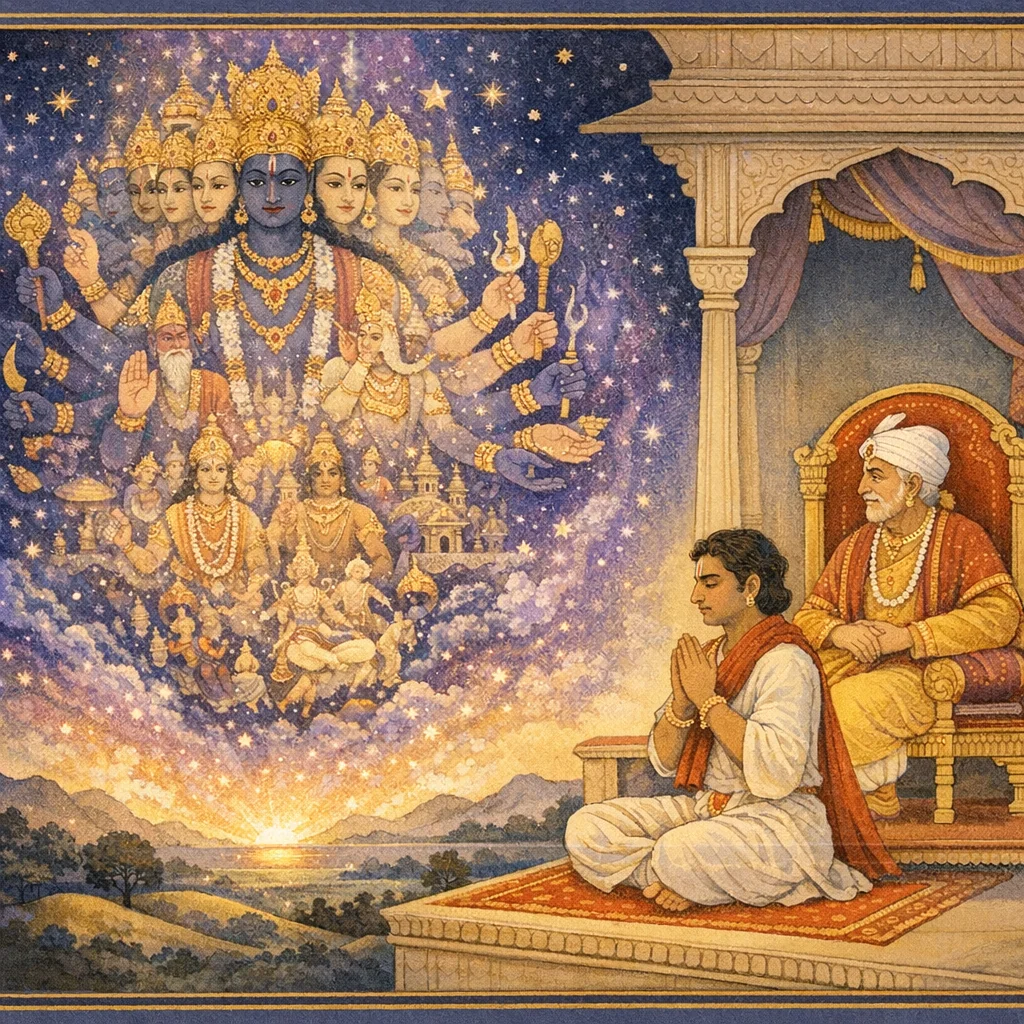
And, O King, remembering again and again that most wondrous form of Hari, great is my amazement, and I rejoice again and again.
और हे राजन्! हरि के उस अत्यन्त अद्भुत रूप का बार-बार स्मरण करके मुझे बड़ा विस्मय होता है और मैं बार-बार हर्षित होता हूँ।
And remembering again and again that exceedingly wondrous form of Hari, O king, great is my amazement; and I rejoice again and again.
This recalls the earlier theophany (viśvarūpa) in narrative memory. ‘Rūpa’ can be read literally (vision of form) or as a symbol of the overwhelming scope of ultimate reality.
FAQs
Awe and wonder can reorganize perspective, diminishing self-centered rumination and increasing perceived meaning; the verse depicts this enduring after-effect.
The ‘wondrous form’ points to the text’s claim that ultimate reality can be disclosed in a way that exceeds ordinary cognition, yet remains recallable as transformative insight.
As a final reflective note, it ties the conclusion back to the earlier vision episode, emphasizing the discourse’s revelatory dimension within the epic frame.
Cultivate practices that evoke constructive awe—contemplation, nature, art, or study—to maintain ethical orientation and a wider sense of perspective.
Ask anything about this verse
Curious about the meaning, context, or a word? Ask, and continue the conversation in the Vedapath app.
A free Google sign-in keeps your chat saved across web and the app.
Read Bhagavad Gita in the Vedapath app
Scan the QR code to open this directly in the app, with audio, word-by-word meanings, and more.