
Shloka 5
Bhakti Yoga — Bhakti Yoga
क्लेशोऽधिकतरस्तेषामव्यक्तासक्तचेतसाम् । अव्यक्ता हि गतिर्दुःखं देहवद्भिरवाप्यते ॥ १२.५ ॥
kleśo ’dhikataras teṣām avyakta-āsakta-cetasām | avyaktā hi gatir duḥkhaṁ deha-vadbhir avāpyate || 12.5 ||

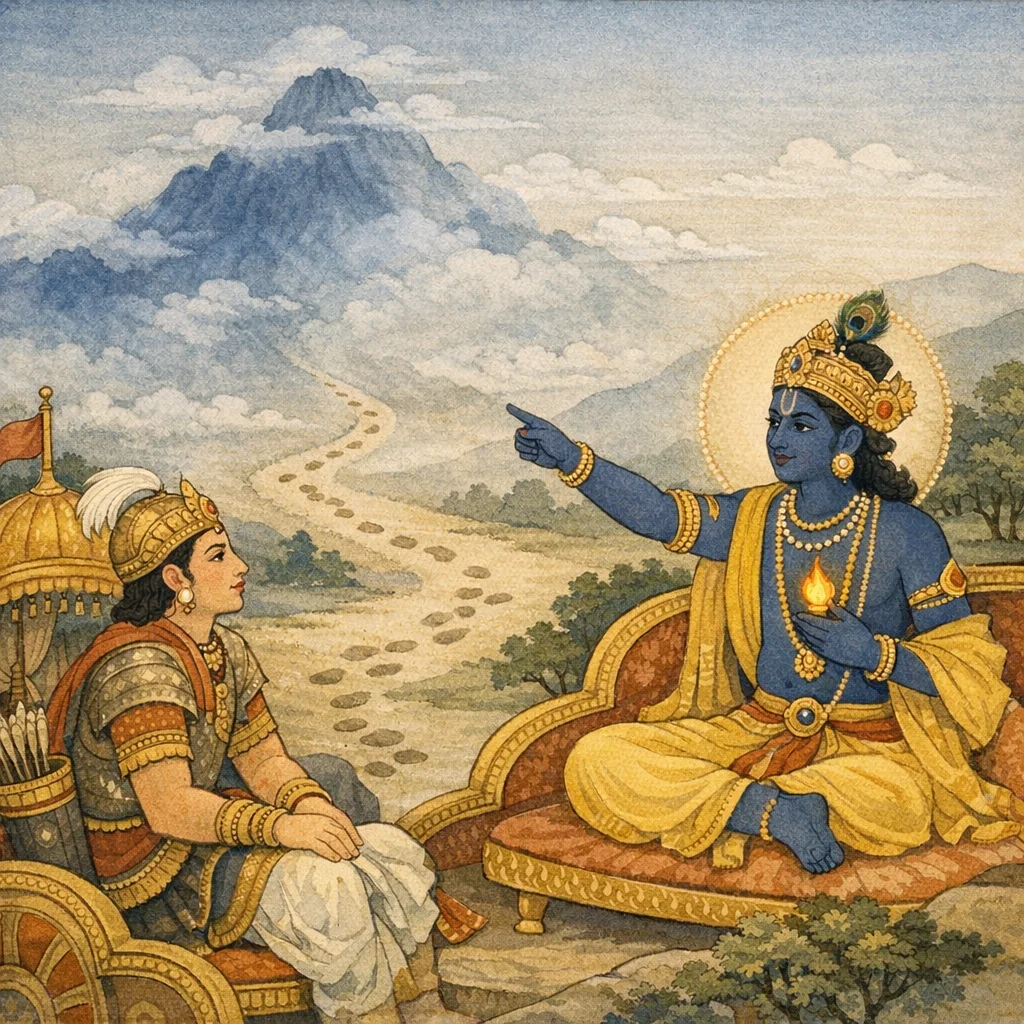
Greater is the difficulty for those whose minds are attached to the unmanifest; for the goal of the unmanifest is hard to attain for embodied beings.
Greater is the difficulty for those whose minds are attached to the unmanifest; for the goal of the unmanifest is hard to attain for embodied beings.
For them—those whose consciousness is attached to the unmanifest—the strain is greater; indeed, the unmanifest path/goal is attained with difficulty by those who are embodied.
Traditional commentaries often explain ‘difficulty’ as the challenge of meditating without concrete supports. Academic readings note an anthropological claim: embodied cognition tends to rely on forms, making purely ‘unmanifest’ contemplation more demanding.
FAQs
It recognizes that humans often learn and focus through imagery, relationship, and concrete anchors; purely abstract focus can increase cognitive load and frustration.
The verse does not deny the unmanifest absolute; it evaluates the practitioner’s route to it as comparatively arduous under embodied conditions.
It functions as Krishna’s comparative assessment: both paths can lead to the same end, but the impersonal route is described as more demanding for most.
When a practice feels too abstract, introduce skillful supports (ritual, mantra, ethical vows, relational devotion) while keeping the underlying aim intact.