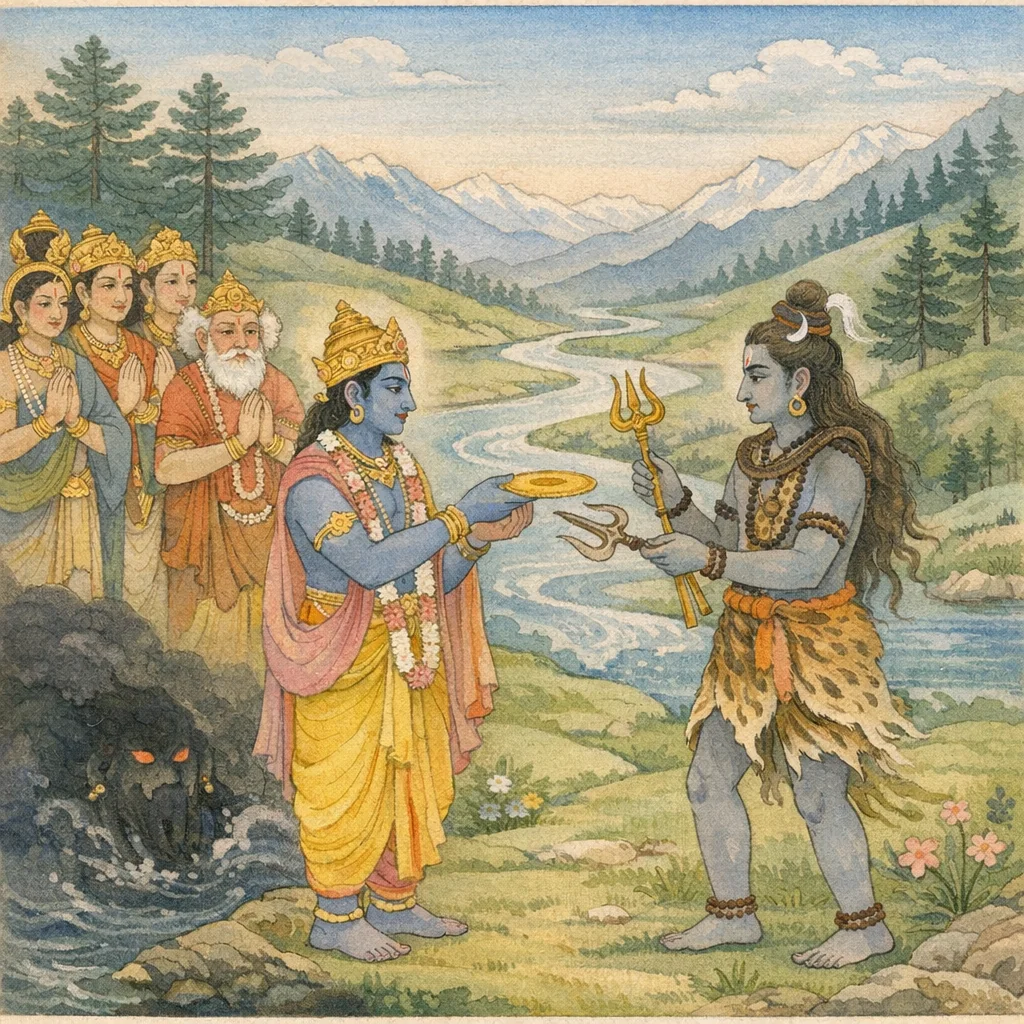
Adhyaya 54: Prahlada’s Pilgrimage and the Origin of the Sudarshana–Trishula Exchange (Jalodbhava Episode)
प्रह्लाद-तीर्थयात्रा तथा जलोद्भव-वधकथा (Prahlāda-Tīrthayātrā tathā Jalodbhava-Vadhakathā)
Sudarshana-Trishula Exchange
Within the Pulastya–Nārada dialogue-frame, this adhyāya first presents Prahlāda’s exemplary tīrtha-yātrā as a model of asura-dharma disciplined by Vedic ritual: fasting (upoṣa), prescribed bathing, deity-pūjā, and pitṛ-tarpaṇa across a chain of sanctified sites. The narrative then pivots to a purātana-kathā explaining a striking iconographic and theological motif: Śiva bearing Sudarśana and Viṣṇu bearing the triśūla. Pulastya recounts the rise of the asura Jalodbhava—made formidable by Brahmā’s boon and destructive of sacrificial order—prompting the devas to seek refuge with Hari and then consult Hara in the Himālaya. In a syncretic theology of mutual empowerment, the two deities invert their weapons to accomplish arisūdana (enemy-slaying), thereby sacralizing rivers and mountain locales (notably Vitastā) through divine action. The chapter thus integrates pilgrimage topography with Harihara unity, presenting geography as a living archive of mythic causality and ritual efficacy.
Divine Beings
Sacred Geography
Mortal & Asura Figures
Key Content Points
- Prahlada’s sequential tīrtha itinerary: ritual bathing, upoṣa, pūjā to Janārdana, Nṛsiṃha, Śaṅkara, and pitṛ-tarpaṇa, establishing tīrtha-mahātmya through practice rather than mere praise.
- Nārada’s question and Pulastya’s purātana-kathā: why Śambhu holds Sudarśana and why Vāsudeva holds the triśūla—an explicit Harihara-syncretic motif.
- Jalodbhava’s boon from Brahmā, his disruption of dharmic rites, the joint strategy of Viṣṇu and Śiva, the weapon-exchange, and the etiological sanctification of Vitastā and associated Himalayan sites.
Shlokas in Adhyaya 54
Verse 5
प्रौष्ठपद्याद्वयं पार्श्वे कुक्षिभ्यां रेवती स्थिता उरःसंस्था त्वनुराधा श्रविष्ठा पृष्ठसंस्थिता
Not specified in the provided excerpt (contextually a narrator/teacher describing nakṣatra-to-body correspondences).
Verse 7
ग्रीवास्थैता तथा ज्येष्ठा श्रवणं कर्णयोः स्थितम् मुखसंस्थस्तथा पुष्यः स्वातिर्दन्ताः प्रकीर्तिताः
‘Jyeṣṭhā’ is likewise said to abide in the neck. ‘Śravaṇa’ is situated in the ears. ‘Puṣya’ is placed in the mouth, and ‘Svāti’ is proclaimed to be the teeth.
Verse 8
हनू द्वे वारुणश्चोक्तो नासा पैत्र उदाहृतः मृगशीर्षं नयनयो रूपधारिणि तिष्ठति
The two jaws are said to be ‘Vāruṇa’; the nose is declared to be ‘Paitra’. ‘Mṛgaśīrṣa’ abides in the eyes of the form-bearing one.
Verse 9
चित्रा चैव ललाटे तु भरणी तु तथा शिरः शिरोरुहस्था चैवार्द्रा नक्षत्राङ्गमिदं हरेः
Citrā is indeed (situated) on the forehead; Bharaṇī likewise on the head; and Ārdrā, abiding in the hair (of the head). Thus is this portion of Hari’s body constituted by the nakṣatras.
Verse 10
विधानं संप्रवक्ष्यामि यथायोगेन नारद संपूजितो हरिः कामान् विदधाति यथेप्सितान्
when the Moon has entered Mūla (nakṣatra)
Verse 12
जानुनी चाश्विनीयोगे पूजयेदथ भक्तितः दोहदे च हविष्यान्नं पूर्ववद् द्विजभोजनम्
When the (lunar) conjunction is with Aśvinī, one should worship the two knees with devotion. At the time of the dohada (the prescribed seasonal/ritual offering), one should offer haviṣyānna (a simple oblation-food), and, as before, feed the twice-born (brāhmaṇas).
Verse 13
आषाढाभ्यां तथा द्वाभ्यां द्वावूरू पूजयेद् बुधः सलिलं शिशिरं तत्र दोहदे च प्रकीर्तितम्
Likewise, under the two Āṣāḍhā (nakṣatras), the wise person should worship the two thighs. There, at the dohada, cool water is prescribed (as the offering).
Verse 14
फाल्गुनीद्वितये गुह्यं पूजनीयं विचक्षणैः दोदहे च पयो गव्यं देयं च द्विजभोजनम्
["Vishnu"]
Verse 16
पार्श्वे भाद्रपदायुग्मे पूजयित्वा विधानतः गुडं सलेहकं दद्याद् दोहदे देवकीर्तितम्
{"bhagavata_parallel": "Naimiṣa as the paradigmatic tīrtha-forest where sages gather (BhP 1.1). Lists of tīrthas and their pāpa-hara power are common across Purāṇas though these specific names are local to this text/tradition.", "vishnu_purana_parallel": null, "ramayana_connection": null, "mahabharata_echo": "MBh 3 (Tīrtha-yātrā) similarly enumerates tīrthas and their fruits.", "other_puranas": ["Skanda Purāṇa (regional tīrtha lists)", "Padma Purāṇa (tīVamana Purana,54,17,VamP 54.17,dve kukṣī revatīyoge dohade mudgamodakāḥ anurādhāsu jaṭharaṃ ṣaṣṭhikānnaṃ ca dohade,द्वे कुक्षी रेवतीयोगे दोहदे मुद्गमोदकाः अनुराधासु जठरं षष्ठिकान्नं च दोहदे,Saromahatmiya,Tirtha Mahima / Vrata-Vidhi (ritual observance),Adhyaya 54 (Saro-mahātmya; nakṣatra-linked offerings and food-gifts),54.17,dve kukṣī revatīyoge dohade mudgamodakāḥ anurādhāsu jaṭharaṃ ṣaṣṭhikānnaṃ ca dohade,dve kukṣī revatī-yoge dohade mudga-modakāḥ | anurādhāsu jaṭharaṃ ṣaṣṭhikānnaṃ ca dohade ||,For the two ‘kukṣi’ (flanks/bellies) when Revatī is conjoined (prevailing)
Verse 25
चित्रायोगे ललाटं च दोहदे चारुभोजनम् भरणीषु शिरः पूज्यं चारु भक्तं च दोहदे
When the Citrā-yoga prevails, the forehead should be worshipped, and fine food should be given as the doḥada-offering. In the Bharaṇī (nakṣatra), the head should be worshipped, and excellent cooked food should be given as the doḥada-offering.
Verse Tirtha Mahima / Vrata and self-restraint
नक्षेत्रयोगेष्वेतेषु सम्पूज्य जगतः पतिम् पारिते दक्षिणान्दद्यात् स्त्रीपुंसोश्चारुवाससी
பின்னர் சுதீர்த்தத்தில் நீராடி, உபவாசமும் புலனடக்கமும் கொண்டவனாய், ஹ்ருஷீகேசனை முறையாக வழிபட்டு, பதரிகாச்ரமத்திற்குச் சென்றான்।
Verse 31
अङ्गोपाङ्गानि देवर्षे पूजयित्वा जगद्गुरोः सुरूपाम्यभिजायन्ते प्रत्यङ्गङ्गानि चैव हि
O Devarṣi, having worshipped the limbs and subsidiary limbs of the Guru of the world, one’s own limbs and sub-limbs indeed become well-formed and excellent in appearance.
Verse 32
सप्तजन्मकृतं पापं कुलसंगागतं च यत् पितृमातृसमुत्थं च तत्सर्वं हन्ति केशवः
Keśava destroys all of that: sin committed across seven births, sin that has come through one’s lineage, and sin arising from one’s father and mother.
Verse 33
सर्वाणि भद्राण्याप्नोति शरीरारोग्यमुत्तमम् अनन्तां मनसः प्रीतिं रूपं चातीव शोभनम्
He attains every auspicious good: the highest bodily health, unending gladness of mind, and a form (appearance) exceedingly beautiful.
Verse 34
वाङ्माधुर्यं तथा कान्ति यच्चान्यदभिवाञ्छितम् ददाति नक्षत्रपुमान् पूजितस्तु जनार्दनः
{"location": "Ujjayinī Mahākāla-kṣetra", "location_type": "tirtha", "region": "Avanti (Malwa)", "sacred_significance": "Local itihāsa legitimizing the kṣetra’s protective power: Mahākāla as guardian who overcomes Antaka (Death).", "cosmic_realm": "bhuloka"}
Verse 38
एवं विधानतो ब्रह्मन्नक्षत्राङ्गो जनार्दनः पूजितो रूपधारी यैस्तैः प्राप्ता तु सुकामिता
Thus, O Brāhmaṇa, when Janārdana—‘Nakṣatrāṅga’—is worshipped according to the prescribed procedure, those worshippers who assume (or seek) a desired form attain their well-desired aims.
Verse 39
एतत् तवोक्तं परमं पवित्रं धन्यं यशस्यं शुभरूपदायि नक्षत्रपुंसः परमं विधानं शृणुष्व पुण्यामिह तीर्थयात्राम
“This supreme teaching you have spoken is most purifying—auspicious, fortune-bringing, fame-bestowing, and a giver of auspicious form. Now hear the highest ordinance concerning the Nakṣatra-Puruṣa, and (hear also) here the meritorious pilgrimage to the tīrthas.”
Frequently Asked Questions
Through Nārada’s inquiry and Pulastya’s response, the chapter presents a syncretic theology in which Viṣṇu and Śiva act as coordinated protectors of cosmic order: they consult together, exchange emblematic weapons (Sudarśana and triśūla) for arisūdana, and thereby demonstrate mutual legitimacy in iconography and ritual devotion.
It functions as a pilgrimage-map anchored in ritual acts—snāna, upoṣa, pūjā, and pitṛ-tarpaṇa—moving through Kurukṣetra and multiple named tīrthas and rivers (Irāvatī, Devikā, Payoṣṇī, Madhumat, Vitastā), plus lakes (Devahrada) and Himalayan locales (Himavatpāda, Bhṛgutunga). Several places are etiologically sanctified by divine action, especially the Vitastā’s purificatory status linked to Hara’s movement in the Himalayan narrative.
The frame makes the text explicitly didactic: Nārada’s question about anomalous iconography prompts Pulastya to authorize a ‘purātana-kathā’ that ties theology (Harihara cooperation), ethics (restoring sacrificial order against Jalodbhava), and topography (rivers and tīrthas) into a single explanatory chain, turning geography into a readable index of dharma.