Adhyaya 10
Ādi Parva, Adhyāya 10: Ruru’s Vow and Ḍuṇḍubha’s Appeal (रुरोः प्रतिज्ञा—डुण्डुभोपदेशः)
Upa-parva: Pauloma Parva (Ruru–Pramadvarā Episode)
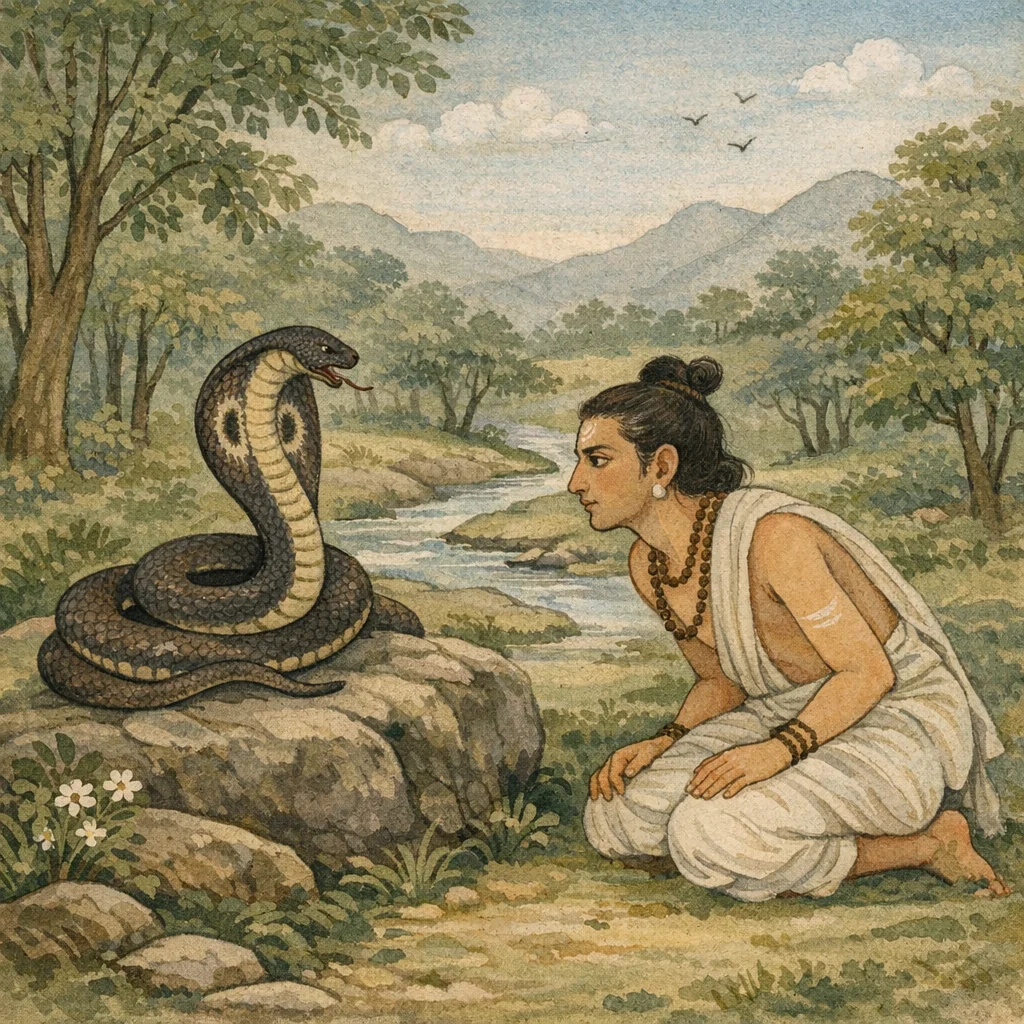
This chapter presents a dialogue structured around grief, retributive intention, and ethical correction. Ruru states that his wife—described as dear as his own life—was bitten by a serpent, leading him to adopt a severe resolution: he will kill any serpent he sees. He then attempts to kill the serpent before him, declaring that the serpent may escape only by surrendering its life. The serpent, identifying itself as Ḍuṇḍubha, responds with a dharma-based argument: other serpents may be responsible for biting humans, but Ḍuṇḍubha is not to be harmed merely due to ‘snake-odor’ or appearance; harms and benefits are not uniform across individuals. The narrator (Sūta) notes that Ruru, alarmed, refrains—mistaking Ḍuṇḍubha for a ṛṣi. Ruru then questions the serpent’s unusual condition, and Ḍuṇḍubha reveals a prior identity as a ṛṣi named Ruru, transformed into a serpent through a brāhmaṇa’s curse. The chapter closes with Ruru asking the cause and duration of the curse, setting up further ethical and causal exposition.
Chapter Arc: Promadvara’s near-loss has turned Ruru into a vow-bound avenger: wherever he sees a serpent, he strikes—his grief sharpened into a single, dangerous purpose. → Ruru encounters a serpent named Dundubha and, true to his vow, rushes to kill it. The serpent speaks—calm, reasoned, and unsettling—warning him that not every snake is guilty, and that blind retaliation itself becomes adharma. → Dundubha reveals a startling truth: he is no ordinary serpent but the cursed rishi Sahasrapad, fallen into snake-form by a brahmin’s imprecation. The intended victim becomes a mirror, forcing Ruru to confront the moral weight of his rage. → Hearing Dundubha’s words and sensing him to be an ascetic rather than a mere beast, Ruru restrains his hand and does not kill him. He questions Dundubha about the cause and term of the curse, shifting from violence to inquiry. → Ruru’s question hangs: why was Sahasrapad cursed, and how long must he endure this serpent-body before release?
Shlokas
Verse 1
(दाक्षिणात्य अधिक पाठका १ श्लोक मिलाकर कुल २४ श्लोक हैं) ऑपन---+र< बक। है २ दशमो<ध्याय: रुरु मुनि और डुण्डुभका संवाद रुस्स्वाच मम प्राणसमा भार्या दष्टासीद् भुजगेन ह | तत्र मे समयो घोर आत्मनोरग वै कृत:
Ruru berkata: “Wahai ular! Isteriku, yang kucintai seperti nyawaku sendiri, telah dipatuk oleh seekor ular. Pada saat itu aku mengikrarkan sumpah yang mengerikan: setiap ular yang kulihat pasti akan kubunuh. Terikat oleh sumpah itu, kini aku berniat membunuhmu; hari ini engkau harus menyerahkan nyawamu.”
Verse 2
भुजड़ूं वै सदा हन्यां यं यं पश्येयमित्युत । ततोऊहं त्वां जिघांसामि जीवितेनाद्य मोक्ष्यसे
“Sesungguhnya aku telah bersumpah bahawa aku akan sentiasa membunuh mana-mana ular yang aku terlihat. Maka sekarang aku berniat membunuhmu; pada hari ini engkau akan dipisahkan daripada nyawamu.”
Verse 3
डुण्ड्रुभ उवाच अन््ये ते भुजगा ब्रह्मन् ये दशन्तीह मानवान् | डुण्डुभानहिगन्धेन न त्वं हिंसितुमहसि
Ḍuṇḍrubha berkata: “Wahai Brahmin, ular-ular yang menggigit manusia di dunia ini adalah ular yang lain. Janganlah engkau mencederakan kami, para ḍuṇḍubha, semata-mata kerana kami berbau (atau menyerupai) ular.”
Verse 4
रुरुके दर्शनसे सहस्रपाद ऋषिकी सर्पयोनिसे मुक्ति एकानर्थान् पृथगर्थनिकदुःखान् पृथक्सुखान् । डुण्डुभान् धर्मविद् भूत्वा न त्वं हिंसितुमहसि
Ḍuṇḍrubha berkata: “Wahai Ruru, meskipun kami berkongsi kelahiran sebagai ular dan terikat bersama dalam penderitaan serta malang, tabiat setiap makhluk berbeza, dan apa jua kebahagiaan yang datang dirasai secara berasingan. Oleh sebab engkau mengetahui dharma, janganlah engkau melakukan kekerasan terhadap para ḍuṇḍubha. Betapa aneh—kami bersatu dalam bencana, namun tidak dalam kegembiraan.”
Verse 5
सौतिर्वाच इति श्रुत्वा वचस्तस्य भुजगस्य रुरुस्तदा । नावधीद् भयसंविग्नमृषिं मत्वाथ डुण्डुभम्,उग्रश्रवाजी कहते हैं--डुण्डुभ सर्पका यह वचन सुनकर रुऱुने उसे कोई भयभीत ऋषि समझा, अतः उसका वध नहीं किया
Sauti berkata: “Setelah mendengar kata-kata ular itu, pada saat itu juga Ruru tidak memukulnya hingga mati. Menganggap Ḍuṇḍubha sebagai seorang resi yang ketakutan, dia pun menahan diri daripada membunuh.”
Verse 6
उवाच चैनं भगवान् रुरु: संशमयन्निव । काम॑ मां भुजग ब्रूहि को$सीमां विक्रियां गत:
Ruru, yang mulia, berkata kepadanya seolah-olah menenangkannya: “Wahai ular, katakanlah kepadaku dengan terus terang—siapakah engkau, yang telah jatuh ke dalam keadaan yang terpesong ini (sebagai ular)?”
Verse 7
डुण्ड्रुभ उवाच अहं पुरा रुरो नाम्ना ऋषिरासं सहस्रपात् । सो<हं शापेन विप्रस्य भुजगत्वमुपागत:
Ḍuṇḍrubha berkata: “Dahulu aku seorang resi bernama Ruru, yang dikenali sebagai ‘yang berkaki seribu’. Namun kerana sumpahan seorang brāhmaṇa, aku telah jatuh ke dalam keadaan sebagai ular.”
Verse 8
रुरुस्वाच किमर्थ शप्तवान् क्रुद्धो द्विजस्त्वां भुजगोत्तम । कियन्तं चैव काल॑ ते वपुरेतद् भविष्यति
Ruru bertanya: “Atas sebab apakah brāhmaṇa itu, dalam kemarahannya, menyumpahmu, wahai yang terbaik antara ular? Dan berapa lamakah bentuk tubuhmu ini akan terus wujud?”
Verse 9
इस प्रकार श्रीमहाभारत आदिपव॑ीके अन्तर्गत पौलोगपर्वमें प्रमद्वराके जीवित होनेये सम्बन्ध रखनेवाला नवाँ अध्याय पूरा हुआ
Demikianlah berakhir bab kesembilan dalam bahagian Pauloga di bawah Ādi Parva bagi Śrī Mahābhārata, yang mengisahkan Pramadvarā dikembalikan kepada kehidupan.
Verse 10
इति श्रीमहाभारते आदिपर्वणि पौलोमपर्वणि रुरुडडुण्डुभसंवादे दशमो<5ध्याय: ॥। १० इस प्रकार श्रीमह्याभारत आदिपर्वके अन्तर्गत पौलोगपर्वमें रुु-डुण्ड्रुभसंवादाविषयक दसवाँ अध्याय पूरा हुआ
Demikianlah, dalam Śrī Mahābhārata, di bawah Ādi Parva, dalam bahagian Pauloma, bab kesepuluh—mengenai dialog antara Ruru dan Ḍuṇḍubha—berakhir.
Frequently Asked Questions
Ruru’s dilemma is whether personal grief justifies indiscriminate retaliation against an entire class (all serpents) when culpability is unverified, and whether appearance alone is sufficient grounds for harm.
The chapter teaches that dharma requires discernment: ethical action should be proportionate, evidence-sensitive, and attentive to individual difference rather than driven by generalized anger or categorical blame.
No explicit phalaśruti is stated in these verses; the meta-function is implicit—positioning the episode as an ethical exemplum within Ādi Parva’s broader instruction on restraint, causality, and the limits of retribution.
Read Mahabharata in the Vedapath app
Scan the QR code to open this directly in the app, with audio, word-by-word meanings, and more.